Nasa launches mission to save falling space telescope
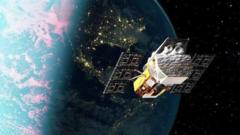
•Nasa launches mission to save falling space telescopeImage source, NASAImage caption, Artist's impression of the Swift observatory which was built to study the cosmosByPallab GhoshScience Corresponden...
•The small space telescope will be intercepted by the LINK craft, which will attempt to grab it with three robotic arms, and try and lift it back to a safe orbit.The rescue mission, launched on Friday,...
•"But Nasa obviously thinks it's worth a go.
هذا الخبر من BBC News. خبر يقدم أدوات ذكاء اصطناعي للتلخيص والترجمة والاستماع.
Nasa launches mission to save falling space telescopeImage source, NASAImage caption, Artist's impression of the Swift observatory which was built to study the cosmosByPallab GhoshScience CorrespondentPublished8 minutes agoA Nasa-funded spacecraft has been sent into space to catch a falling telescope.The Swift observatory detects some of the most powerful explosions in the Universe - but is at risk of crashing back to Earth in the coming months. The small space telescope will be intercepted by the LINK craft, which will attempt to grab it with three robotic arms, and try and lift it back to a safe orbit.The rescue mission, launched on Friday, has never been attempted before, and Dr Simeon Barber, a space scientist, has said it is "high risk". "But Nasa obviously thinks it's worth a go. And the science community is hopeful about this because it's an important telescope that enables us to study super high-energy phenomena that we have no other means to study," said Barber, a senior research fellow at the Open University.Image source, BBC NewsThe Swift observatory is falling because increased solar activity has pushed out the Earth's atmosphere such that it touches Swift. This drags on the observatory and slows it down as it orbits the Earth, lowering its altitude.When it was first launched it sat in an orbit at 373 miles (600 km) and has now lowered to around 220 miles (360 km), with most of that descent in the past two years.Satellites, fall to Earth and burn up on re-entry all the time. But Swift is scientifically special, beloved by the researchers who use it to peer into the very dawn of the cosmos.The observatory, which is the size of a large car, was launched in 2004, with three telescopes aboard, to study the most powerful explosions in the Universe. These are caused by the final, violent deaths of giant stars and by the collisions of the embers they leave behind. They release in just a few seconds the same energy as the...المصدر: BBC News | Source: BBC News
ملاحظة تحريرية | Editorial Note: نُشر هذا المقال في الأصل بواسطة BBC News. خبر (Khabr) هي منصة إعلامية أردنية مرخّصة تعمل بالذكاء الاصطناعي. نضيف قيمة تحريرية من خلال: تحليل ذكي للأخبار، ملخصات تلقائية، رواية صوتية بالذكاء الاصطناعي، ترجمة متعددة اللغات، وتدقيق الحقائق. هدفنا جعل الأخبار أكثر وضوحاً وسهولةً للقارئ العربي.
This article was originally published by BBC News. Khabr is a licensed Jordanian AI-powered news platform (Registration #82086). We add editorial value through: AI-powered news analysis, automated summaries, AI audio narration, multi-language translation (Arabic, English, French, Turkish), and AI fact-checking. Our mission is to make news more accessible and understandable for Arabic-speaking audiences worldwide.