Tetouan – Morocco has taken a further step in its efforts to combat human trafficking, signing a new cooperation agreement between the National Council for Human Rights and the Ministry of Justice aimed at strengthening coordination, prevention, and victim protection mechanisms across the country.
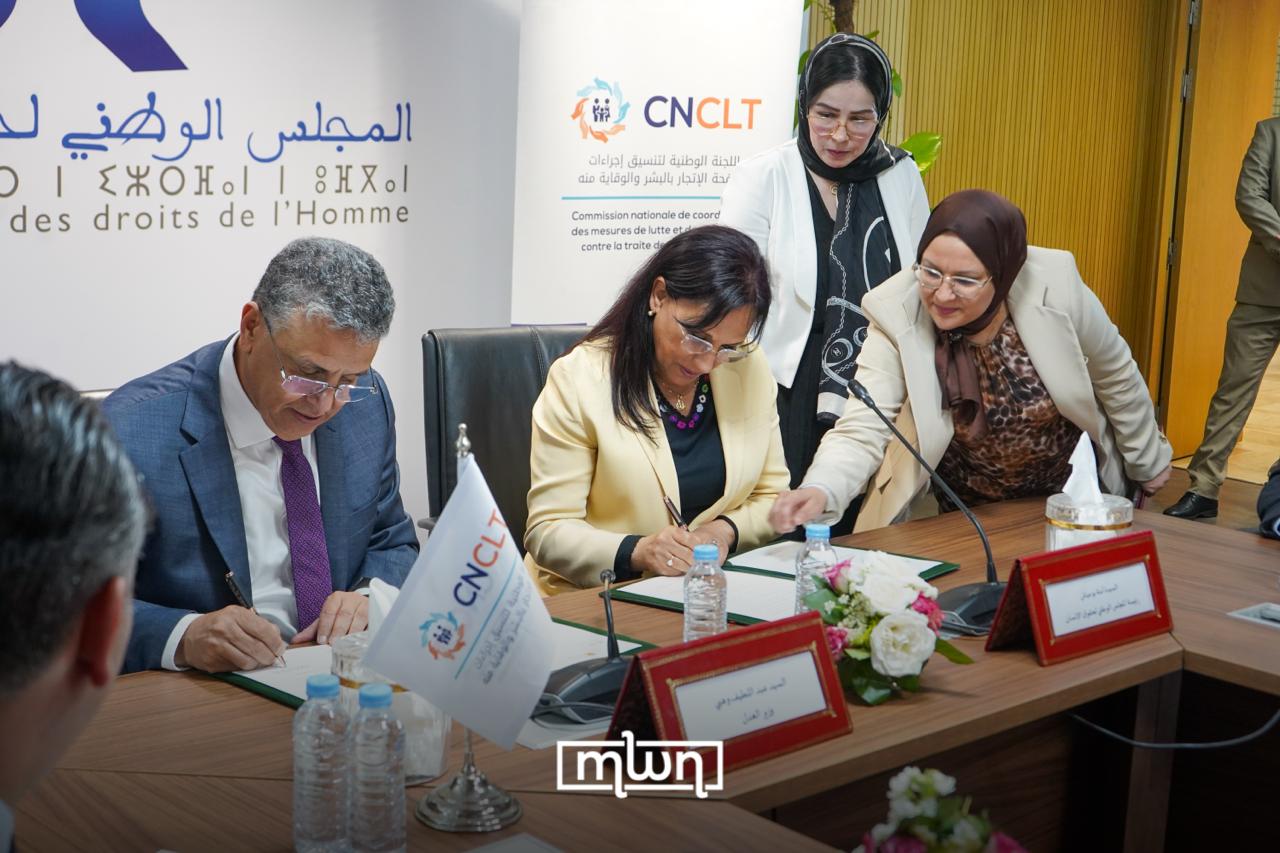
The memorandum of understanding, signed on Wednesday at the Council’s headquarters in Rabat by Amina Bouayach, president of the Council, and Abdellatif Ouahbi, reflects what both sides describe as the continuation of several years of institutional cooperation.
Officials say that earlier joint efforts have already produced concrete results, including the protection of victims and the prosecution of individuals involved in trafficking networks.
The new agreement seeks to build on that record by introducing a more structured and comprehensive coordination framework.
At its core is the establishment of regional mechanisms across Morocco’s twelve regions, designed to improve collaboration between judicial authorities, security services, healthcare providers, and civil society organizations.
Speaking after the signing ceremony, Bouayach said the initiative represents an important step in consolidating previous work and addressing gaps that have emerged in the national response to human trafficking.
She emphasized that the agreement is not a starting point, but rather an evaluation and reinforcement of an existing process that has gradually taken shape over recent years.
According to Bouayach, the creation of regional coordination mechanisms is intended to ensure that all relevant actors operate within a unified framework, allowing for faster responses, clearer communication, and more effective support for victims.
These mechanisms are designed to facilitate coordination between institutions that often operate in parallel, particularly in complex cases that require legal, medical, and social intervention.
Strengthening coordination and victim support
The National Council for Human Rights will assume responsibility for overseeing these mechanisms at the national level.
This role includes monitoring implementation, ensuring consistency across regions, and promoting adherence to a human rights-based approach in all aspects of anti-trafficking efforts.
A central component of the agreement is its focus on prevention and victim support.
Moroccan authorities have increasingly emphasized the need to address the root causes of trafficking while strengthening systems for identifying, assisting, and protecting victims.
The memorandum highlights the importance of improving referral pathways and ensuring that victims receive appropriate care, including access to healthcare and legal assistance.
Particular attention is given to women and children, who are often among the most vulnerable to trafficking.
Officials involved in the agreement stressed that these groups require tailored protection measures and sustained institutional support, especially in cases involving exploitation or abuse.
For his part, Ouahbi presented the agreement as part of a broader effort to enhance Morocco’s institutional response to human trafficking.
He noted that effective action in this area depends on close cooperation between multiple actors, including government agencies, law enforcement, and non-governmental organizations.
The Ministry of Justice, acting through the national commission responsible for coordinating anti-trafficking measures, will work alongside the Council to strengthen monitoring systems and improve coordination between stakeholders.
The agreement also aims to reinforce mechanisms for tracking cases and ensuring that victims are referred to the appropriate services in a timely manner.
While Moroccan authorities have made progress in recent years, challenges remain in ensuring consistent implementation across regions and improving coordination between institutions.
The new memorandum is intended to address these challenges by formalizing cooperation and providing a clearer framework for joint action.
The emphasis on a human rights-based approach reflects a broader shift in how trafficking is addressed, moving beyond a purely security-focused response to one that prioritizes the protection and dignity of victims.
This approach requires not only legal action against perpetrators, but also sustained investment in support services and prevention strategies.
Civil society organizations are expected to play a key role in this framework, particularly in identifying victims and providing support at the community level.
Their involvement is essential to bridging gaps between institutions and ensuring that responses are grounded in local realities.
The signing ceremony brought together officials and stakeholders involved in anti-trafficking efforts.
It sheds light on what both parties described as a shared commitment to strengthening Morocco’s capacity to respond to a complex and evolving challenge.
The agreement does not introduce entirely new structures, but rather seeks to improve the effectiveness of existing ones through better coordination and clearer responsibilities.
By aligning the efforts of multiple actors under a unified framework, authorities aim to create a more coherent and responsive system.
As Morocco continues to confront the issue of human trafficking, the success of this initiative will depend on its implementation at both the national and regional levels.
Officials say the focus now shifts from agreement to execution, with the expectation that the new coordination mechanisms will lead to more effective prevention, stronger protection for victims, and more consistent prosecution of those responsible.
The memorandum represents both a continuation and a recalibration of Morocco’s approach, reflecting an understanding that addressing human trafficking requires sustained cooperation, institutional clarity, and a firm commitment to human rights principles.
The post Morocco Moves to Reinforce Anti-Trafficking Framework Through New Institutional Pact appeared first on Morocco World News.