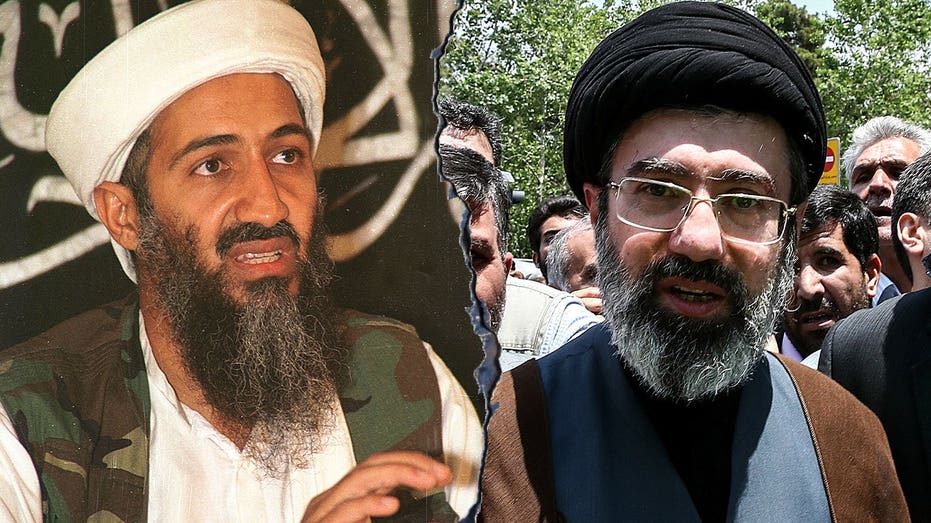
Mojtaba Khamenei using ‘bin Laden template’ to survive, learned from Abbottabad: analyst
•Iran’s Supreme Leader Mojtaba Khamenei has spent nearly three months in hiding as tensions with the U.S.
•escalate — a disappearance that counterterrorism analysts say mirrors the final years of al Qaeda mastermind Osama bin Laden.The comparison comes amid a critical standoff between Washington and Tehran...
•On Wednesday, Trump told reporters he was in "no hurry."Khamenei, meanwhile, appeared to share three posts on his official X account on May 18 but remains out of public view."For the first time in the...
هذا الخبر من Fox News. خبر يقدم أدوات ذكاء اصطناعي للتلخيص والترجمة والاستماع.
المصدر: Fox News | Source: Fox NewsIran’s Supreme Leader Mojtaba Khamenei has spent nearly three months in hiding as tensions with the U.S. escalate — a disappearance that counterterrorism analysts say mirrors the final years of al Qaeda mastermind Osama bin Laden.
The comparison comes amid a critical standoff between Washington and Tehran that prompted President Donald Trump to pause a planned strike on May 19. On Wednesday, Trump told reporters he was in "no hurry."
Khamenei, meanwhile, appeared to share three posts on his official X account on May 18 but remains out of public view.
"For the first time in the history of the Islamic Republic, the United States has done to Tehran what it spent two decades doing to al-Qaeda and ISIS," counterterrorism expert Dr. Omar Mohammed told Fox News Digital.
"The U.S. has driven its leader into the same kind of operational invisibility that bin Laden lived in for 10 years in Abbottabad," he added.
"Both Mojtaba Khamenei and bin Laden inherited their status on the back of an American operation, and both responded the same way: by ceasing to exist publicly," Mohammed said before adding that bin Laden "stopped releasing dated videos around 2007 and confined himself to audio messages carried by hand."
Bin Laden founded al-Qaeda in the late 1980s and masterminded the Sept. 11, 2001, terrorist attacks against the United States.
After the U.S. invasion of Afghanistan, bin Laden evaded capture for a decade by hiding inside a fortified compound in Abbottabad, Pakistan.
To avoid Western electronic surveillance, he severed his digital footprint and relied exclusively on a network of physical couriers, said Mohammed, an expert with the Antisemitism Research Initiative at George Washington University’s Program on Extremism.
U.S. intelligence eventually tracked one of those couriers to the compound, culminating in the 2011 Navy SEAL raid that killed the al Qaeda leader.
OPERATION EPIC FURY: HOW AMERICA'S AIR POWER IS CRUSHING IRAN’S TERROR REGIME
"Bin Laden survived with no cables out of the Abbottabad compound. Communications were carried by hand by two trusted couriers, the Kuwaiti brothers," Mohammed said.
"Bin Laden stayed hidden for the rest of his life because the moment he surfaced was the moment he died. Mojtaba’s incentives point the same way. Mojtaba Khamenei won’t emerge," he said.
"The Abbottabad lesson, which Tehran will have studied closely, is that the safest hiding place is not a cave in Tora Bora but a walled compound in a garrison town," Mohammed added, recalling how U.S. forces targeted bin Laden in the cave complex before he escaped.
Bin Laden also lived roughly a mile from Pakistan’s top military academy, hiding in plain sight behind high concrete walls and barbed wire, Mohammed noted.
"The logical Iranian equivalents are hardened sites under or alongside IRGC facilities," Mohammed added, referring to the Islamic Revolutionary Guard Corps and possible locations where Khamenei could be.
As previously reported by Fox News Digital, one of Khamenei’s few recent communications was an X post declaring a "holy war," framing the geopolitical clash as a mandatory religious obligation.
INSIDE IRAN’S RULING IDEOLOGY: HOW A ‘HOLY MISSION’ AND MESSIANIC DOCTRINE FUEL REGIME EXTREMISM
"This is a religious leader calling for sacred war against America and the Jews from an undisclosed location because his enemies have publicly vowed to kill him on sight," Mohammed said, describing the narrative as "the bin Laden template, almost line for line."
Mohammed also suggested Khamenei’s retreat into the shadows marks a watershed moment for Washington and the future of the Iranian regime.
His predecessor and father, Supreme Leader, Ayatollah Ali Khamenei, was killed Feb. 28 in a targeted U.S.-Israeli airstrike in Tehran during Operation Epic Fury.
"This regime that for 47 years projected its power through a single visible Supreme Leader at the Friday prayer pulpit can no longer produce that figure on demand," he said, calling it a "strategic milestone."
"Predecessors killed by U.S. strikes and successors who cannot show their faces. Real power exercised by a security apparatus rather than by the nominal figurehead."
"Now one side is announcing operations on three continents through its president; the other is governed on paper by a man whose own population is uncertain where he is or what state he is in," Mohammed said.
"The contrast is also about the optics of leadership during this war," he added.
ملاحظة تحريرية | Editorial Note: نُشر هذا المقال في الأصل بواسطة Fox News. خبر (Khabr) هي منصة إعلامية أردنية مرخّصة تعمل بالذكاء الاصطناعي. نضيف قيمة تحريرية من خلال: تحليل ذكي للأخبار، ملخصات تلقائية، رواية صوتية بالذكاء الاصطناعي، ترجمة متعددة اللغات، وتدقيق الحقائق. هدفنا جعل الأخبار أكثر وضوحاً وسهولةً للقارئ العربي.
This article was originally published by Fox News. Khabr is a licensed Jordanian AI-powered news platform (Registration #82086). We add editorial value through: AI-powered news analysis, automated summaries, AI audio narration, multi-language translation (Arabic, English, French, Turkish), and AI fact-checking. Our mission is to make news more accessible and understandable for Arabic-speaking audiences worldwide.