Europe’s border crisis with Belarus has intensified after authorities in Lithuania discovered a growing number of migrant tunnels dug under the border between the two countries.
Authorities in Vilnius believe the Belarusian government is complicit in helping thousands of migrants breach Lithuanian border controls.
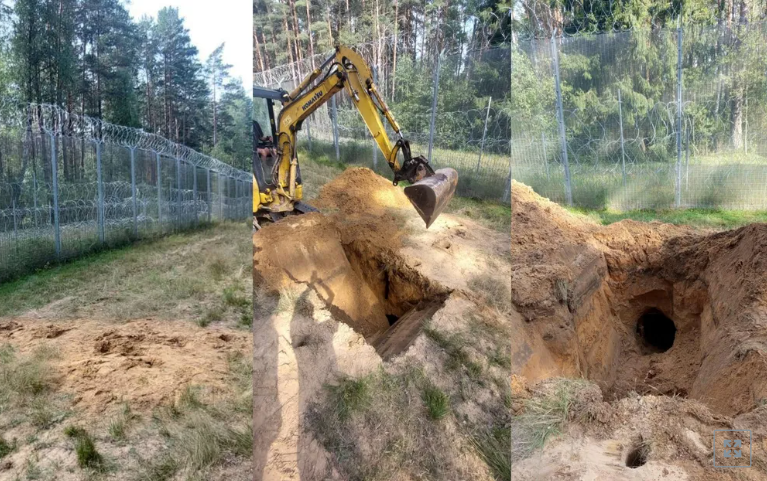
GB News has obtained evidence of one of the latest tunnels dug under the border fence by Afghan illegal immigrants in the past few days, which had not yet been discovered by Lithuanian border guards.
More than a dozen tunnels have been unearthed by authorities since the beginning of the year.
The Lithuanian government is concerned the crisis is growing again, as four new tunnels have been constructed over the past two weeks alone.
Last week, Lithuanian border guards were alerted after dozens of migrants managed to cross through one of the new border tunnels.
As authorities rushed to the scene within a local forest, migrants ran off into the thick undergrowth.
Helicopters, drones and police dogs were used to track some of them down.

A total of 38 illegal immigrants were eventually located and detained.
The vast majority, including two women, were from Afghanistan.
They were all sent back through the border fence into Belarus.
The last tunnel constructed in the past week was dug by a group of Afghan illegal immigrants.
LATEST DEVELOPMENTS
- Mega dinghy carrying RECORD number of illegal migrants reaches Britain as 230 cross Channel
- Spanish protesters vent fury at British tourists...while second Ceuta invasion looms
- EU civil war explodes as Italian foreign minister blasts 'disproportionate' response to crisis

The tunnel is around two metres deep and is supported by hundreds of wooden props, cut down and fashioned from tree branches in the nearby forest.
For several years, Lithuania, Latvia and Poland have been accusing the regime of Alexander Lukashenko in Belarus of deliberately orchestrating the migration crisis along part of the European Union's eastern border.
Multiple tunnels have also been discovered in neighbouring Poland over the past year.
The EU has accused Belarus and Minsk's ally Moscow of plotting to destabilise Poland by encouraging people, mainly from the Middle East and Africa, to cross the frontier.
Belarus and Russia have repeatedly dismissed these accusations.
Lithuanian border guards enlisted specialists from the Polish Border Guard to help them locate some of the latest tunnels.
They used specialised equipment to detect underground passages. Lithuania's border with Belarus is about 430 miles long, around 340 miles of which is fenced.
The border guard service has now begun using a specialised ground-penetrating seismic detection system, which can pinpoint high levels of vibrations over a long distance.
General Rustamas Liubajevas, Commander of Lithuania's State Border Guard Service, said the nature of the tunnels had led him to believe "the migrants are not working alone".
He said: "They wouldn't be able to go through with this without logistical support from the Belarusian authorities, as they need a lot of material like wood to strengthen the tunnels' walls."
Lukashenko has denied facilitating migration flows to neighbouring states.
However, Lithuanian authorities say the pressure from Belarus is building again to levels not seen since tens of thousands of migrants crossed into the country, Poland and Latvia in 2021.
Last Spring, GB News obtained video evidence of thousands of migrants massing on Europe's southeastern flank, with many using ladders and wire cutters to breach border fences in Bulgaria and Greece.
The latest worrying reports of new migrant tunnels in Lithuania come just a fortnight since more than 70,000 illegals invaded the Spanish enclave of Ceuta in Morocco.
Most have been sent back over the border, but social media reports suggest another mass incursion into Ceuta is being planned for sometime next week.
Our Standards: The GB News Editorial Charter