• Marriage halls increase rates or avoid long-term pricing commitments due to economic uncertainty
• Govt austerity measures have led to stricter enforcement of wedding regulations, including the 10pm curfew and one-dish policy
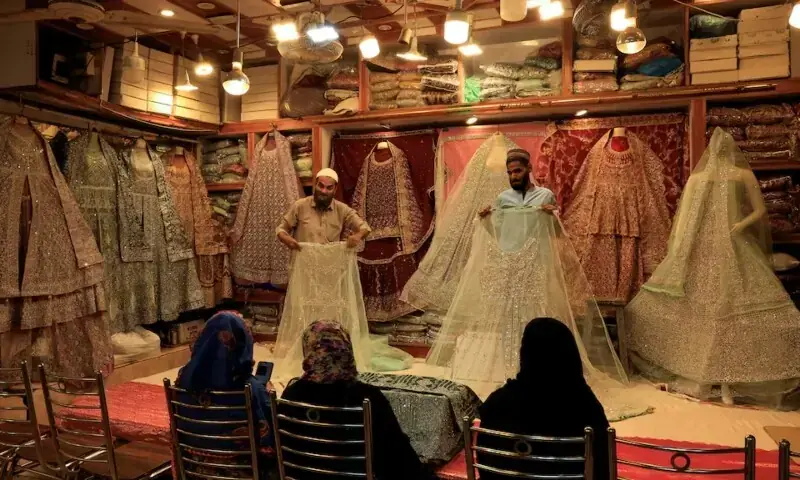
KARACHI: With temperatures climbing, wedding invitations seem to have mercifully dwindled to a stop for those who dread the sweat of suits, heels, and layers of makeup. And not a day too soon, given how the ongoing war has impacted this wedding-obsessed country.
Amid surging fuel rates and inflation, pricing volatility has reached new highs. Several venues have raised rates by up to Rs500 per head, while others are refusing to commit to winter pricing altogether, citing uncertainty around oil and input costs, says Izzah Zaman, co-founder of wedding-tech startup Shadiyana.
Alongside this, the government’s austerity measures have led to stricter regulatory enforcement: a 10pm wedding cutoff, police intervention in cases of violations, and crackdowns on the one-dish policy, resulting in venue closures across Islamabad.
There are also operational challenges. Weddings in the capital, in particular, are increasingly vulnerable to external disruptions, whether due to security cordons near the Margalla Hills during peace talks or city-wide VIP protocols that delay guest arrivals without warning.
Media reports suggest that last winter’s wedding season in Karachi alone was worth around Rs33 billion, while Shadiyana estimates the nationwide market at approximately Rs900 million.
All of this is unfolding within an industry that has historically operated at enormous scale, albeit through a fragmented and informal economy. This disconnect is what Shadiyana aims to address.
The idea took shape in 2021, at the height of Pakistan’s startup boom, when funding was pouring into companies such as Airlift.
While much of that capital pursued models tested elsewhere, Izzah Zaman and her co-founder, Neelam Shoaib, chose a less-travelled path: weddings. “When we thought about weddings, we realised this isn’t something you can simply copy-paste from the West. It’s a very local problem,” she says.
Pakistan’s wedding economy has historically been structurally resistant to organisation. Entire neighbourhoods, such as North Nazimabad in Karachi, function as dense clusters of 60 to 70 wedding halls, where discovery remains largely physical and inefficient.
Finding a venue often means driving from one location to another, only to discover that most dates are already booked. Shadiyana’s proposition is to bring this chaos online and streamline it with just a few clicks.
In essence, Shadiyana is a wedding marketplace that connects users with vendors offering a wide range of services, from mehendi artists and photographers to its primary revenue driver: marriage halls.
The company began modestly in 2021 with $2,500 in funding from Ms Zaman’s alma mater, Carnegie Mellon. Since then, it has helped organise over 30,000 weddings across Karachi, Lahore, and Islamabad, leading to an $800,000 raise from Indus Valley Capital.
Today, the platform, which includes both a website and a mobile app, reports more than half a million users and over 600 vendors listed on its platform.
The company’s business model is anchored primarily in commissions, which comprise roughly 80 per cent of revenue. This is supplemented by vendor subscriptions and marketing add-ons, including services such as a wedding-night workshop that educates brides on the religious and medical aspects of their first night together.
In practice, when a user books a venue through the platform, Shadiyana earns a percentage of the transaction, with rates varying by category. Photographers may generate commissions of around 10pc, while venues yield between 2pc and 10pc, depending on the size of the deal.
Yet, even as the platform formalises parts of the process, it remains exposed to the same pressures reshaping the wider industry.
Before the latest inflationary wave driven by the US-Iran conflict, the average wedding ticket size on Shadiyana stood at around Rs600,000. Through the platform, wedding budgets have ranged from as little as Rs20,000 to as much as Rs4.4 million.
However, the broader trend points towards contraction. A startup that began operations during the pandemic, then navigated the Russia-Ukraine conflict, domestic inflation, a near-default economic crisis, and now ongoing geopolitical tensions, has effectively grown alongside a series of economic shocks.
The impact is evident in consumer behaviour. Guest lists that once averaged 400 people have now shrunk to around 150. Budgets for venues, photography, and catering are also being reduced.
As the war continues and fiscal pressures tighten for ordinary people, weddings will still take place, albeit on significantly smaller budgets.
Published in Dawn, May 9th, 2026