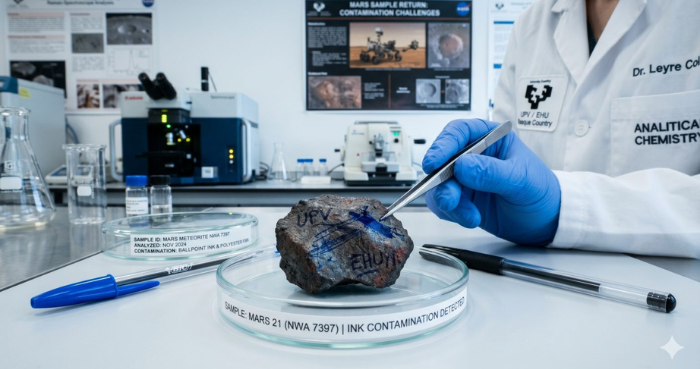
Martian meteorite samples found contaminated with terrestrial ballpoint pen ink
•Must ReadScience & TechnologyMartian meteorite samples found contaminated with terrestrial ballpoint pen inkBy Web Desk-Apr 19, 2026Martian meteorites frequently make global headlines, but a fasci...
•While analyzing meteorite samples received directly from NASA’s Johnson Space Center, scientists found microscopic traces of ballpoint pen ink.
•Published in Applied Geochemistry, this surprising discovery highlights how these rare extraterrestrial samples readily pick up terrestrial contaminants during standard laboratory preparation, despite...
هذا الخبر من ARY News EN. خبر يقدم أدوات ذكاء اصطناعي للتلخيص والترجمة والاستماع.
Must ReadScience & TechnologyMartian meteorite samples found contaminated with terrestrial ballpoint pen inkBy Web Desk-Apr 19, 2026Martian meteorites frequently make global headlines, but a fascinating discovery by a research team at the University of the Basque Country has revealed something completely unexpected. While analyzing meteorite samples received directly from NASA’s Johnson Space Center, scientists found microscopic traces of ballpoint pen ink. Published in Applied Geochemistry, this surprising discovery highlights how these rare extraterrestrial samples readily pick up terrestrial contaminants during standard laboratory preparation, despite rigorous institutional efforts to maintain strict sterility. Extraterrestrial samples inevitably undergo severe physical changes as they travel through space and enter Earth’s atmosphere. This atmospheric entry causes extreme temperatures and pressures that form a crusty outer layer over the rock, effectively masking its original mineralogical composition. To study the authentic material beneath, scientists must thoroughly clean and process the meteorites using various methods such as ultrasonic cleaning, diamond-saw cutting, and chemical solvent soaking. However, the Spanish research team emphasized that these highly varied techniques severely lack standardized, contamination-aware preparation protocols across different laboratories. The researchers analyzed six specific slices of post-processed Martian meteorites collected between 2001 and 2014 using Raman spectroscopy. While they anticipated finding expected processing leftovers like diamond traces or ethyl alcohol, the results yielded incredibly bizarre additions. The advanced analysis detected a synthetic organic molecule used in gel pens, a copper compound utilized in ballpoint ink, tall oil rosin matching commercial printer ink, and blue polyester likely originating from laboratory textiles. While scientists are highly unlikely to mistakenly identify the...المصدر: ARY News EN | Source: ARY News EN
ملاحظة تحريرية | Editorial Note: نُشر هذا المقال في الأصل بواسطة ARY News EN. خبر (Khabr) هي منصة إعلامية أردنية مرخّصة تعمل بالذكاء الاصطناعي. نضيف قيمة تحريرية من خلال: تحليل ذكي للأخبار، ملخصات تلقائية، رواية صوتية بالذكاء الاصطناعي، ترجمة متعددة اللغات، وتدقيق الحقائق. هدفنا جعل الأخبار أكثر وضوحاً وسهولةً للقارئ العربي.
This article was originally published by ARY News EN. Khabr is a licensed Jordanian AI-powered news platform (Registration #82086). We add editorial value through: AI-powered news analysis, automated summaries, AI audio narration, multi-language translation (Arabic, English, French, Turkish), and AI fact-checking. Our mission is to make news more accessible and understandable for Arabic-speaking audiences worldwide.