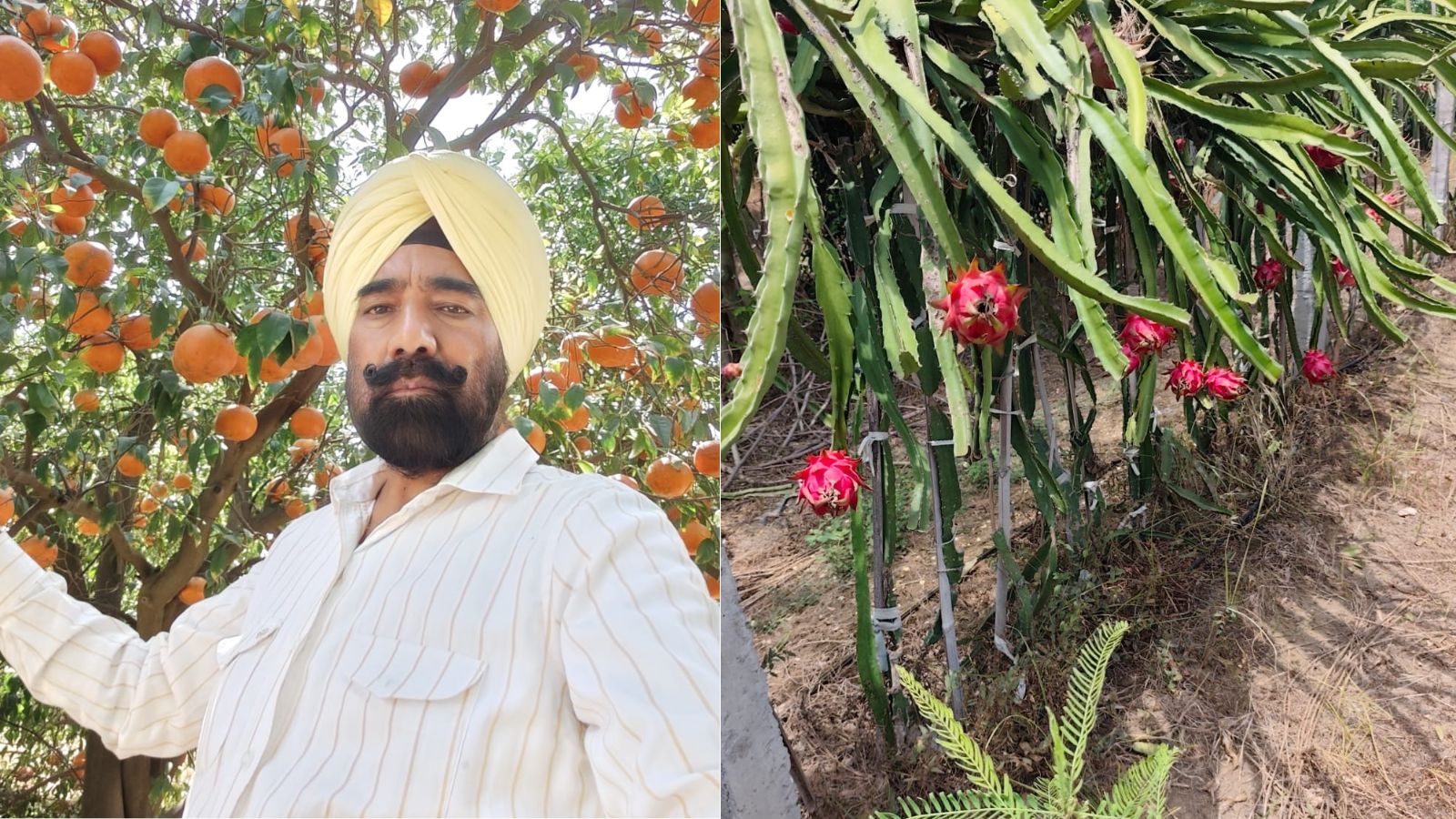
Weather ePaper Today’s Paper Journalism of Courage Home ePaper Politics Explained Opinion India Business Premium Cities UPSC Entertainment Sports World Lifestyle Tech Subscribe Sign In TrendingUPSC OfferIPL 2026US NewsPuzzles & GamesLegal NewsFresh TakeHealthResearch🎙️ Podcast Advertisement function checkAndLoadWindowSizeScript() { if (window.jQuery) { // jQuery is loaded, include your script jQuery(document).ready(function($) { // Your existing script for checking window width if (window.innerWidth) var page_w = window.innerWidth; else if (document.all) var page_w = document.body.clientWidth; if (page_w > 1024) { $(".add-left, .add-right").show(); } else { $(".add-left, .add-right").hide(); } }); } else { // jQuery is not loaded, check again after 0.2 seconds setTimeout(checkAndLoadWindowSizeScript, 200); } } // Initial call to the function checkAndLoadWindowSizeScript(); NewsCitiesChandigarhKinnows to dragon fruit, saffron to pearls: a lesson in data-driven diversification from a Bathinda farm Kinnows to dragon fruit, saffron to pearls: a lesson in data-driven diversification from a Bathinda farm At the 36-acre farm that he shares with his brother in Ghuman Kalan village near Maur Mandi in Bathinda, Bhullar has reimagined agriculture as a high-efficiency, precision-based enterprise. Written by: Anju Agnihotri Chaba6 min readJalandharUpdated: Apr 19, 2026 11:30 AM IST Sukhpal Singh Bhullar's kinnow (left) and dragon fruit farm (right). (Express Photo) Make us preferred source on Google Whatsapp twitter Facebook Reddit PRINT In Punjab, where migration abroad is often seen as the surest path to prosperity, a 61-year-old farmer is cultivating a different dream. Once weighed down by debt, Sukhpal Singh Bhullar now runs an innovation-driven farming enterprise that generates over Rs 12 lakh per acre in profits, with a target of Rs 20 lakh per acre in the coming year. Bhullar’s message, especially to the youth and his own son settled in Canada, is simple: “The soil here can give more than dollars. Aao, ab laut chalen (come back to your roots).” At the 36-acre farm that he shares with his brother in Ghuman Kalan village near Maur Mandi in Bathinda, Bhullar has reimagined agriculture as a high-efficiency, precision-based enterprise. By blending kinnow orchards with dragon fruit, intercropping seasonal vegetables, experimenting with saffron cultivation in controlled environment, and even venturing into pearl farming, he ensures that every inch of land is productive. “I don’t think in terms of acres anymore. I think per square metre or foot,” says Bhullar, a commerce graduate who credits his business mindset for transforming his approach to farming. Bhullar’s journey began in adversity. In 1984, his family’s transport business in Barnala collapsed, leaving them with a debt of Rs 9 lakh and mortgaged land in their native village. “We returned to the village and started from scratch. People doubted us, calling us ‘city people’ trying to farm. So we decided to live on the farm and prove ourselves,” he recalls. Starting with vegetables for quick returns, and guided by Punjab Agricultural University, Bhullar gradually expanded cultivation. Over time, the family cleared its debt, reclaimed mortgaged land, and purchased an additional 16 acres. In 1989, he planted kinnow on five acres. By 2005, the entire farm had shifted to kinnow orchards, abandoning the traditional wheat-paddy cycle. “Those crops (wheat and paddy) cannot sustain today’s farmer. We need diversification and planning,” he says. Bhullar’s kinnow orchards are scientifically designed with optimized spacing of about 20×15 feet row to row and plant to plant, accommodating nearly 135 plants per acre. His innovation extends beyond cultivation. In the late 1990s, he developed a manual grading machine capable of sorting the fruit into six categories, earning him a national award. In 2007, he set up a waxing and grading plant at a cost of Rs 7 lakh, five-times cheaper than Rs 35 lakh alternative available in the markets. He handles his own marketing, with much of his produce reaching Kolkata before being exported further. “Farmers must not only grow but also learn to market their produce,” he emphasizes. A major turning point in his farming journey came with intercropping. Two years ago, Bhullar introduced dragon fruit between kinnow rows. “Earlier, kinnow alone gave Rs 5–6 lakh per acre. Now, with dragon fruit, returns have reached Rs 12 lakh per acre, and as plants mature, it will touch Rs 15 lakh,” he says. He has planted around 13,000 dragon fruit plants across seven acres and is now adding papaya to push returns toward Rs 20-lakh per acre mark. Seasonal crops such as onion, cauliflower, and lobia help cover labour costs. With separate drip irrigation systems, sensors, and careful crop selection, Bhullar ensures efficient use of water and nutrients. “The key is selecting crops that complement, not compete,” he adds. In a bold experiment, Bhullar has also begun cultivating saffron, traditionally grown in Kashmir, inside a controlled indoor setup. After years of study, he started with a 15×15 ft room, investing about Rs 7 lakh. Using aeroponic technique, temperature control, humidity regulation, and LED lighting, he successfully replicated the climate required for saffron. His first yield was about 150 grams, sold at Rs 400–500 per gram. He expects production to reach one kilogram this year and optimal yield by the third year. “It requires very little daily attention, but proper training is essential,” he says. With India’s annual saffron demand estimated at 60–80 tonnes and domestic production far lower, Bhullar sees significant potential in the crop. Adding to his diversified model is pearl farming. Using water tanks, he cultivates around 12,500 mussels, expecting to produce up to 20,000 pearls over two years. “These small areas of saffron and pearl farming will generate income in millions,” he says. Bhullar’s efforts have earned him three national awards, five state awards, and numerous honours at agricultural fairs. His farm provides seasonal employment to over 100 workers and year-round work to 10 labourers. He also conducts training sessions for farmers, promoting what he calls a “youth model” of agriculture. Despite his success, his vision remains personal. His son Vattandeep Singh Bhullar, a professional horse rider, runs Punjab Equestrian Centre in Canada, where he teaches horse riding and related activities. “My dream is to build a model where farming income surpasses what people earn abroad,” Bhullar says. “I want my son, and thousands like him, to return.” Looking ahead, he plans to expand into spirulina cultivation, strengthen direct marketing, and launch fresh juice outlets. He reminisces how during a visit to the US, he asked a scientist about the best manure for citrus plants and the scientist replied, “farmer’s footprints!”. Bhullar says constant field presence allows farmers to understand their crops better and respond to their needs in time. Standing in his orchard, he sums up his philosophy: “In farming, the future is not in acres—it is in ideas.” Stay updated with the latest - Click here to follow us on Instagram
المصدر: Indian Express
| Source: Indian Express