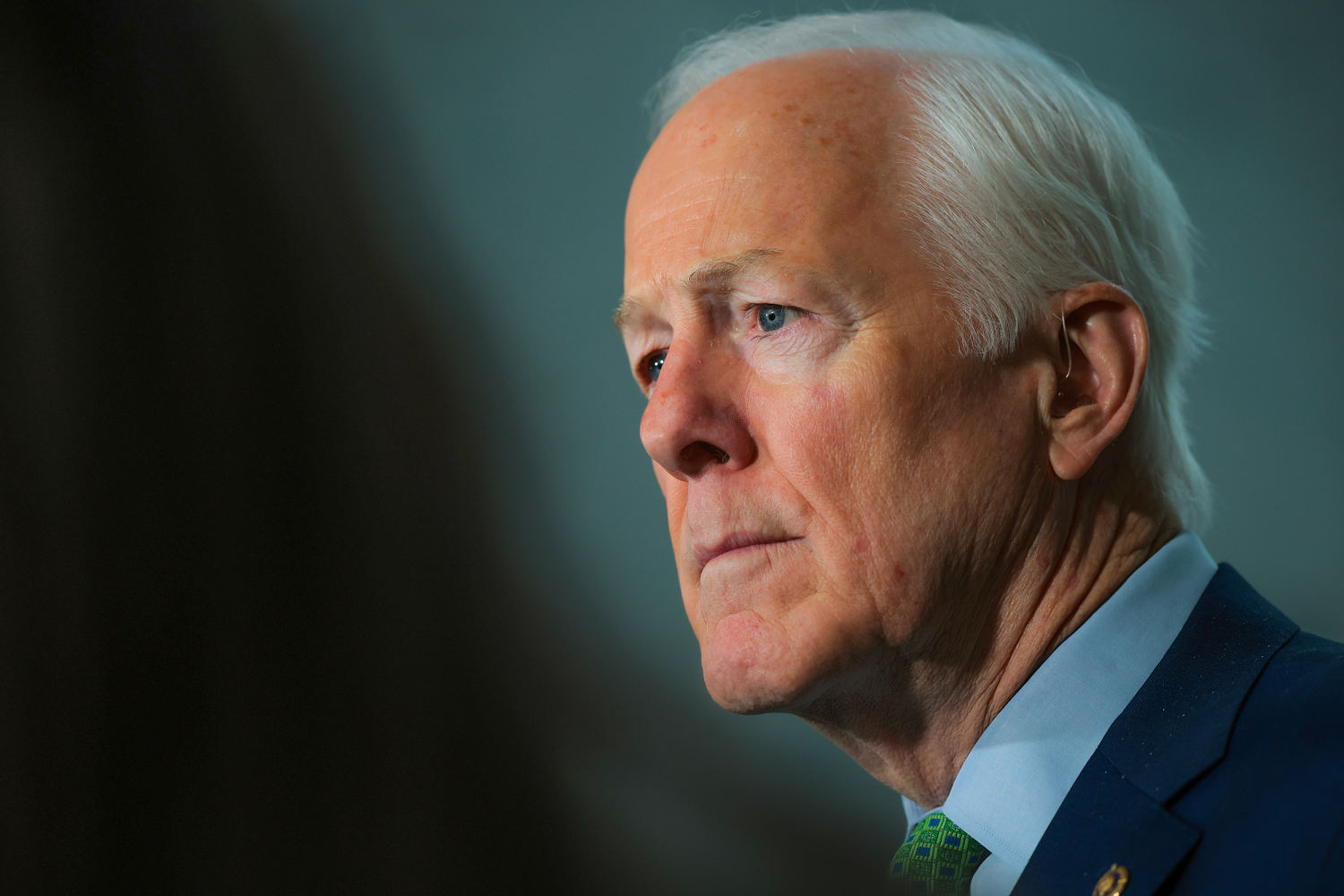
John Cornyn undone by past Trump misgivings, after decades as a loyal party man
•Ahead of his Republican primary runoff Tuesday, Sen.
•John Cornyn highlighted a photo of himself standing next to President Donald Trump as his pinned post on X.
•He boosted one post disputing that he’s “disloyal” to Trump and another about voting “yes on every major Trump law.” The posts captured an important side of Cornyn: a loyal Republican soldier, standin...
هذا الخبر من NBC News. خبر يقدم أدوات ذكاء اصطناعي للتلخيص والترجمة والاستماع.
Ahead of his Republican primary runoff Tuesday, Sen. John Cornyn highlighted a photo of himself standing next to President Donald Trump as his pinned post on X. He boosted one post disputing that he’s “disloyal” to Trump and another about voting “yes on every major Trump law.” The posts captured an important side of Cornyn: a loyal Republican soldier, standing with his party’s leader. There’s no disputing that Cornyn’s voting record was almost perfectly aligned with Trump. Texas Attorney General Ken Paxton’s lopsided victory in the election results captured an important reality of the GOP in 2026, too: That’s not enough. Trump jumped in last week to issue a late endorsement for Paxton, who defeated Cornyn on Tuesday night. In January, Cornyn’s 24-year Senate career will come to an end. Ultimately, Trump noted last week, he had “worked well” with Cornyn. But he compared Cornyn unfavorably with Paxton on another key metric, saying Cornyn “was not supportive of me when times were tough.” Plenty of Trump allies shared the view throughout the race, citing factors outside his vote card as why they didn’t view him as sufficiently loyal. Behind Cornyn’s record were an institutionalist instinct and a long paper trail of misgivings about controversial Trump actions. Unlike Sen. Bill Cassidy, R-La., another recent Trump target who lost his primary, Cornyn voted to acquit Trump on impeachment charges in 2021. But he remained deeply critical of the Capitol riot and argued in subsequent years that Trump shouldn’t run again in 2024, calling him unelectable and backing a new direction for the GOP. Months later, as Trump was dominating early primaries and cruising to the nomination, Cornyn backtracked and endorsed him. As a former chair of the National Republican Senatorial Committee and a Senate GOP whip for six years, including Trump’s first two years, Cornyn always saw himself as a team player after the arguments had settled. “To beat Biden, Republicans need to unite around a single candidate, and it’s clear that President Trump is Republican voters’ choice,” Cornyn said in early 2024. In Trump’s first term, Cornyn was part of a group of Republicans who sought to nudge him toward traditional conservatism. In 2017, Cornyn criticized Trump’s controversial firing of FBI Director James Comey and defended various prominent figures against criticism, including special counsel Robert Mueller and former Defense Secretary Mark Esper. Paxton allies put together a list of the alleged heresies to convince Trump that he couldn’t trust Cornyn. “Cornyn has gone out of his way to stab President Trump and MAGA in the back at every turn, while defending every terrible deep state actor,” said Republican consultant Caroline Wren, an outspoken Cornyn critic. It also appeared to hurt Cornyn that he was among many Republicans reluctant to endorse nuking the chamber’s 60-vote filibuster threshold to pass the Trump-backed Save America Act, which would impose nationwide voter ID laws. Paxton had no such qualms, quickly siding with Trump in that goal. Whether out of deference to his party leader, a change in principle or political opportunism, Cornyn later followed suit, after Paxton pushed him to a runoff in March. Trump’s endorsement of Paxton disappointed many Senate Republicans. Majority Leader John Thune of South Dakota and NRSC Chair Tim Scott of South Carolina had pleaded with him to back Cornyn, seeing him as a safer general election bet than Paxton, whose history of controversies includes getting impeached (but then acquitted) by the Republican-led Texas Legislature in 2023. “Sen. Cornyn is a principled conservative. He is a very effective senator for the state of Texas,” Thune told reporters. “But I don’t — none of us control what the president does. He made his decision about that. That doesn’t change the way I feel, and I am certainly supportive of and will continue to be supportive of Sen. Cornyn in his re-election.” In a sign of the growing rift between Trump and the Senate GOP, Thune said Trump didn’t give him a heads-up before he threw his support to Paxton. Apart from his voting record, Cornyn’s years as a campaign chair, leadership member and prolific donor to fellow Republican candidates endeared him to colleagues. As NRSC chair, he navigated the “tea party” era with some bumps in the road, as GOP voters bucked his preferred picks in a number of contested primaries. Some of those candidates, like Marco Rubio, went on to serve amiably with Cornyn for years. Others lost to Democrats, costing the party winnable seats in 2010 and 2012. But Cornyn’s rise up the ranks continued, and he became majority whip in 2013, under former Republican leader Mitch McConnell. But unlike McConnell, Cornyn was term-limited out of the job in 2019 and replaced in the No. 2 position by Thune, who narrowly defeated him to replace McConnell in late 2024. Another sign of Cornyn’s survival instincts came on the issue of immigration, a perennially divisive issue for which he had a front-row seat as a Judiciary Committee member and border-state senator. Bipartisan deals struck under George W. Bush, Barack Obama and Trump in his first term imposed tougher border security in exchange for legal status for at least some people in the country illegally. Trump’s White House turned against the 2018 deal to fund a border wall in exchange for legalizing young immigrants in the country illegally, known as “Dreamers.” Each deal was blasted on the right as “amnesty” for lawbreakers — the type of vote that could come back to haunt a Republican in a primary. Cornyn voted against each of them. Still, it will be Paxton who faces James Talarico this fall, as Democrats continue to chase their elusive goal of winning statewide in Texas. “Texas is a huge mess for the Republicans,” said Senate Minority Leader Chuck Schumer, D-N.Y., who has simultaneously worked with Cornyn on bills and fought unsuccessfully to defeat him. Speaking a few hours after Trump endorsed Paxton, Schumer added: “And I believe that we’re in much better shape taking back Texas than we were a few days ago.”المصدر: NBC News | Source: NBC News
ملاحظة تحريرية | Editorial Note: نُشر هذا المقال في الأصل بواسطة NBC News. خبر (Khabr) هي منصة إعلامية أردنية مرخّصة تعمل بالذكاء الاصطناعي. نضيف قيمة تحريرية من خلال: تحليل ذكي للأخبار، ملخصات تلقائية، رواية صوتية بالذكاء الاصطناعي، ترجمة متعددة اللغات، وتدقيق الحقائق. هدفنا جعل الأخبار أكثر وضوحاً وسهولةً للقارئ العربي.
This article was originally published by NBC News. Khabr is a licensed Jordanian AI-powered news platform (Registration #82086). We add editorial value through: AI-powered news analysis, automated summaries, AI audio narration, multi-language translation (Arabic, English, French, Turkish), and AI fact-checking. Our mission is to make news more accessible and understandable for Arabic-speaking audiences worldwide.