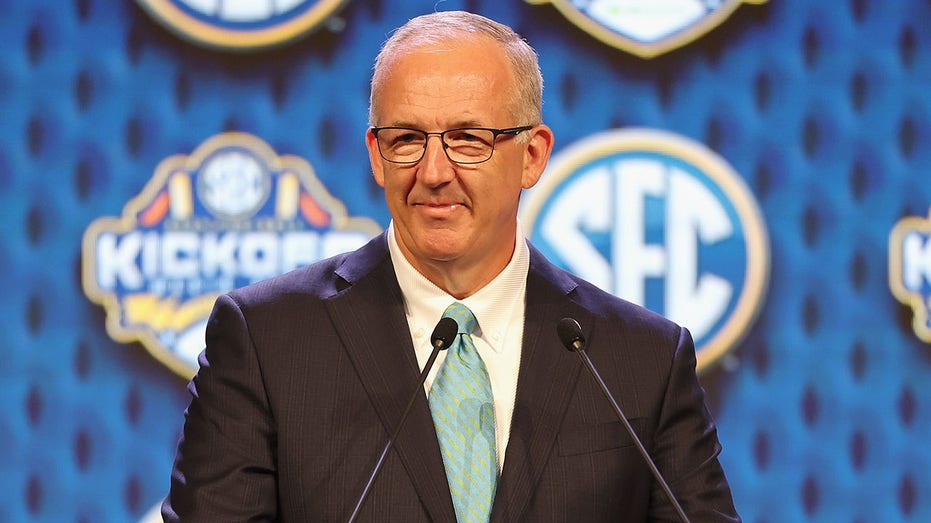
Amid thousands of vacationers roaming the Hilton Sandestin Resort over Memorial Day weekend, some of the most powerful figures in college athletics will head into town for meetings behind closed doors to debate the future of the SEC — and potentially the future of college sports itself.
While families shuffle between the indoor pool and the white-sand beaches of Florida’s Gulf Coast, SEC coaches, athletic directors, university presidents and commissioner Greg Sankey will spend the week discussing the growing chaos surrounding NIL, College Football Playoff expansion and whether the conference needs to take matters into its own hands.
Earlier in the week, Big Ten commissioner Tony Petitti drew a massive line in the sand out in California, much like the ones glistening outside the meeting rooms here in Florida, by maintaining that either the college football playoff expands to 24-teams or the conference will not budge on the 16-team format that the SEC has been lobbying in favor of over the past year.
It's done, there will be no compromise in the eyes of Big Ten officials, though dialogue between Petitti and Greg Sankey continues on a daily basis.
But, the bigger problem lies in the mess that has been front and center on Capitol Hill over the past four years with potential legislation (SCORE Act) that has once again stalled before making it to the House floor thanks to another last second disaster, which also included the "National Black Caucus" coming out against the SEC.
For that part, which is already being discussed within the conference, a conversation around the political aspect of passing some type of legislation now hinges on whether Sens. Ted Cruz, R-Texas, and Maria Cantwell, D-Wash., could finish a bipartisan bill that can actually be seen by administrators across college athletics.
"If we don't get federal legislation in my opinion, we're going to have do this conference by conference because we can't allow the wild west to continue any longer," Georgia President Jere Morehead said Thursday. "I'm prepared next week in Destin to be ready to vote on creating an SEC mechanism, SEC rules that we have to do if Congress isn't going to be act as they should. We just cannot continue down this current path, We have waited months after months for congress to act and it hasn't occurred yet."
You can bet your sparklers that the tenor inside Hilton's San Destin Resort could reach a fever pitch, as conference Presidents and Athletic Directors look for answers on what they are intending to do moving forward.
It's obvious that expanding the playoff past twelve teams is not going to happen unless the SEC gets onboard with the Big Ten. I might have a better chance at running to the local gas station and hitting the lottery at this point, though money does solve a lot of problems for SEC officials.
INSIDE THE FIGHT: NIL ARMS RACE FUELING NEW PUSH FOR COLLEGE FOOTBALL PLAYOFF EXPANSION
In reality, Greg Sankey works for the presidents, not the other way around. If the folks running college campuses within the conference feel as though there is a need for change, or some type of compromise, they will let Sankey known about it extensively next week.
The thought process this time last year was that a move to nine-game conference schedule meant the CFP would expand, with a few caveats thrown in. But the gist of it centered around how those within the SEC were pumping out statistics regarding strength of schedule, and they weren’t doing this for additional press coverage.
As you've seen over the past few months, a number of coaches within the SEC have come out in-favor of expanding the playoff, which is not shocking.
What should draw your attention is the fact they are doing this while Greg Sankey continues to discuss a 16-team format, while also noting his bosses need additional information around the financial aspect of a move to 24.
BIG TEN'S TONY PETITTI MAKES IT CLEAR TO SEC: AGREE TO 24-TEAM CFP EXPANSION OR FORMAT STAYS AT 12
And, he's not wrong. If you’re going to have to rid of the conference title game, at some point, there needs to be a way to make it financially feasible. The SEC is not walking away from a guaranteed contract that pays them nearly $100 million per year from ESPN for one game. That's just ludicrous to think.
So, you have to find a substitute, which Vanderbilt's Clark Lea recently discussed with OutKick, mentioning that incorporating the CFP into that final weekend could be a possible solution. Think of it as a 'Play-In' weekend in Atlanta.
Multiple athletic directors and coaches within the SEC have mentioned to FOX News that continuing to kick the can down the road is no longer an option.
There have been numerous conversations about the current state of ongoing issues within college athletics between conference officials over the past few months, so they are not strolling into Destin to work on a blank canvas.
Well, given the current state of Congress, we are starting to see a shift in talking points related to somehow setting up a governing body that can actually enforce rules.
Right now, the College Sports Commission lacks a signed fully binding agreement from conference administrators, leaving many NIL and revenue-sharing rules without meaningful enforcement. While the CSC can challenge certain financial deals — and has already won at least one arbitration case involving Nebraska — disagreements over oversight and authority continue to create problems across the sport.
As a result, voices throughout college athletics are becoming louder. If federal legislation never arrives, the SEC and Big Ten may decide they have no choice but to create their own systems for governance and enforcement.
DABO SWINNEY IS RIGHT: COACHES OPINIONS DON’T MATTER IN COLLEGE FOOTBALL PLAYOFF EXPANSION FIGHT
According to multiple sources, this will be a heavy point of emphasis inside the meeting rooms starting on Tuesday morning. At this point, SEC leaders are open to any and all suggestions, and there will be plenty of banter about how they can create their own guidelines.
Can you imagine if one SEC or Big Ten school doesn’t get their way with an eligibility or financial dispute, then decides to sue their own conference in hopes of a favorable ruling?
Exactly.
After a week in which the spotlight centered heavily on the Big Ten’s meetings, attention now shifts to the SEC, where the direction of college athletics will once again be the main talking point.
Tony Petitti drew his line in the sand. Now the question is whether Greg Sankey and the SEC are prepared to do the same.