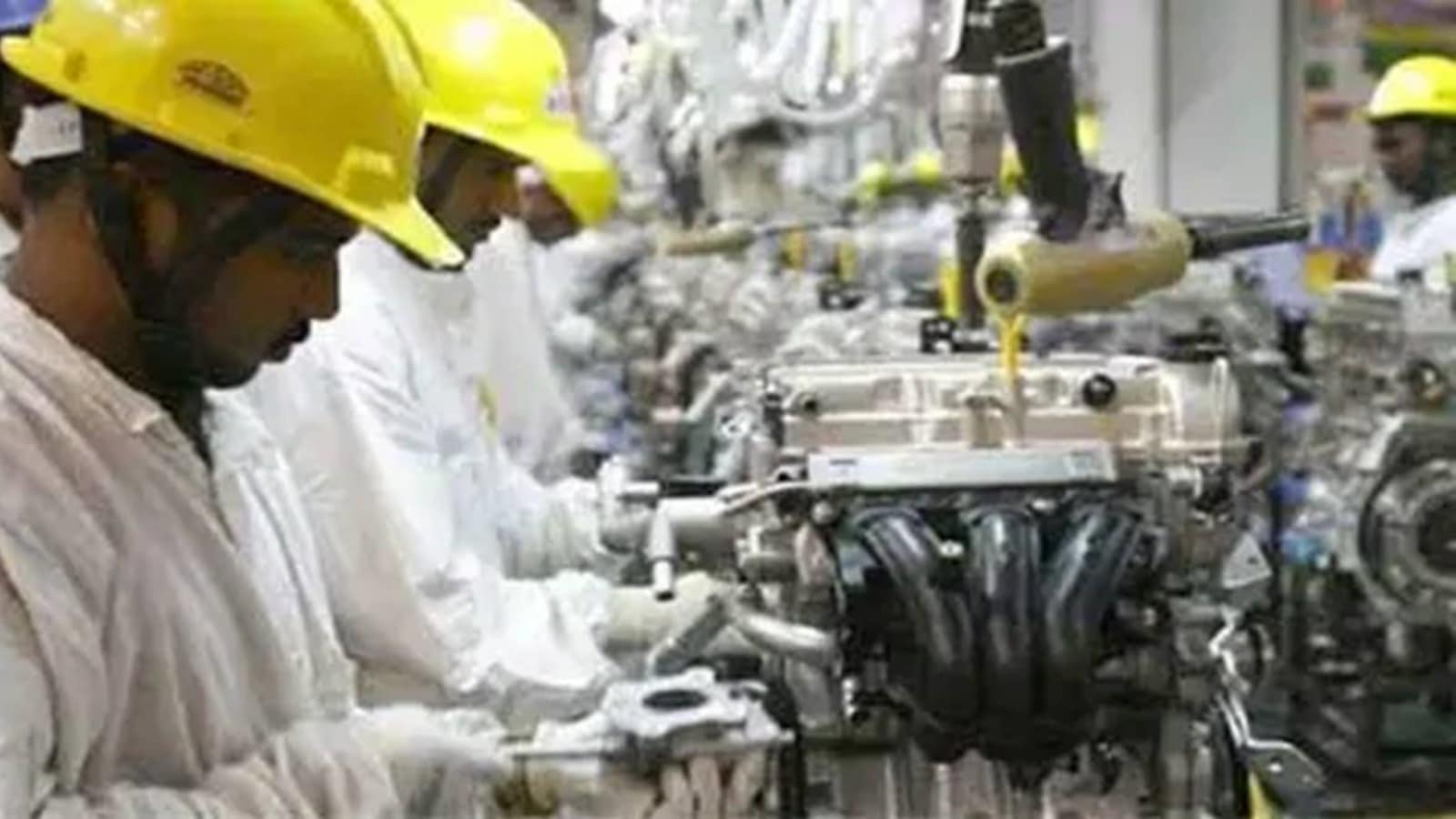
Industrial workers say wage hikes trail rise in cost of living; factories stay shut after protests
✨ AI Summary
🔊 جاري الاستماع
Weather ePaper Today’s Paper Journalism of Courage Home ePaper India Cities UPSC Premium Entertainment Politics Sports World Explained Opinion Business Lifestyle Tech Subscribe Sign In TrendingUPSC OfferIPL 2026US NewsPuzzles & GamesLegal NewsFresh TakeHealthResearch🎙️ Podcast Advertisement function checkAndLoadWindowSizeScript() { if (window.jQuery) { // jQuery is loaded, include your script jQuery(document).ready(function($) { // Your existing script for checking window width if (window.innerWidth) var page_w = window.innerWidth; else if (document.all) var page_w = document.body.clientWidth; if (page_w > 1024) { $(".add-left, .add-right").show(); } else { $(".add-left, .add-right").hide(); } }); } else { // jQuery is not loaded, check again after 0.2 seconds setTimeout(checkAndLoadWindowSizeScript, 200); } } // Initial call to the function checkAndLoadWindowSizeScript(); NewsBusinessIndustrial workers say wage hikes trail rise in cost of living; factories stay shut after protests Industrial workers say wage hikes trail rise in cost of living; factories stay shut after protests Workers said minimum wage rates differ across states, which was also one of the major causes of discontentment, especially in the Noida industry area, where widespread protests turned violent on Monday. Written by: Ravi Dutta Mishra, Pratyush Deep7 min readNoidaApr 15, 2026 12:50 AM IST Meanwhile, input costs rose sharply across a broad range of items, including aluminum, chemicals and fuels. For now, firms appear to be absorbing much of the increase, keeping output prices relatively contained,” Bhandari said. Make us preferred source on Google Whatsapp twitter Facebook Reddit PRINT The Uttar Pradesh and Haryana governments may have hiked the minimum wage for workers in the state after days of protest, but labour union leaders said the hikes fail to adequately cover for the rise in the cost of living, especially given that the last minimum wage revision happened a decade ago or even earlier in these states. The rise in prices of LPG gas cylinders after the war in West Asia has pushed workers over the edge, resulting in spiralling protests, the union leaders said. Workers said minimum wage rates differ across states, which was also one of the major causes of discontentment, especially in the Noida industry area, where widespread protests turned violent on Monday. Violence in the industrial area on the outskirts of the national capital commenced on Monday after the Haryana government hiked minimum monthly wages by 35%. The Centre of Indian Trade Unions (CITU) on Tuesday also pointed out that revised wages for unskilled workers in Uttar Pradesh stood at Rs 13,690. In contrast, the comparable figures for New Delhi and Haryana were Rs 15,221 and Rs 18,456, it said. Meanwhile, the All India Trade Union Congress (AITUC) also said that the minimum wage revision is ineffective. “Workers have long simmered with anger over extremely difficult working conditions, very low wages, accidents, and humiliating treatment. Over the past month, a shortage of gas (LPG) and rampant inflation pushed their tolerance beyond its limit. Due to black marketeering in gas and rising inflation, prices of vegetables, food items, and daily necessities in workers’ localities are rising rapidly. A meal plate at roadside eateries that previously cost Rs 60 has now reached Rs 100-120,” CITU said. Naim Ahmed, the District Secretary of the AITUC in Noida, said workers are unhappy with the hike, and the minimum wage for unskilled workers should be at least Rs 21,000. He told The Indian Express that several labour union leaders, including him, have been under house arrest since April 9. “The reality is that in many states, minimum wages have not been revised for the past 10 years, even as prices of essential commodities have continuously risen. In most industrial areas, contract workers are migrants who live in extremely difficult conditions, deprived of basic facilities. This movement is not an isolated incident. Just two months ago, thousands of contract workers in the Barauni Refinery area launched a similar agitation. This was followed by large-scale protests in Panipat and Surat as well,” AITUC said. Several days of protests in industrial hubs of Haryana and UP led to their state governments hiking minimum wages. The Haryana government on April 9 revised the monthly minimum wages for unskilled workers to Rs 15,220 with effect from April 1. On Tuesday, the UP government also increased interim monthly wages to Rs 13,690 for unskilled workers from Rs 11,313. However, labour unions in Haryana also said the government and administration should take steps to improve the poor conditions of workers, and the minimum wage should be revised to Rs 23,196. CITU said the police administration is trying to defame the workers’ movement by claiming that outsiders are instigating it. At 12:30 in the noon on Tuesday, most of the hundred-odd workers of the Noida-based footwear manufacturer, Ess Aar Pvt Ltd, were slated to get together to commemorate the factory’s foundation day. However, on Tuesday afternoon, the notice on the ground floor of the factory stood as a grim reminder of the planned celebration as the factory found itself in the middle of workers’ unrest that became violent on Monday. The windshield of the director’s vehicle had been smashed into pieces, the reception vandalised, and the operation was brought to a grinding halt. Down the road, nearly four cars were gutted in a fire near the Maruti Suzuki service centre where angry workers had stormed inside the facility, vandalising the premises. Across the industrial hub in Noida, scars of the unrest — damaged office premises and shattered glasses from broken tinted glasses — still scattered like remnants of a storm. Across protest sites in Noida, the workers complained that their monthly wages barely rose over the years, even as living expenses increased manyfold. 19-year-old Pradeep (name changed), who has been working at a factory for the past two years in Noida phase 2 industrial area, said the rent for the tiny room where he and three others stay has increased from Rs 5,500 to Rs 6,500 since April 1. Similarly, LPG shortage has also pushed them to shift to induction as the price of LPG in the black market has been skyrocketing. Several white collar employees in Noida, who saw vandalism in their office premises said a group of workers asked them to join in protests, and their personal vehicles were also damaged. Vikram (name changed), who worked at a Noida-based Maruti Suzuki service centre, said several bikes that belonged to semi-skilled workers were torched. “On seeing a crowd with mobs, I quickly tried to take my bike inside. But several bikes that belonged to employees were torched,” Vikram said, while showing the damaged portions of the premises. Manisha (name changed), who works at a corporate office in Sector 63, said the workers stormed their office during lunchtime and vandalised whatever they found on their way. She maintained that while they did not attack any individuals, they insisted on joining them in the protest going on at a nearby factory. “When our male colleagues urged them to let the women employees leave, one of the protesting workers said, ‘You guys only work in air conditioning, and have no idea how our women face hardship every day.’ After that, we had no option but to join the protest,” she told The Indian Express. Visuals from Monday showed dozens of four-wheeler vehicles have been damaged during the protests across Noida. At a factory in Sector 63, protesters smashed two four-wheelers parked inside its premises, but did not touch the temple in the same yard. “They know four-wheelers mainly belong to either owners or management,” a worker in charge of security said. Meanwhile, the inflation has begun picking up amid the continued blockade of the Strait of Hormuz. Dipti Deshpande, Principal Economist, Crisil said inflation based on the Consumer Price Index edged up to 3.4% in March from 3.2% in February and food inflation was the largest contributor as it rose to 3.9% from 3.5%, while fuel inflation rose to 1.7% from 0.1% and core inflation stood unchanged at 3.7% for a third month in a row. The industrial impact of the war in West Asia is emerging across industrial areas, with India’s manufacturing PMI index slipping to 53.9 in March from 56.9 in February. Pranjul Bhandari, Chief India Economist at HSBC, said India’s manufacturing PMI is at its lowest level since June 2022 owing to the disruptions linked to the conflict. “Output and new orders slowed noticeably, signalling softer demand and greater uncertainty. Meanwhile, input costs rose sharply across a broad range of items, including aluminum, chemicals and fuels. For now, firms appear to be absorbing much of the increase, keeping output prices relatively contained,” Bhandari said. Ravi Dutta Mishra is a Principal Correspondent with The Indian Express, specializing in economic policy and financial regulations. With over five years of experience in business journalism, he provides critical coverage of the frameworks that govern India's commercial landscape. Expertise & Focus Areas: Mishra’s reporting concentrates on the intersection of government policy and market operations. His core beats include: Trade & Commerce: Analysis of India's import-export trends, trade agreements, and commercial policies. Banking & Finance: Covering regulatory changes and policy decisions affecting the banking sector. Professional Experience: Prior to joining The Indian Express, Mishra built a robust portfolio working with some of India's leading financial news organizations. His background includes tenures at: Mint CNBC-TV18 This diverse experience across both print and broadcast media has equipped him with a holistic understanding of financial storytelling and news cycles. Find all stories by Ravi Dutta Mishra here ... Read More