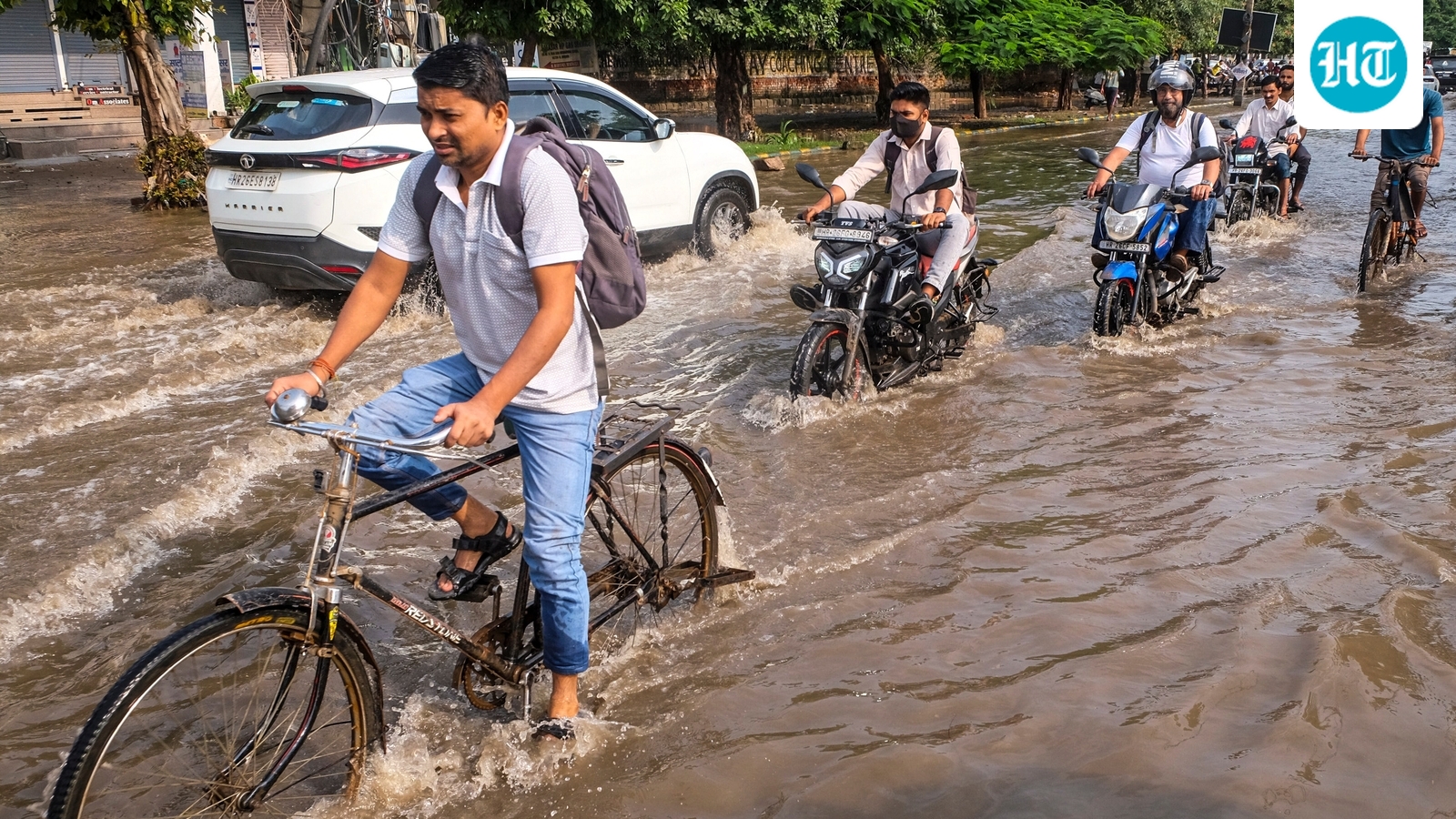
E-PaperSubscribeSubscribeEnjoy unlimited accessSubscribe Now! Get features like India’s monsoon is weakening at a point in the season when it should be at its most productive. The India Meteorological Department (IMD) said below-normal rainfall is expected across the country for at least the next two weeks — through September 2 — and the all-India deficit, already at 14% below the long-period average as of Saturday, will grow further as the monsoon trough stays pinned to the Himalayan foothills rather than sweeping across central India. Commuters wade through a waterlogged road following heavy rain, in Gurugram, Haryana, Saturday, Aug. 22, 2026. (PTI)The prediction was part of IMD’s extended range forecast dated August 20 and it now adds to growing worry over this year’s winter crop that has been sown over recent weeks. Despite some weather systems developing, rainfall is expected to remain below normal across the country in both weeks of the forecast window, the agency said. Also Read | Vast swathes of farmlands still short of rain despite late spells Heavy to very heavy rain is more likely along the Himalayan belt and in parts of northeast and east India, but subdued conditions are expected to persist over Peninsular India for the coming week. A low-pressure area is likely to form over the north Bay of Bengal off the West Bengal–Bangladesh coasts within 24 hours, and is expected to bring heavy to very heavy rainfall over Odisha and Chhattisgarh until August 26. The monsoon trough’s position is the immediate problem. “This will reduce rainfall over the rest of the country as it will be centred only around the Himalayan belt and northeast India,” said Navdeep Dahiya, an independent weather expert, adding the trough is expected to stay in the foothills for at least a week. The trough’s failure to dip southward into central India — where it typically drives the heaviest and most agriculturally significant rainfall during August — means the regions that most need rain are the least likely to receive it. Also Read | Skymet raises drought risk, cuts monsoon forecast to 85% of LPA as El Nino gains On Monday, private forecaster Skymet Weather dramatically its revised seasonal forecast: monsoon rainfall is now expected at just 85% of LPA, down from its own April projection of 94%, with a 70% probability of drought. “Skymet foresees a 70% chance of drought and expects the seasonal rainfall to be 85% of the Long Period Average (LPA),” the forecaster said. Skymet warned that the remaining weeks of August would bring inequitable distribution across the country’s four homogeneous rainfall regions, with a strengthening El Niño and a weak Indian Ocean Dipole — which in a positive phase can partially offset El Niño’s suppressive effect on monsoon moisture, but is currently failing to do so — expected to deepen the deficit further in September. The deficit is already distributed unevenly. East and northeast India carry the sharpest shortfall at 26% below LPA. The south Peninsula is 23% behind. Northwest India stands at 11% below normal, while central India — which saw a recovery from low-pressure-system-driven rainfall earlier in the season — is the closest to par at just 3% below. Skymet’s revision marks one of the sharpest mid-season downgrades in recent years — a 9-percentage-point drop from its April forecast. IMD’s own trajectory has followed the same direction, though less steeply: the agency’s April forecast of 92% of LPA was revised to 90% in June. IMD has not issued a further revision since, but the current deficit trend — and the extended range forecast showing no relief through early September — suggests the 90% figure may itself be overtaken. Also Read | Kharif crops' productivity at risk as monsoon trough shifts, widespread regional variations Experts said the consequences for Indian agriculture are becoming starker. “2026 monsoon has been erratic in crucial rain fed regions of MP, Maharashtra, Karnataka, Rajasthan and Gujarat. We are running a deficit of around 14% and the outlook due to strengthening of El Nino and below par rainfall in balance days of August can increase the monsoon deficit to upwards of 15%. The crops specially tur in pulses, soyabean and maize which are grown in rain fed regions need special attention, monitoring and yield assessment,” said Garima Jain, chief executive officer of agri business at Torq Commodities India. “The erratic monsoon and further shortage can push food inflation higher in the coming days and situation gets accentuated by the global supply chain situation specially non supply of cargoes from Russian Ukraine creating logistics bottlenecks. The good supply chain in light of deteriorating monsoon should be top priority of the govt,” added Jain. The El Niño driving this season’s underperformance continues to intensify. Britain’s Met Office said on Friday the event is on track to become the most powerful in over a century, with sea-surface temperatures in the Pacific expected to exceed 3°C above normal — a level that could push 2027 past 2024 as the hottest year on record globally. Jasjeev Gandhiok is an Assistant Editor with Hindustan Times, where he covers environment, climate change, the clean energy transition and wildlife at the National Bureau. Gandhiok has over a decade of experience in journalism and is based in Delhi. He has reported extensively on Delhi and the National Capital Region (NCR). This includes the region's air pollution woes, a polluted Yamuna and on urban wildlife still thriving in the region. He joined HT in October 2021. Prior to that, he had five-year stint at The Times of India in Delhi, where he also covered Delhi, with a focus on environment and wildlife. Gandhiok has covered some recent events around the Capital too, ranging from the farmers' protests, the northeast Delhi riots and the CAA-NRC protests, reporting from the ground on all of these. He also travels across the country to report on how environment and climate change impact everyday life, while also writing on endangered species. His reports in 2019 on toxic leachate from Delhi's landfills led to the National Green Tribunal (NGT) taking suo motu cognisance and ultimately asking the state government to start bio-mining to flatten and remove all three landfills in the capital. He also closely tracks the implementation of government policies on climate, renewable energy and environmental protection. His focus remains on impactful, public-interest journalism which explains how environmental decisions affect people's everyday lives.Read More
المصدر: Hindustan Times
| Source: Hindustan Times
ملاحظة تحريرية | Editorial Note:
نُشر هذا المقال في الأصل بواسطة Hindustan Times.
خبر (Khabr) هي منصة إعلامية أردنية مرخّصة تعمل بالذكاء الاصطناعي.
نضيف قيمة تحريرية من خلال: تحليل ذكي للأخبار، ملخصات تلقائية، رواية صوتية بالذكاء الاصطناعي، ترجمة متعددة اللغات، وتدقيق الحقائق.
هدفنا جعل الأخبار أكثر وضوحاً وسهولةً للقارئ العربي.
This article was originally published by Hindustan Times.
Khabr is a licensed Jordanian AI-powered news platform (Registration #82086).
We add editorial value through: AI-powered news analysis, automated summaries, AI audio narration, multi-language translation (Arabic, English, French, Turkish), and AI fact-checking.
Our mission is to make news more accessible and understandable for Arabic-speaking audiences worldwide.