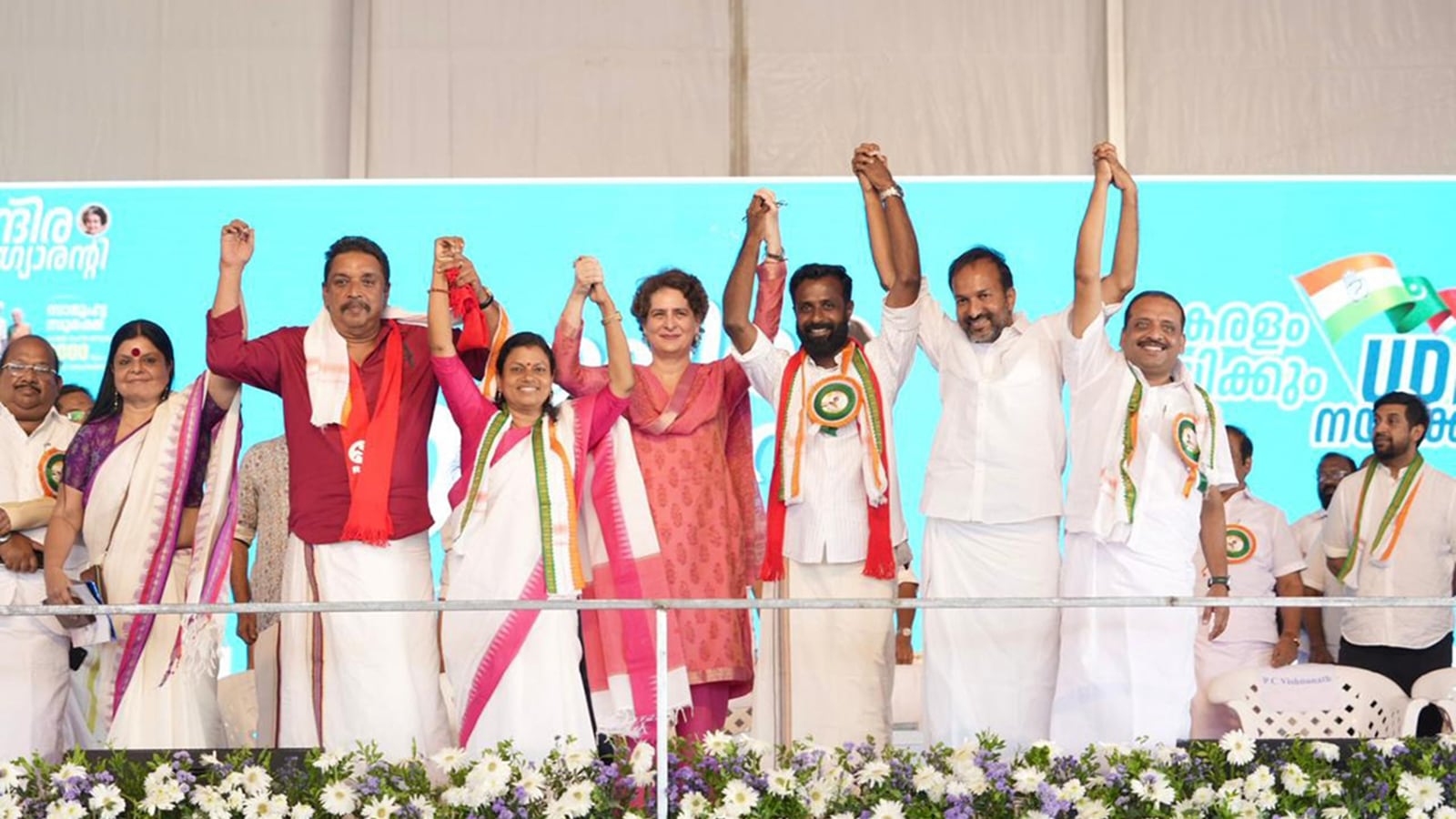
Weather ePaper Today’s Paper Journalism of Courage Home ePaper Politics Explained Opinion India Business Premium Cities UPSC Entertainment Sports World Lifestyle Tech Subscribe Sign In TrendingUPSC OfferIPL 2026US NewsPuzzles & GamesLegal NewsFresh TakeHealthResearch🎙️ Podcast Advertisement function checkAndLoadWindowSizeScript() { if (window.jQuery) { // jQuery is loaded, include your script jQuery(document).ready(function($) { // Your existing script for checking window width if (window.innerWidth) var page_w = window.innerWidth; else if (document.all) var page_w = document.body.clientWidth; if (page_w > 1024) { $(".add-left, .add-right").show(); } else { $(".add-left, .add-right").hide(); } }); } else { // jQuery is not loaded, check again after 0.2 seconds setTimeout(checkAndLoadWindowSizeScript, 200); } } // Initial call to the function checkAndLoadWindowSizeScript(); NewsPolitical PulseIn poll-bound states, parties slow to field women candidates In poll-bound states, parties slow to field women candidates Data from recent elections held after the women’s quota law was passed in 2023 shows modest gains in women nominees, with large gaps persisting. Written by: Anjishnu Das, Lalmani Verma6 min readLucknow, New DelhiApr 20, 2026 10:00 AM IST Priyanka Gandhi Vadra (centre) campaigns in Kerala. Congress fielded fewer female candidates in the state compared to 2021. (File Photo) Make us preferred source on Google Whatsapp twitter Facebook Reddit PRINT Even as the Lok Sabha rejected Bills to fast-track women’s reservation, an analysis of elections held since the quota law was passed in 2023 shows only a handful of parties significantly increased women candidates. In poll-bound states, most parties have made only marginal gains when it comes to fielding women in Assembly elections. In Assam, Kerala, West Bengal, Tamil Nadu and the Union Territory of Puducherry, most parties only marginally increased the number of women candidates, while there are five cases of parties reducing the number of women nominees. In Bengal, the Congress has fielded 35 women, up from just seven in 2021. The party is contesting all 294 seats this year, whereas it had contested just 92 seats in 2021 in alliance with the CPI(M) and the Indian Secular Front. This means the share of women among the party’s total candidates has risen from 7.6% to 11.9%. The TMC has roughly maintained the number of women candidates, going from 48 out of 290 in 2021 (16.55%) to 52 out of 291 (17.86%) this year. The BJP, however, has fielded five fewer women, dropping from 38 to 33. In Tamil Nadu, both the ruling DMK and the Opposition AIADMK have fielded 19 women in 176 and 172 seats, respectively. While the AIADMK has roughly maintained its 2021 level of fielding 17 women, the DMK has fielded six more women than in 2021. As a share of candidates, the two parties are even at 11%. In Kerala, the BJP and the Congress fielded fewer women than five years ago, while the Left’s CPI(M) and CPI saw marginal increases compared to 2021. However, with the BJP contesting fewer seats this time, the share of women candidates has risen from 13.9% to 14.3%, while the Congress has seen a decline from 10.8% to 9.9%. The CPI(M), which is contesting the lion’s share of the Left’s seats, also recorded a marginal increase in the share of women candidates, from 14.7% to 15.6%. In Assam, while the Congress fielded 13 women, up from 9 in 2021, the BJP gave tickets to 6 women, down from 7 in 2021. As a proportion, women made up 13.3% of the Congress’s candidates and 6.7% of the BJP’s nominees. An analysis of the Assembly elections held before and after the quota Bill was passed in September 2023 — it was notified on Thursday — shows that the legislation had a limited impact in pushing parties to field more women candidates. After the Bill was passed, there were just six instances of parties fielding more than 20% women candidates, topped by the Congress in the Sikkim Assembly polls in 2024. Four of its 12 candidates, or 33.3%, were women. Later that year, in Jharkhand, 3 of the All Jharkhand Students Union Party’s (AJSU Party) 10 candidates were women, putting their share at 30%. The only other parties to field more than 20% women candidates were Odisha’s Biju Janata Dal or BJD (23.8%) in 2024, the Congress in Jharkhand in 2024 (23.3%), Kerala’s CPI (20.8%) in the ongoing elections, and the Congress in Chhattisgarh’s 2023 polls (20%). In the previous elections in all these states, none of these parties had fielded more than 20% women candidates. A comparison of Assembly polls held before and after the passage of the women’s quota law in 2023 shows that there were 38 instances of parties increasing the proportion of women candidates and 24 instances of declines in the proportion of women candidates. However, among the states and parties that saw increases in the share of women candidates, only 10 registered an increase of at least 5 percentage points. The biggest proportional increase was recorded by the Congress in Sikkim at 16.7%, but the absolute number of women candidates remained unchanged at four. Between the 2019 and 2024 Sikkim Assembly polls, the party went from contesting 24 seats to 12, thus increasing the share of women candidates. The most notable among the parties that saw at least a 10 percentage point increase in the proportion of women candidates is the BJD in Odisha, which contested 146 seats in 2019 and all 147 in 2024, and increased the number of women candidates from 20 to 30. Among the major national parties, the BJP’s highest proportion of women candidates came in Jharkhand (17.6%) and Chhattisgarh (16.7%) — both in polls held after the 2023 passage of the women’s quota law. Before the law was passed, the BJP’s highest share of women candidates was in Chhattisgarh and Mizoram in 2018 at 15.6% and 15.4%, respectively. While the BJP recorded its highest increase in the share of women candidates in Jharkhand (8.8 percentage points) between 2019 and 2024, the biggest decline came in Andhra Pradesh (7.5 percentage points), where it contested just 10 seats in 2024 (down from 173 in the previous polls) and fielded no women. The BJP also fielded no women candidates in the Puducherry polls this month and in 2021. The Congress, on the other hand, besides recording among the highest post-quota proportions of women candidates in Sikkim, Jharkhand, and Chhattisgarh, also fielded 15.8% women candidates in Arunachal Pradesh in 2024. Before the 2023 quota Bill was passed, the Congress’s highest proportion of women candidates was 19.4% in Jharkhand in 2019, 16.7% in Sikkim in 2019, and 15.2% in Delhi the following year. While Sikkim recorded the highest proportional increase in women candidates in Sikkim, the biggest declines came in Puducherry, Andhra Pradesh, and Delhi. In states where parties launched cash transfer programmes for women either as pre-poll schemes or manifesto promises, the number of women candidates generally saw an increase. For instance, in the 2023 Madhya Pradesh, 2024 Maharashtra, and 2025 Bihar Assembly polls, most parties raised the number of women candidates compared to the previous elections, even if the increase was marginal in some cases. Notably, though, the Nitish Kumar-led JD(U) in Bihar actually reduced the proportion of women candidates despite its campaign being heavily centred on direct benefit transfer schemes for women. Lalmani is an Assistant Editor with The Indian Express, and is based in New Delhi. He covers politics of the Hindi Heartland, tracking BJP, Samajwadi Party, BSP, RLD and other parties based in UP, Bihar and Uttarakhand. Covered the Lok Sabha elections of 2014, 2019 and 2024; Assembly polls of 2012, 2017 and 2022 in UP along with government affairs in UP and Uttarakhand. ... Read More
المصدر: Indian Express
| Source: Indian Express