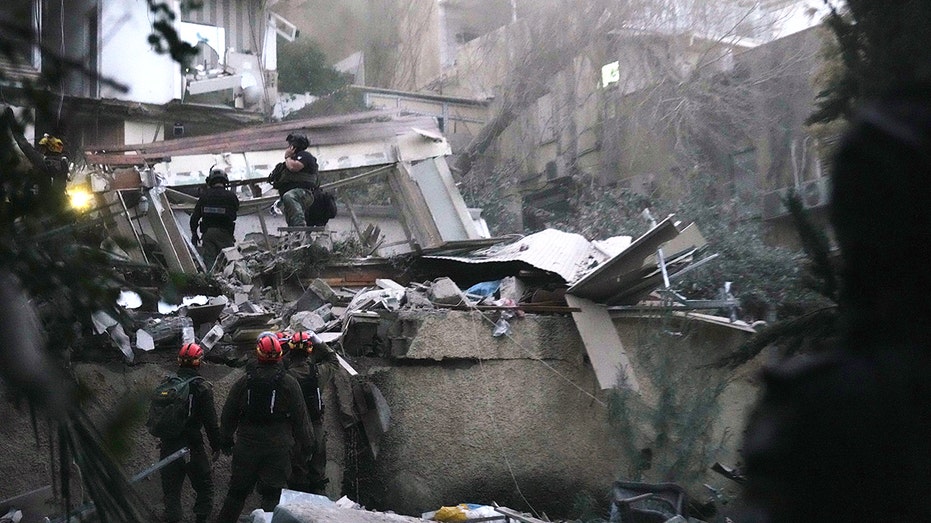
I have just 90 seconds to get to safety from another deadly attack. This is our normal
•There is a version of my life that exists between sirens.In the city where I live, you have about a minute and a half to reach shelter when a siren sounds.
•It is a number that embeds itself into your life and starts to shape everything around it.
•You do not think about it all the time, but it is always there, sitting in the background of everything you do.You begin to measure your life by how fast you can reach safety.
هذا الخبر من Fox News. خبر يقدم أدوات ذكاء اصطناعي للتلخيص والترجمة والاستماع.
المصدر: Fox News | Source: Fox NewsThere is a version of my life that exists between sirens.
In the city where I live, you have about a minute and a half to reach shelter when a siren sounds. It is a number that embeds itself into your life and starts to shape everything around it. You do not think about it all the time, but it is always there, sitting in the background of everything you do.
You begin to measure your life by how fast you can reach safety. How far am I from shelter, who is with me, whether I can get there in time, whether they can. Then the questions become more specific, harder to ignore. If a siren sounds, do I help my mother, who walks with a crutch, my dog, terrified and shaking, or my 3-year-old niece?
When the siren sounds, there is no pause for interpretation. The body moves before the mind catches up. You gather what you can and run. Only afterward does the awareness arrive, delayed and slightly disjointed.
And then, just as quickly, you return.
That is the part that is hardest to explain.
You go back upstairs, reopen your laptop, and continue the sentence you left unfinished. You answer messages, adjust what was interrupted and tell people that everything is fine. Sometimes you even laugh it off, because that is what you have learned to do.
Life resumes with a kind of efficiency that is almost unsettling.
IRAN REGIME HIDES IN BUNKERS AS CIVILIANS LEFT EXPOSED WITHOUT ADEQUATE BOMB SHELTERS OR SIRENS
This is what we call normal.
But it is not normal. Nor should it be. It is normalization.
A week ago, I woke up to the smell of smoke drifting through my window. I turned on the television, watched the footage and asked my dad, "Isn’t it our street?"
After weeks, or maybe years, of living like this, you learn to distinguish between the sound of an interception and the sound of a fall. We knew what we had heard. I just did not expect it to be that close.
IDF UNCOVERS HEZBOLLAH WEAPONS STASH INSIDE HOSPITAL IN LEBANON
At first, I went back to bed.
Then the smell grew stronger, and I realized something had landed in the street behind my bedroom window. Not a direct hit, just a fragment, a jagged piece of metal that did not belong there, resting among things that did: a child’s ball, a red slide, a lemon tree, a wooden fence.
For a moment, I stood there trying to place it within the logic of a normal morning. I took a picture and sent it to a few people.
"We’re OK," I wrote, because that is what you do. You move on.
From the outside, this is often described as resilience. A society that continues, people who adapt, life that goes on despite everything. And it is true. Life does go on. Cafes are open, people go to work, conversations continue. There is movement, routine, even laughter.
From a distance, it can look almost intact.
But that is also what makes it so easy to misunderstand.
Wars are discussed in abstractions, in strategy and deterrence, in escalation and regional balance, in economic cost and political consequence, in language that makes them almost sound structured and contained.
US WOMEN'S BASKETBALL PLAYER SPEAKS OUT ON BEING TRAPPED IN ISRAEL DURING IRANIAN COUNTERSTRIKE
But that is not how it is lived.
That language rarely captures what it means to structure a life around interruption, to move through the world with the awareness that everything can stop and start again without warning. And yet, that is where its cost accumulates, not only in what is lost, but in what is slowly redefined.
After more than two years of war, this life begins to feel both familiar and exhausting. You grow accustomed to it even as it wears you down. There is a quiet discipline to it, a way of moving through the world that begins to feel routine.
And still, with each pause in escalation, there is the same instinctive hope. That this will be the last time. That this will be the moment after which things settle. But that hope exists alongside a quieter understanding that it probably will not.
For people my age, life is supposed to move forward in measurable ways. Years are meant to accumulate into something continuous. A degree is meant to take three or four years. You are supposed to start building something, to fall in love, to begin a life that feels like it is finally taking shape.
Instead, time never quite gets to move forward.
I have yet to complete a single academic year without it being interrupted by war. What should have been a straight line has instead been broken apart, repeatedly. Time was spent not building a life but responding to one that keeps being disrupted. Now, what was supposed to be the final year unfolds once more under sirens, in and out of shelters, shaped by that same uncertainty.
And yet, from the outside, it still looks like continuity. Over time, your expectations shift. You stop asking whether this is normal. You start asking whether it is manageable. You build your life around that question.
From the outside, that can look like strength. If everything continues, then how abnormal can it really be?
But abnormality is not always visible in what stops.
CLICK HERE FOR MORE FOX NEWS OPINION
Sometimes it is visible in what continues, in the fact that a life can absorb this much disruption and still appear intact.
There is a version of my life that does not include this calculation. It is not extraordinary. It is simply uninterrupted, a life measured in plans, not contingencies, in years, not ninety seconds.
That life still exists.
But the distance between it and the one I am living now is about a minute and a half.
ملاحظة تحريرية | Editorial Note: نُشر هذا المقال في الأصل بواسطة Fox News. خبر (Khabr) هي منصة إعلامية أردنية مرخّصة تعمل بالذكاء الاصطناعي. نضيف قيمة تحريرية من خلال: تحليل ذكي للأخبار، ملخصات تلقائية، رواية صوتية بالذكاء الاصطناعي، ترجمة متعددة اللغات، وتدقيق الحقائق. هدفنا جعل الأخبار أكثر وضوحاً وسهولةً للقارئ العربي.
This article was originally published by Fox News. Khabr is a licensed Jordanian AI-powered news platform (Registration #82086). We add editorial value through: AI-powered news analysis, automated summaries, AI audio narration, multi-language translation (Arabic, English, French, Turkish), and AI fact-checking. Our mission is to make news more accessible and understandable for Arabic-speaking audiences worldwide.