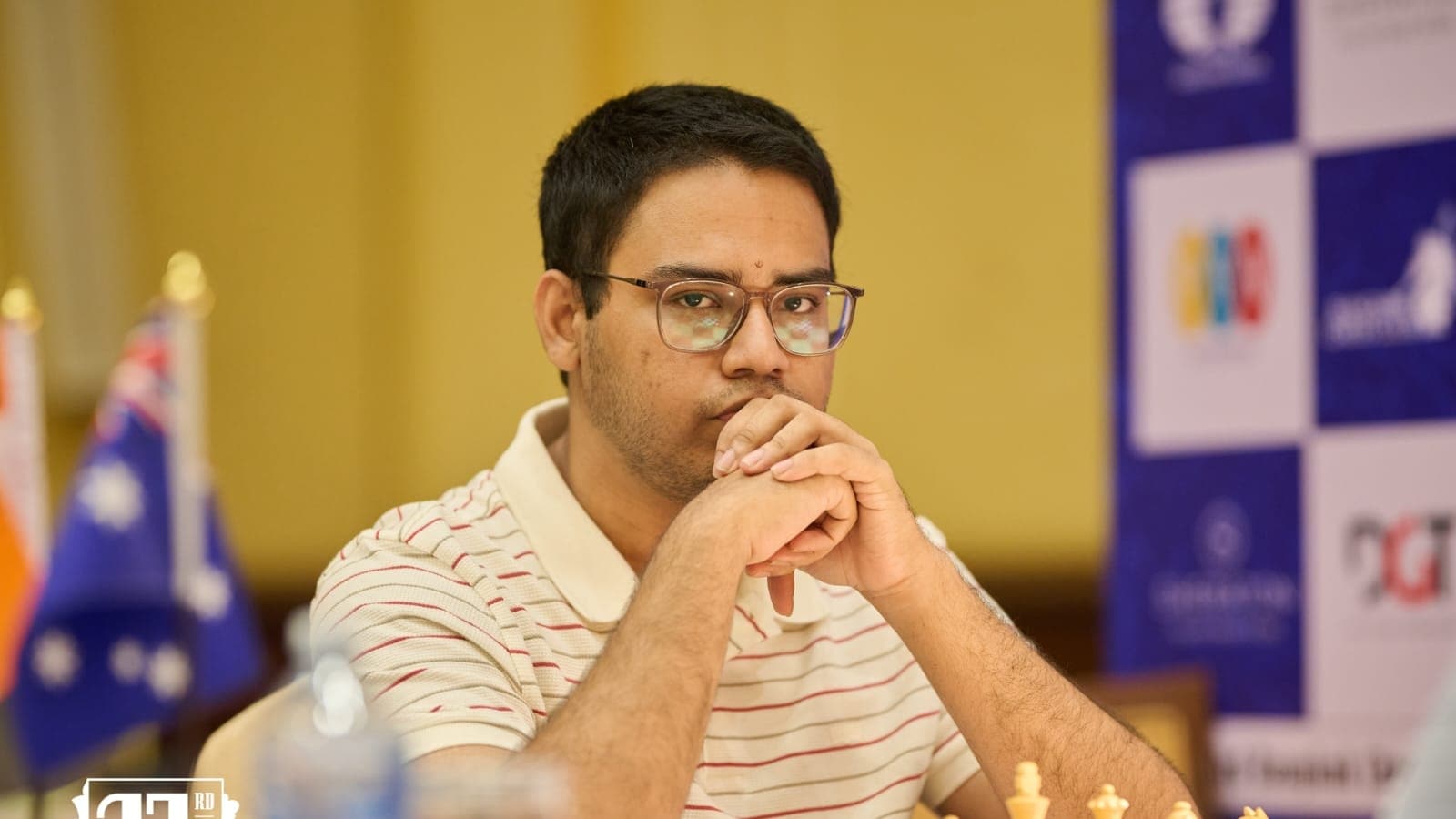
Weather ePaper Today’s Paper Journalism of Courage Home ePaper Politics Explained Opinion India Business Premium Cities UPSC Entertainment Sports World Lifestyle Tech Subscribe Sign In TrendingCricketIPL 2026Live ScoreIPL 2026 Points Table Advertisement function checkAndLoadWindowSizeScript() { if (window.jQuery) { // jQuery is loaded, include your script jQuery(document).ready(function($) { // Your existing script for checking window width if (window.innerWidth) var page_w = window.innerWidth; else if (document.all) var page_w = document.body.clientWidth; if (page_w > 1024) { $(".add-left, .add-right").show(); } else { $(".add-left, .add-right").hide(); } }); } else { // jQuery is not loaded, check again after 0.2 seconds setTimeout(checkAndLoadWindowSizeScript, 200); } } // Initial call to the function checkAndLoadWindowSizeScript(); NewsSportsChessHow much does it cost for one to become a chess Grandmaster? How much does it cost for one to become a chess Grandmaster? The thinking that chess is a cheap sport is a misconception, with families of prodigies like Aronyak Ghosh and Mayank Chakraborty spending close to 50 lakh to nourish their dream Written by: Amit Kamath7 min readApr 22, 2026 08:00 AM IST India's newly-minted grandmaster Aronyak Ghosh playing at the Bangkok Chess Club Open, where he earned his third and final GM norm. Make us preferred source on Google Whatsapp twitter Facebook Reddit PRINT Mrinal Ghosh does some quick mental math before he arrives at a jaw-dropping estimate: his family has spent about Rs 46 lakh over the past decade and a half to sustain his son Aronyak’s chess career. Just to make him a grandmaster. Then he drops the real headline statement that Rs 46 lakh is probably the least anyone in India has spent in the pursuit of becoming a GM. For a middle-class family in Kolkata, raising even this amount has meant sacrifices. Of Mrinal’s ancestral property. Of his wife Sanchita’s wedding jewellery. And Aronyak’s own prize money won at events, every penny of which is invested back into his career. All of those sacrifices finally saw Aronyak become India’s 95th grandmaster earlier this week. There is a misconception that chess is a cheap sport. No expensive equipment or accoutrements needed, after all. No need to employ sports science teams either. No need to book stadiums or courts to train in. But Aronyak’s rise to grandmaster status has shone a light like never before on the financial burden of the pursuit to become a grandmaster. “Parents should be prepared with at least Rs 70 lakh (from the start of the chess career to becoming a GM) if one plans to get their kid to be a GM,” says Monomita Chakraborty, the mother of Mayank Chakraborty, India’s 94th grandmaster. These are just costs incurred in getting a player to the grandmaster level. To get better from there, the costs multiply rapidly. In fact, many people in the sport will tell you that Aronyak and Mayank got to the GM level really cheap. Sample this: 12-year-old Aarav Sarbalia’s father Yatin estimates that they spent Rs 25-30 lakh just in 2025 to fuel his dream in the sport. Currently, Aarav is a FIDE Master, which is two rungs below the grandmaster level. “We spent at least four months of last year abroad playing in tournaments. We were hoping to land some sponsors who would help us bear the burden, but when none came, we started to make content on Instagram, hoping that it would eventually lead to monetisation opportunities,” says Yatin. It’s a practice that has caught on in Indian chess in the past 15 years: young stars travelling abroad collecting norms or ratings. Around 2015-16, this became common among players rated above 2100. But since COVID, players flying abroad chasing norms has become so commonplace that even players in the 1700-1800 ratings bracket are doing it. “Players take around six-eight trips to play in European tournaments in a year these days to gain norms. That costs Rs 15-20 lakh, including touring and coaching. This figure pretty much doubles when it’s a player chasing GM norms,” says Sreekar Chennapragada, whose MGD1 not only organises tournaments but also manages players like Arjun Erigaisi. ALSO READ | India’s chess prodigies chase norms, rating points and dreams, one budget trip to Europe at a time Realising that there was a real gap in tournaments in India where GM norms could be easily achieved, organisations like Pravaha Foundation and Chola Chess are now organising GM-norm tournaments in the country. Constrained by funds, players like Mayank and Aronyak have played plenty of their events in India, but GMs norms are usually gained abroad. What Yatin said about the lack of sponsorship is a common refrain in chess. Everyone from Mrinal to Monomita voices their frustrations with attracting sponsors, despite their kids’ talent being obvious. Monomita also points out that until a few years ago, Sports Authority of India would give one-time incentives for IMs and GMs for getting the titles, which is gone now. If chess players don’t spend on excessive equipment, and don’t usually need sports science professionals, where do they spend all the money? It’s spent on the metaphorical village it takes to raise a prodigy. It starts with the coaches. Like most other sports, elite players in chess also transition into coaching, many times without actually retiring from playing themselves. But in chess, unlike in other sports, training costs are calculated on an hourly basis. And an hour of a GM’s time as a coach can go anywhere from Rs 10,000 to Rs 20,000. A coach for a grandmaster to compete at the highest level (events like Candidates) are even higher. Mrinal says that many times coaches have contracts that stipulate a minimum number of hours that the player has to work with them, rather than just a one-off, hour-long session. Yatin points at the flip side: since top coaches are always in high demand, sometimes you cannot even get them for more than an hour, so you end up working with multiple coaches, which again means higher expenditure. Then, there are training partners — elite players one can hire on an hourly basis to play training games against. A rising star like Aarav can enter tournaments but can only pray to be paired with a top grandmaster. Which means, if they want to sharpen their skills on a regular basis, the surest way would be to hire a training partner, who will also charge eye-watering fees for an hour’s worth of playing training games. Then there are seconds – good chess players who act as aides to other chess players, helping them with opening preparation, among other things. Sometimes, seconds or coaches sign contracts with players stipulating a percentage of the prize money they earn in tournaments. “The players who are above 2600 rating (when a player becomes a GM, their rating is usually around 2500), they spend at least around Rs 4-5 lakh per month on the sport,” is Mrinal’s estimate. He is quick to add that once you become a grandmaster, you get “conditions”: tournament organisers will take care of your accommodation, occasionally even flights. But until you get there, it’s all paid for by parents. In the case of players like Mayank, such trips demand creative thinking to bring costs under control. “We stay in very basic cheap apartments in Europe, share apartments, with a common washroom at times. These are usually far from the centre of the town,” says Monomita, before pointing out that costs rise if you play in Nordic countries. “We also carry food from home wherever we can.” With both their sons newly-minted grandmasters, both Mrinal and Monomita are now calculating what it will take for them to rise higher. “Where my son is standing at the moment — a rating in the 2550 bracket — just to go up to 2650 will cost so much money that I don’t even dare dream about it,” says Mrinal. Amit Kamath is Assistant Editor at The Indian Express and is based in Mumbai. He primarily writes on chess and Olympic sports, and co-hosts the Game Time podcast, a weekly offering from Express Sports. He also writes a weekly chess column, On The Moves. ... Read More
المصدر: Indian Express
| Source: Indian Express
ملاحظة تحريرية | Editorial Note:
نُشر هذا المقال في الأصل بواسطة Indian Express.
خبر (Khabr) هي منصة إعلامية أردنية مرخّصة تعمل بالذكاء الاصطناعي.
نضيف قيمة تحريرية من خلال: تحليل ذكي للأخبار، ملخصات تلقائية، رواية صوتية بالذكاء الاصطناعي، ترجمة متعددة اللغات، وتدقيق الحقائق.
هدفنا جعل الأخبار أكثر وضوحاً وسهولةً للقارئ العربي.
This article was originally published by Indian Express.
Khabr is a licensed Jordanian AI-powered news platform (Registration #82086).
We add editorial value through: AI-powered news analysis, automated summaries, AI audio narration, multi-language translation (Arabic, English, French, Turkish), and AI fact-checking.
Our mission is to make news more accessible and understandable for Arabic-speaking audiences worldwide.