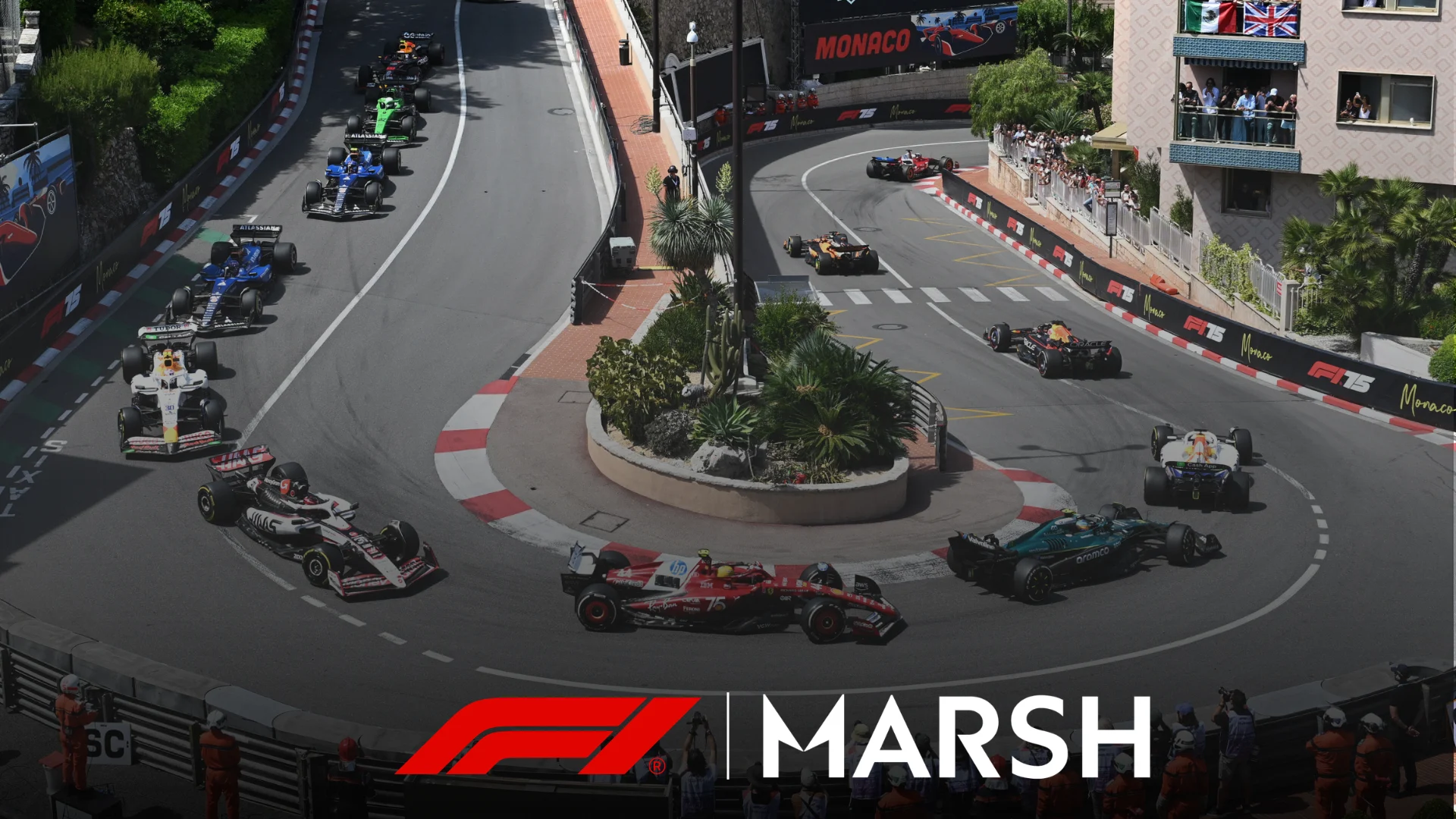
(opens in a new tab)Sign InSubscribeF1ScheduleChevron DropdownPrevious 2026 SeasonDriver Standings Team StandingsArchive 1950-2025F1 AwardsNewsChevron DropdownWhat is F1? What is F1 TV?F1 GlossaryGet involved2026 RegulationsNewsVideosHow F1 drivers and strategists tackle the Monaco Grand PrixEA SPORTS launches F1 25 2026 Season PackJean Alesi looks back on his one and only F1 win from 1995AudioUnlockedOur writers pick their favourite McLaren F1 momentsPlay4:53Insider Intel: F1 car x Road car? Ask Sam Collins 0:182026 Canadian Grand Prix: Perez forced to retire after suspension failure Alexander AlbonFernando AlonsoKimi AntonelliOliver BearmanGabriel BortoletoValtteri BottasFranco ColapintoPierre GaslyIsack HadjarLewis HamiltonNico HulkenbergLiam LawsonCharles LeclercArvid LindbladLando NorrisEsteban OconSergio PerezOscar PiastriGeorge RussellCarlos SainzLance StrollMax VerstappenAll Drivers Hall of FameTeamsChevron DropdownAlpineAston MartinAudiCadillacFerrariHaas F1 TeamMcLarenMercedesRacing BullsRed Bull RacingWilliamsAll TeamsFantasy & GamingChevron DropdownF1 Sim RacingFantasyF1 25F1 Manager 24F1 PredictF1 ClashF1 Members' AreaMenuFIA if(window.f1MobileDetection.iOSSafari) { var meta = document.createElement("meta"); meta.name = "apple-itunes-app"; meta.content = "app-id=835022598, app-argument=https://www.formula1.com/en/latest/article/the-risk-perspective-how-f1-drivers-engineers-and-strategists-tackle-the-monaco-grand-prix.2GImf5MWJqGNRgUx7ZhNh8.2GImf5MWJqGNRgUx7ZhNh8"; document.head.appendChild(meta); } {"@context":"https://schema.org","@type":"NewsArticle","@id":"https://www.formula1.com/en/latest/article/the-risk-perspective-how-f1-drivers-engineers-and-strategists-tackle-the-monaco-grand-prix.2GImf5MWJqGNRgUx7ZhNh8","url":"https://www.formula1.com/en/latest/article/the-risk-perspective-how-f1-drivers-engineers-and-strategists-tackle-the-monaco-grand-prix.2GImf5MWJqGNRgUx7ZhNh8","mainEntityOfPage":"https://www.formula1.com/en/latest/article/the-risk-perspective-how-f1-drivers-engineers-and-strategists-tackle-the-monaco-grand-prix.2GImf5MWJqGNRgUx7ZhNh8","datePublished":"2026-06-03T15:22:52.675Z","dateModified":"2026-06-03T15:22:52.675Z","headline":"THE RISK PERSPECTIVE: How F1 drivers, engineers and strategists tackle the Monaco Grand Prix","author":"F1","description":"In Formula 1, performance is decided in moments where conditions change instantly, and decisions carry consequence. The difference isn’t just speed – it’s perspective.","image":{"@type":"ImageObject","url":"https://www.formula1.com/etc/designs/fom-website/social/f1-default-share.jpg"},"isAccessibleForFree":"true","publisher":{"@type":"SportsOrganization","@id":"https://www.formula1.com#organization","name":"Formula 1","logo":{"@type":"ImageObject","url":"https://www.formula1.com/etc/designs/fom-website/social/f1-default-share.jpg","width":"480","height":"120"}}}MonacoData2026THE RISK PERSPECTIVE: How F1 drivers, engineers and strategists tackle the Monaco Grand PrixIn Formula 1, performance is decided in moments where conditions change instantly, and decisions carry consequence. The difference isn’t just speed – it’s perspective. Formula 1 lives on its history, Monaco more than most circuits. It isn’t quite the track driven back in 1929, but there’s enough retained that the original field wouldn’t feel out of place on the modern circuit – and in many instances, the backdrops to pictures of Audis and Alpines hasn’t changed since it was Bugattis and Delages in the frame. But an old-school circuit brings with it a range of old-school issues that drivers, strategists and race engineers have to think their way around to write their own chapter in the chronicle of this most famous of races. Let’s take a look at how they might approach it in The Risk Perspective, in partnership with Marsh, Formula 1's Official Risk Partner and Official Insurance Brokering Partner. Dave Greenwood has many good Monaco recollections: he was part of winning Renault and Ferrari teams, but his fondest memories, however, are the two points scored by Jules Bianchi for Marussia, where he was chief engineer and then during his stint as Kimi Raikkonen’s race engineer at Ferrari, capturing pole position in 2017. Today, as Racing Director at Alpine, he has a watching brief on both race engineering and strategy for the Enstone-based squad. “Track position is key in Monaco, and that’s why we put a huge emphasis on Qualifying, with all of our running before the race primarily targeted at Qualifying,” he explains. “Clearly Monaco is a one-stop race. You could stop on Lap 1, fit the hard tyre and go to the end. The tyre life is very easy here. What tends to happen, rather than us looking at the deterministic solution, or even the sort of statistical probability-based approach, is a very tactical race.” “It isn’t impossible to overtake in Monaco, it’s just very, very difficult. So, what comes into play are other factors. If you have both cars running in close proximity, you can use team tactics to engineer a gap. And you’re always thinking about Safety Cars, and around the ability to have openness in your strategy to take advantage of those. “It’s a race, for instance, where you can quite often see the front-runners perhaps start on a harder tyre to go very, very long, creating a window to pit into without falling back into the midfield pack.” Alex Chan is formerly Valtteri Bottas’ race engineer, and is now Head of Race Engineering for Audi. Set-up in Monaco, he says, has some interesting areas of risk and reward, and all of the quirks a team might expect on a circuit that’s been in business since the 1920s. “The unique thing about Monaco this year is that it doesn’t have any Straight Mode zones: there is no active aero,” he says. “In previous years, we’d have seen everyone trying to put as much wing on the cars as they could. “We don’t really have that available for 2026 – but you will still see everyone trying to chuck on any extra downforce they do have available, because another thing to consider is, compared to the last four years of ground-effect cars, we have an overall lower level of downforce in 2026.” The trade-off in mechanical set-up is the usual one, albeit with perhaps a bigger premium on getting it right here, as Alex explains. “Typically, when talking about stiffnesses and going softer with the set-up, we’re trying to improve the ride of the car at the expense of potentially going away from our aerodynamic optimum. This is one of the trickiest things to get right in F1, full-stop. “Monaco with all the low-speed content, you would think ride is more important – but Monaco has high-speed too: up the hill at Massenet into the Casino, Tabac, the whole Swimming Pool complex – so we still need to find the right trade between high and low speed. The Swimming Pool is one of the key sections of the track the drivers need to get right“It’s not necessarily the case that a stiffer car is going to be a faster car: drivers go quicker with more laps, but they also go quicker with a better set-up and, for me, a fast car is also an easy car to drive. Driver confidence absolutely brings a lap-time gain.” Finally, while set-up in Monaco tends to focus on Qualifying, teams can’t simply ignore the race. And one factor on the narrow, twisting streets of the Principality is the ubiquity of cars forming into trains. Following disrupts airflow, which the cars need for cooling. This also creates a dilemma. “The two main areas of the car that need cooling are the power unit and the brakes. Monaco is tricky for the brakes. It doesn’t have the big, heavy high-torque events you get at other circuits, but it also doesn’t have the straights between the braking events you need to cool things back down. This makes it a tricky place to manage temperatures, even without the traffic, which makes it a further step more difficult. “Opening up the cooling on the car comes at the cost of some downforce. How much you do this is a risk-assessment thing: how much management are you prepared to allow yourself in the race, at the cost or gain of some extra downforce? We are heavily biased in favour of Qualifying performance in Monaco – but you still need to make sure you can get to the end of the race!” Alex Albon recorded an excellent eighth position on his Monaco debut for Toro Rosso in 2019, and has finished ninth in his most recent two races in the Principality with Williams. With the 2026 cars, the Circuit de Monaco, he believes, is the track most likely to produce a race analogous to what we’ve seen in recent years. “I think with the layout of the track, this is one of the most similar, in terms of driving the car, to last year,” he says. “I think, if anything, it may be better, because the cars are smaller. I’d hope to see a bit of difference in the racing as a result of that.” A criticism of Qualifying in the early rounds of 2026 was that the cars in some situations were sacrificing speed at end-of-straight to recharge. That’s changed a little now, with a lower recharge limit for Qualifying – but Alex argues the new realities of 2026 haven’t particularly affected the amount of risk a driver will be willing to take around a Qualifying lap of Monaco. “We’re pushing flat out,” he says. “Our risk level is the same as last year, but the ways we achieve lap time is different. You’re still trying to go as quickly as you can in the corners, with slight differences in how you get a lap time. You’re still pushing pretty hard!” While Monaco is the slowest track on the F1 calendar, to a trackside audience, it feels like the fastest – and nowhere is this more evident than in the Swimming Pool. Screaming along the quayside, the entry is left-right, followed by a right-left exit. Straight-lining the twin chicanes as much as possible makes this a case of threading the needle, slipping between the left and right barriers on entry, and then between the inside barrier and outside kerb on exit. It can go wrong in the race – Mick Schumacher spectacularly snapped his Haas in half during the 2022 event after losing control in the middle of the section – but it’s a flat-out fully-committed lap in Qualifying, or a Quali sim, that usually leads to trouble, particularly at the exit. There is more than a hint of bravado in the assertion that the way to be fast in Monaco is to rub the stickers off the tyres – ie get close enough to the walls to scuff the sidewalls – and teams will frequently be checking the corners of the car after the driver reports kissing the barriers, with the Swimming Pool exit one of the prime spots. Go a fraction too far and a kiss turns into a blow – Charles Leclerc, already on provisional pole, snapped a track rod here in 2021, and ploughed into the exit wall, eventually meaning he was unable to start the race and P1 on the grid went empty. Leclerc berated himself – but he’s in good company. Max Verstappen in 2018 and Carlos Sainz in 2023 had carbon copy accidents. Realistically, this is always going to be an incredibly subjective judgement, and it feels ridiculous to not plumb for Ayrton Senna’s inch-perfect defence in ’92, or Stirling Moss in ’61, driving an underpowered customer Lotus, or Danny Ricciardo defending for his life in a crippled 2018 Red Bull, or, or, or… but we’re going for the third of Graham Hill’s five Monaco victories, and the one that earned him the nickname ‘Mr Monaco’: the 1965 Monaco Grand Prix. Ayrton Senna scored a fine victory in 1992 after a staunch defence from Nigel MansellThings started very well for Hill. He took pole position for BRM and led away at the start, holding the position until Lap 25, when he went off. Bob Anderson with a broken Brabham was limping back to the pits when Hill came across him at the Chicane du Port. Flat-out and unsighted, Hill had little choice but to take the escape lane. He then jumped out of the car and pushed it back down the onto the track, hopped back in and continued, now running P5. He soon had company when team mate Jackie Stewart spun at Sainte Devote, and the Scottish rookie let his team-leader through – but Hill had half a minute to make up to the leading pack of double World Champion Jack Brabham and the Ferrari pair of Lorenzo Bandini and reigning World Champion John Surtees. Brabham retired from the lead, removing one obstacle, but Hill was able to get back on the Ferraris over 20 relentless laps. He passes Surtees for P2 at Mirabeau on Lap 53, and set off after Bandini, pulling the same move on Lap 65. Monaco back in the day ran the full distance of 100 laps. There was still plenty of time for drama, with Paul Hawkins spinning his Lotus into the harbour (thankfully surfacing unhurt) but Hill underlined his superiority by building up a lead of over a minute by the flag. Mr Monaco would win his eponymous race twice more, but 1965 was his greatest triumph. 30 years ago, Olivier Panis crossed the line to take a remarkable Monaco Grand Prix victory. It was his only F1 win, and the last hurrah for the Ligier team. Starting P14, he’s the only driver to have won in Monaco from outside the top 10 starting positions. A combination of factors contributed to Panis’ unlikely victory. A wet race was highly attritional, Panis was robust in his overtaking, and able to pass cars when no-one else could, but he also timed the one strategic decision he needed to take absolutely perfectly. Panis had a poor Qualifying session, afflicted by a misfiring Mugen-Honda V10, but in Sunday morning warm-up he was the quickest car on track. Rain started to fall, and race organisers authorised an extra warm-up to allow drivers to get used to the conditions. It didn’t help, with six drivers – including Michael Schumacher – out on the first lap. Panis gained two spots, up to P12, then passed Martin Brundle on Lap 7, Mika Häkkinen on Lap 16 and Johnny Herbert on Lap 25. With Gerhard Berger having also retired and Heinz-Harold Frentzen making a pit-stop for a new front wing, Panis was running P7 when a dry line started to appear. No-one particularly wants to be the canary in the cage by making the first stop, but Frentzen, a lap down, had little to lose and rolled the dice on Lap 26. The times on his out-lap were sufficiently good that, the next time around, on Lap 28, race leader Damon Hill, together with Eddie Irvine, Panis and Brundle all dived in. The rest of the field followed on Laps 29 and 30, but taking the risk and going early moved Panis up to P4. He moved up to P3 when Irvine spun; P2 when Hill had an engine failure, and the lead on Lap 60 when Jean Alesi suffered a suspension failure. The race didn’t go the full distance, ending at the two-hour mark, and only three cars made it to the flag. David Coulthard finished second, 4.8s behind Panis. When Panis pitted, the McLaren driver had been running in P4, three places ahead of the Frenchman. After his stop, on Lap 30, he came out behind… on such decisions are Monaco Grands Prix won and lost… The Risk Perspective is brought to you in association with Marsh, Formula 1’s Official Risk Partner and Official Insurance Brokering Partner. F1FacebookXInstagramYouTube© 2003-2026 Formula One World Championship Limited
المصدر: Formula 1 - فورمولا 1
| Source: Formula 1 - فورمولا 1