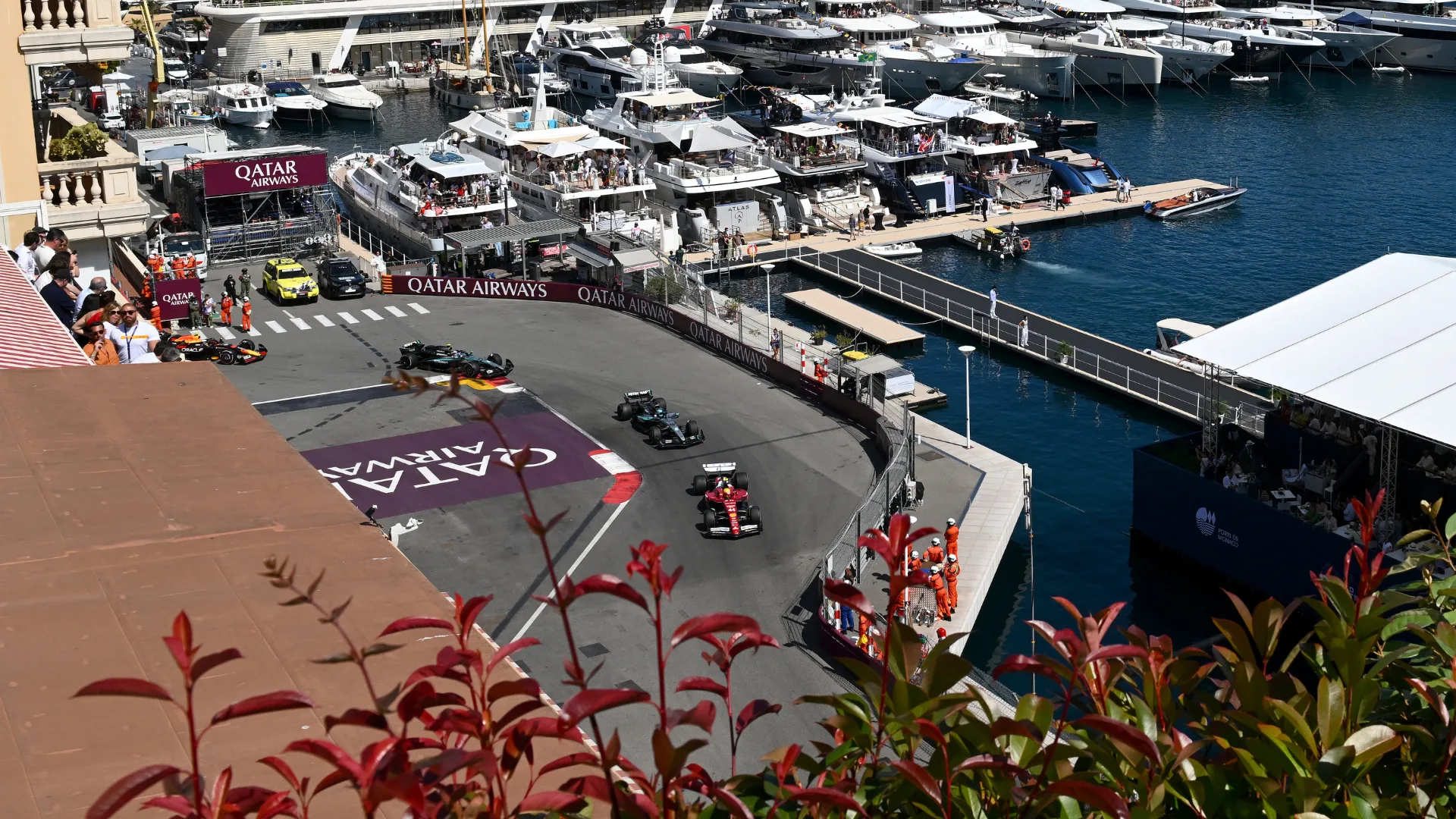
(opens in a new tab)Sign InSubscribeF1ScheduleChevron DropdownPrevious 2026 SeasonDriver Standings Team StandingsArchive 1950-2025F1 AwardsNewsChevron DropdownWhat is F1? What is F1 TV?F1 GlossaryGet involved2026 RegulationsNewsVideosHow every Monaco corner got its nameFacts, stats and trivia ahead of the 2026 Monaco GPEverything you need to know about the Circuit de MonacoWhy Active Aero will not be used at the Monaco Grand PrixPlay1:17Track View: Onboard with Lando Norris around Monaco 4:53Insider Intel: F1 car x Road car? Ask Sam Collins Alexander AlbonFernando AlonsoKimi AntonelliOliver BearmanGabriel BortoletoValtteri BottasFranco ColapintoPierre GaslyIsack HadjarLewis HamiltonNico HulkenbergLiam LawsonCharles LeclercArvid LindbladLando NorrisEsteban OconSergio PerezOscar PiastriGeorge RussellCarlos SainzLance StrollMax VerstappenAll Drivers Hall of FameTeamsChevron DropdownAlpineAston MartinAudiCadillacFerrariHaas F1 TeamMcLarenMercedesRacing BullsRed Bull RacingWilliamsAll TeamsFantasy & GamingChevron DropdownF1 Sim RacingFantasyF1 25F1 Manager 24F1 PredictF1 ClashF1 Members' AreaMenuFIA if(window.f1MobileDetection.iOSSafari) { var meta = document.createElement("meta"); meta.name = "apple-itunes-app"; meta.content = "app-id=835022598, app-argument=https://www.formula1.com/en/latest/article/explained-how-every-monaco-corner-got-its-name.5ClYqWmfpeUpsRJA6mDNaX.5ClYqWmfpeUpsRJA6mDNaX"; document.head.appendChild(meta); } {"@context":"https://schema.org","@type":"NewsArticle","@id":"https://www.formula1.com/en/latest/article/explained-how-every-monaco-corner-got-its-name.5ClYqWmfpeUpsRJA6mDNaX","url":"https://www.formula1.com/en/latest/article/explained-how-every-monaco-corner-got-its-name.5ClYqWmfpeUpsRJA6mDNaX","mainEntityOfPage":"https://www.formula1.com/en/latest/article/explained-how-every-monaco-corner-got-its-name.5ClYqWmfpeUpsRJA6mDNaX","datePublished":"2026-06-04T11:20:29.379Z","dateModified":"2026-06-04T11:20:29.379Z","headline":"EXPLAINED: How every Monaco Grand Prix corner got its name","author":"F1","description":"Have you ever wondered who Antony Noghès was, or what Beau Rivage actually means? F1.com explains how every corner at the Circuit de Monaco was named.\n","image":{"@type":"ImageObject","url":"https://media.formula1.com/image/upload/f_auto/q_auto/v1780571945/fom-website/2026/Monaco/16x9%20single%20image%20-%202026-06-04T121842.036.png"},"isAccessibleForFree":"true","publisher":{"@type":"SportsOrganization","@id":"https://www.formula1.com#organization","name":"Formula 1","logo":{"@type":"ImageObject","url":"https://www.formula1.com/etc/designs/fom-website/social/f1-default-share.jpg","width":"480","height":"120"}}}ExplainedMonaco2026EXPLAINED: How every Monaco corner got its nameHave you ever wondered who Antony Noghès was, or what Beau Rivage actually means? F1.com explains how every corner at the Circuit de Monaco was named. From Sainte Devote to the Swimming Pool, each of the 18 corners at the Monaco Grand Prix has a unique story behind it, contributing to the circuit’s iconic nature and incredibly rich history. You’ll hear commentators rave about drivers climbing Beau Rivage or exiting the Nouvelle Chicane, but where did all of these distinctive names come from? Here, we delve into the origins behind them… The run from pole position to the first corner is the shortest on the calendar, with less than 150m before drivers take on the tight right-hand turn that offers one of the best overtaking opportunities on the opening lap. Hidden behind the barriers and signs is a small chapel named for the patron saint of Monaco – Sainte Devote, a fourth century martyr – to which this corner is dedicated. It’s seen plenty of errors over the years, including Felipe Massa’s near-identical shunts in FP1 and the race back in 2013. After making their way through the chaos of Sainte Devote, drivers charge uphill to Beau Rivage, a longer stretch with a slight curve. The name translates to ‘beautiful coastline’ or 'shore' as the corner runs alongside the stunning Mediterranean Sea, although those in the cars are likely distracted by their approach to the blind crest of the hill. Next up is Massenet, a sweeping left-hander named for Jules Massenet, a French opera composer who is remembered by a statue that stands close by. Like many of the corners, it has seen its fair share of drivers being caught out by the track’s narrow width and crashing into the barriers, such as Lewis Hamilton in FP3 last season. Part of Monaco’s glamour comes from its casino culture, with one making an appearance as the drivers navigate Turn 4. Opened in 1865, the Casino de Monte Carlo stands tall at the side of the circuit and is one of the principality’s statement landmarks, giving the alluring plaza its name. While it’s one of the most spectacular backdrops in F1, drivers barely register the building or its fountains, instead focusing on the descent to the track’s next technical challenge. This kicks off a slow sequence of corners, but the reduced speeds don’t mean that the difficulty is any lower. Mirabeau Superior, like its partner turn Mirabeau Inferior, owes its name to the Mirabeau Hotel that used to stand to the right of Turn 7. It’s since been converted into an apartment block that has overlooked many incidents over the years – back in 2014, Nico Rosberg controversially drove straight down the escape road and brought out the yellow flags, preventing his Mercedes team mate Hamilton from challenging him for pole position. The hairpin is instantly recognisable, and its layout is aptly named for its resemblance to the U-shaped part of a hair accessory. It’s the slowest corner on the calendar, but the way it bunches up cars as they crawl around the tight left-hander always creates a spectacle. Originally called the Station Hairpin (unsurprisingly, there was formerly a train station there), it’s undergone more name changes since a hotel was built on the site and changed hands multiple times. Some may still remember it as the Loews or Grand Hotel Hairpin, but it’s now most commonly known as the Fairmont Hairpin. Drivers then snake their way down to the second turn named after the Mirabeau Hotel. Its ‘inferior’ moniker isn’t a reflection of its status, but simply implies that it’s at a lower elevation to its partner at Turn 5 – they’re sometimes known as Mirabeau Haute and Bas, which are French for ‘high’ and ‘low’. As the speed picks up again, the racers take a sharp right around Portier, which refers to Le Portier, a residential neighbourhood in Monaco. This corner has fantastic views of the harbour and offers the last flashes of sunlight before drivers charge into the tunnel, which Ayrton Senna famously cut short when he crashed into the wall in 1988. A day after delivering one of his finest Qualifying laps, the Brazilian was well on his way to victory with a commanding lead of 55s over his McLaren team mate Alain Prost, but a lapse in concentration saw him spin into the barriers and retire from the race. Turn 9 – The tunnel The tunnel – suitably named for the enclosed passageway – plunges drivers into what looks like darkness before their eyes readjust and they shoot through the gradual right-hand bend, testing their courage and ability to adapt to the aerodynamic differences. It was the location of a bizarre incident in 2004 when Michael Schumacher, leading behind the Safety Car, was hit by Juan Pablo Montoya and went into the guard rail, ruining his chances of equalling Senna’s record six wins in Monaco. As they emerge from the other side of the tunnel and find themselves blinded by daylight, they reach one of the best spots for overtaking. Previously named the Chicane du Port due to its position by the docks, it was modified and renamed Nouvelle – French for ‘new’ – in 1986. Spectators are most likely to see drivers lunge past each other here as they manoeuvre over the kerbs, but the heavy braking required has also prompted a multitude of crashes. Alberto Ascari and Paul Hawkins were the only drivers to completely misjudge it and end up in the water, which is practically impossible today thanks to the hefty barriers. Unlike the preceding Nouvelle Chicance, Tabac has barely changed throughout the decades of racing in Monaco and remains a tight and notoriously difficult turn. In contrast to its challenging nature, it was charmingly named after a tobacco shop that is nestled into the corner. Calling the Swimming Pool a corner is slightly misleading, given it’s actually two chicanes taken in quick succession. The original circuit layout included a direct run from Tabac to the final corner, but it was readjusted in 1973 to accommodate the Rainier III Nautical Stadium, which somewhat predictably included a swimming pool. More commonly known as Piscine in French, this section pushes the drivers’ accuracy to its limits as they come agonisingly close to kissing the barriers on either side of the track. Slightly less self-explanatory is La Rascasse. It follows a small bend coming out of the Swimming Pool section that is labelled on circuit maps as Turn 17 and doesn't have a nickname, making La Rascasse the 18th and penultimate corner in Monte Carlo. It’s a tribute to a bar located just over the barriers, which is itself named after a fish that lives in the Mediterranean, having originally been a hub for local fishermen. Now a more upmarket venue, it still welcomes customers and is a hospitality hotspot over race weekends. Those who were there in 2006 would have seen Schumacher start a scandal by parking up in the last minutes of Qualifying, blocking his rival Fernando Alonso from improving his time. Turn 19 – Antony Noghès Last but by no means least is Antony Noghès, fittingly named for the founder of the Monaco Grand Prix. He organised the very first race in the principality in 1929 and was a motorsport lover through and through, aiding in the creation of the Monte Carlo Rally and suggesting that all races should end with the waving of a chequered flag. Drivers fling their cars around this final turn and accelerate down the main straight, rounding out a lap of one of F1’s most important circuits. F1FacebookXInstagramYouTube© 2003-2026 Formula One World Championship Limited
المصدر: Formula 1 - فورمولا 1
| Source: Formula 1 - فورمولا 1