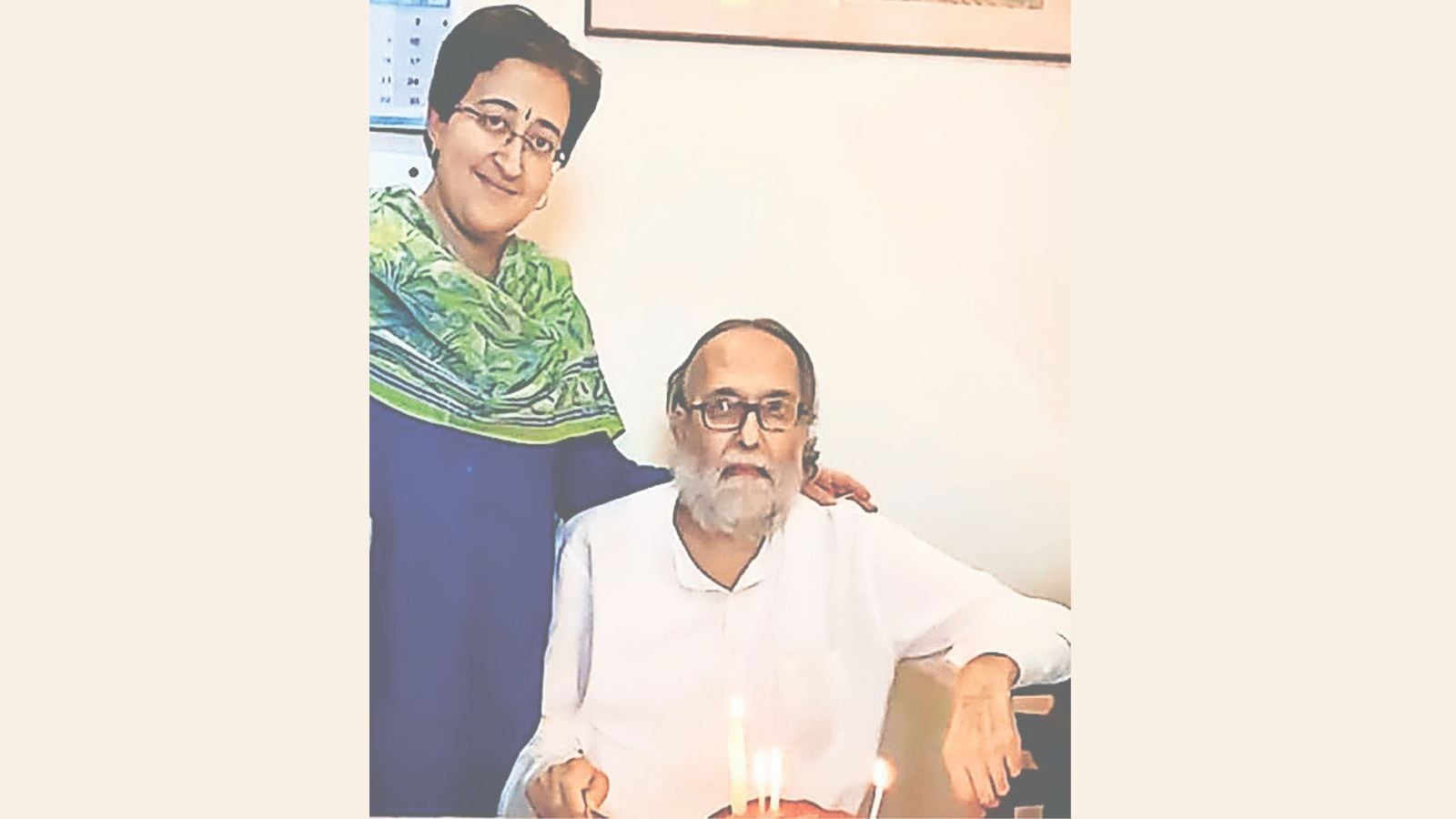
Weather ePaper Today’s Paper Journalism of Courage Home ePaper Politics Explained Opinion India Business Premium Cities UPSC Entertainment Sports World Lifestyle Tech Subscribe Sign In TrendingUPSC OfferIPL 2026US NewsPuzzles & GamesLegal NewsFresh TakeHealthResearch🎙️ Podcast Advertisement function checkAndLoadWindowSizeScript() { if (window.jQuery) { // jQuery is loaded, include your script jQuery(document).ready(function($) { // Your existing script for checking window width if (window.innerWidth) var page_w = window.innerWidth; else if (document.all) var page_w = document.body.clientWidth; if (page_w > 1024) { $(".add-left, .add-right").show(); } else { $(".add-left, .add-right").hide(); } }); } else { // jQuery is not loaded, check again after 0.2 seconds setTimeout(checkAndLoadWindowSizeScript, 200); } } // Initial call to the function checkAndLoadWindowSizeScript(); NewsCitiesDelhiHistorian Vijay Singh, who shaped DU classrooms and debates, passes away Historian Vijay Singh, who shaped DU classrooms and debates, passes away A longtime professor of history at DU's Satyawati College and the father of fomer Delhi Chief Minister Atishi, Singh died on Friday. He was around 80. Colleagues said he had been unwell in recent years. By: Express News Service5 min readNew DelhiApr 18, 2026 09:48 AM IST Professor Vijay Singh, father of Delhi's former CM Atishi, passes away. Make us preferred source on Google Whatsapp twitter Facebook Reddit PRINT In the 1990s, in the staff rooms and meeting halls of Delhi University (DU), where tempers often rose, Professor Vijay Singh never stopped arguing. But he never stopped listening as well. A longtime professor of history at DU’s Satyawati College and the father of fomer Delhi Chief Minister Atishi, Singh died on Friday. He was around 80. Colleagues said he had been unwell in recent years. For more than four decades in the classroom and beyond it, Singh built a reputation that is difficult to summarise in the conventional language of academic achievement. And yet, across DU, his influence endures in classrooms, in political conversations, and in the memory of those who argued with him over ideas. “He was a remarkable scholar and teacher, a person of great integrity,” said author and historian Mahesh Rangarajan, who first met Singh as a student in 1982. “He had very clear and strong views, but he never imposed them. You could argue any view with him; he would never hold it against you.” At Satyawati College, where Singh spent most of his career, he became known for being accessible at all times to his students and colleagues. He taught papers on interwar Europe and the rise of fascism, drawing on a deep command of Russian and Soviet history. But what students remembered was not only the breadth of his knowledge, but also his refusal to let knowledge become a barrier. “He took history to the last student in the class,” Rangarajan said. Students, including those less fluent in English or new to academic language, found in him a patient guide. He would sit with them through what he himself called “extremely naive questions”, explaining answers. “He treated you as a fellow student of history, whether you were in your first year or finishing a book,” Rangarajan recalled. Even colleagues who disagreed with him sharply found themselves drawn into that same intellectual generosity. “He was a hardcore Left person, a political activist,” said Pallavi Prasad, a faculty member at Satyawati College who joined in 2006 and taught alongside him. “But he did not let that interfere with his teaching. He was sincere about his work in college.” Singh’s classroom was only one part of his intellectual life. The other unfolded in the charged political culture of DU – in teachers’ associations, protest meetings, court corridors, and living-room discussions that stretched late into the evening. He was associated with a strand of Left politics that was often critical of dominant positions within the university. Along with his wife, Tripta Wahi, also an academic, he was part of networks that engaged with questions of gender justice, academic freedom, and state power. “They were very much in the thick of all the progressive movements in the university,” said Nandita Narain, who had known Singh since the early 1980s. Their home on the Hindu College campus where Wahi taught became a meeting point – for campaigns around sexual harassment, for discussions following the 2001 Parliament attack, and later, for debates around the trial and execution of Afzal Guru. Singh brought the same intensity to these spaces as he did to the classroom. But here, too, he was willing to engage. “He was very upfront about his views,” said Sanjaya Kumar Bohidar, a retired professor from Shri Ram College of Commerce, who knew Singh from the late 1980s. “That’s why there were a lot of disagreements… but that never affected our personal relationship.” Arguments were fierce. “When they went on, it felt like the end of the world,” Bohidar said. “But then we would sit together and talk normally.” For those who worked closely with him, Singh’s defining quality was not only intellectual openness but a certain stubborn courage, an insistence on speaking, even when the outcome seemed uncertain. “He was fearless,” Prasad said. “He could stand up in staff council meetings, in the academic council, and speak against the Vice-Chancellor. He was not calculative.” That conviction shaped his understanding of activism. “When I asked him if it was futile to keep protesting, he said: ‘whether you are able to change things or not is immaterial… what matters is that you raise questions’,” she recalled. Colleagues recall Singh’s ability to connect contemporary events to deep historical processes — to move from the Russia-Ukraine war to 19th-century geopolitics without losing the thread. “He had formidable knowledge,” Rangarajan said. At the same time, he carried his learning lightly. There was humour dry, often British in tone, shaped by his early years abroad and a sense of ease that dissolved hierarchies. “He had a very gentle demeanour, which went with strongly held opinions,” Rangarajan said. “He was a gentleman of the old school.” Singh’s influence also extended, quietly, into the institutional life of DU. In the late 1970s and early 1980s, he was part of a small group of teachers who pushed for changes in the history curriculum arguing for a broader engagement with European, medieval, and global histories. Some of those ideas eventually found their way into syllabi, shaping generations of students. “He had a very large informal circle,” Rangarajan said. Stay updated with the latest - Click here to follow us on Instagram
المصدر: Indian Express
| Source: Indian Express