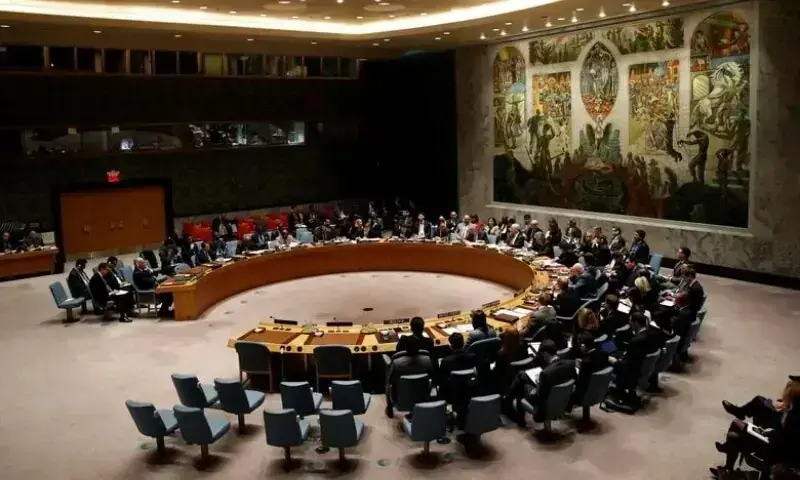
The secretary general of the Gulf Cooperation Council (GCC) on Thursday called for the UN Security Council to authorise the use of force to protect the Strait of Hormuz from Iranian attacks.
Iran has placed a stranglehold on the key shipping lane — threatening fuel supplies and buckling the global economy — in retaliation for US-Israeli strikes on the country that triggered the month-old Middle East war.
“Iran has closed the Strait of Hormuz, prevented commercial vessels and oil tankers from transiting, and imposed conditions on some to pass through the Strait,” said Jassem al-Budaiwi, head of the GCC.
He spoke in New York at the first Security Council meeting on cooperation with the GCC, which comprises Saudi Arabia, the United Arab Emirates, Bahrain, Qatar, Kuwait and Oman.
“We call upon the Security Council to assume its full responsibility and take all necessary measures to protect maritime routes and ensure the safe continuation of international navigation,” al-Budaiwi said.
Bahrain has proposed a draft resolution that would greenlight states to use “all necessary measures” to ensure free transit through the Strait of Hormuz. However, the measure has divided the 15-member Security Council.
According to diplomatic sources, Russia, China and France — who each hold veto privileges — have voiced strong objections despite several modifications to the text.
“We want a Security Council decision that addresses the situation comprehensively with the root causes, and not one-sided and unbalanced,” Anna Evstigneeva, deputy representative of Russia, said on Wednesday.
French President Emmanuel Macron has said that a military operation to free the Strait is “unrealistic”. A fifth version of the draft text was distributed to member states on Thursday.
Around a fifth of the world’s oil and liquefied natural gas passes through the Strait of Hormuz in peacetime.
Its near-total closure is impacting global supplies of important commodities, including oil, liquid natural gas, and fertiliser. That has led to a sharp rise in energy prices.