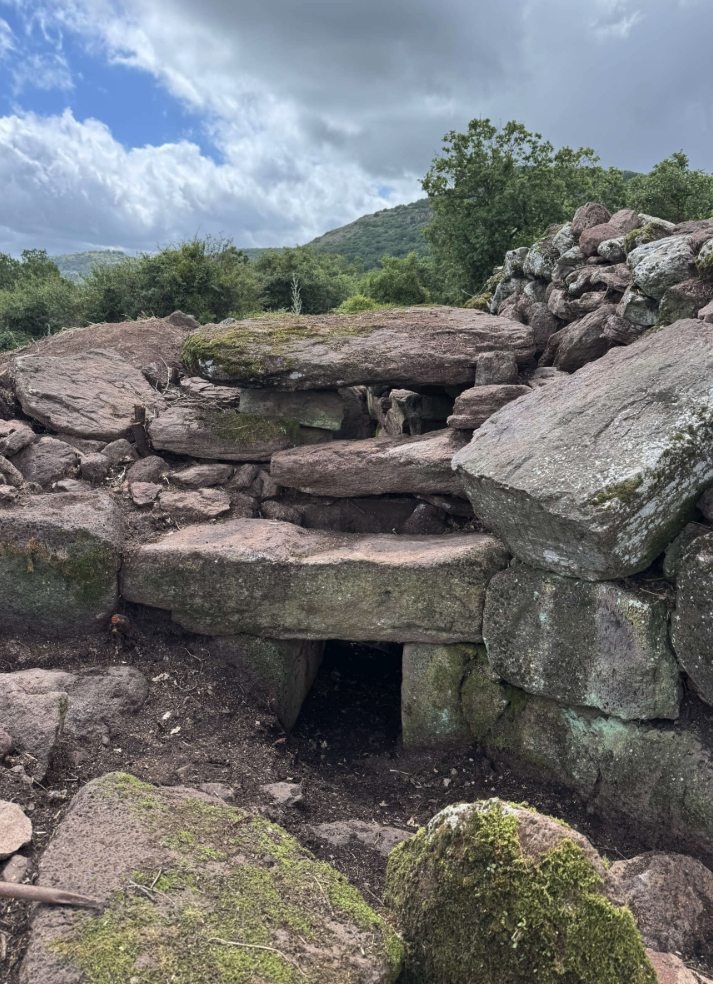
Archaeologists in Sardinia have uncovered a Tomb of the Giants at the Carrarzu Iddia site in the municipality of Bortigali, near the town of Macomer in the province of Nuoro.
The monument had been entirely concealed beneath dense vegetation for years before being identified during survey work.
The find was made by Sardinia's two Superintendences of Archaeology, Fine Arts, and Landscape, which had already been carrying out excavation and restoration at a nuraghe on the same site.
Once the tomb was located, the superintendences coordinated with local landowners to clear away the overgrowth and debris obscuring the structure.
Situated on the southern slope of Crastu Littu at roughly 740 metres above sea level, the site commands sweeping views across the Macomer plain, the Abbasanta and Paulilatino highlands, and as far as the Gulf of Oristano.
The funerary structure, built from trachyte blocks, has survived in what archaeologists describe as exceptional condition.
Both its burial chamber and the monumental semicircular exedra at the entrance, a hallmark of this distinctive Sardinian tomb type, remain clearly visible.
What has particularly intrigued researchers is an unusual internal arrangement near the entrance, where the burial chamber is split into two distinct levels.
This construction technique has seldom been recorded among known Tombs of the Giants, making it an especially noteworthy feature.

Its rarity means the layout will undergo further detailed study, potentially illuminating poorly understood aspects of Nuragic funerary customs and building methods.
Despite evidence of past illegal excavations, a problem that has plagued archaeological sites across the island, significant ceramic artefacts were still recovered from within the chamber.
These ceramic finds are particularly valuable because they document human activity stretching back to the very earliest phases of Nuragic civilisation, enabling researchers to establish a clearer chronology for the monument's use.
The tomb forms part of a far larger archaeological complex at Carrarzu Iddia.
The surrounding area contains two proto-Nuragic structures, a sacred well, a settlement, and an extensive burial ground that was already in use before the Nuragic period began.
LATEST DEVELOPMENTS
- Astronomers capture sharpest-ever picture of the Sun in 'major step forward' to understanding our universe
- Deadly volcano reawakens from decades of silence after killing 30,000 people in just minutes
- Archaeologists discover 'lost 2,000-year-old civilisation' that can be compared to ancient Greece

A dolmen at the site provides evidence of even older occupation, confirming that the area served funerary and ritual purposes long before Nuragic culture emerged.
Traces of human presence across the complex span an extraordinarily wide timeframe, from prehistory through to the Roman era.
Archaeologists say the landscape reveals a highly organised territorial system in which dwellings, places of worship and cemeteries were closely interlinked rather than existing as isolated monuments.
The Tombs of the Giants rank among the most iconic architectural achievements of Nuragic civilisation, with their origins generally traced to approximately 1,800BC, a time of deep social and cultural upheaval on the island.
Architecturally, they evolved from earlier dolmen structures, featuring substantially larger burial chambers designed for collective interment and introducing the curved exedra that became synonymous with Nuragic building traditions.
The exedra served not merely as a structural element but as a ceremonial space where communities gathered for rites of ancestor veneration, a practice central to Nuragic religious life.
The enlarged chambers likely reflect shifting social organisation and evolving attitudes towards death.
For scholars, the Carrarzu Iddia tomb presents a rare opportunity: its remarkable preservation, unusual two-tier layout, and recovered ceramics together promise fresh understanding of early Nuragic construction methods, burial practices, and chronology.
Our Standards: The GB News Editorial Charter