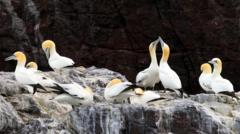
Gannet colonies could take 15 years to recover from bird flu
•Gannet colonies could take 15 years to recover from bird fluImage source, PA MediaImage caption, Gannets on Bass Rock were first exposed to H5N1 bird flu in 2022ByCraig HutchisonBBC Scotland NewsPubli...
•The researchers warned that as adult breeding birds drive population growth in colonies, the spike in deaths will have a long-term impact.They recommended that the global conservation status of Northe...
هذا الخبر من BBC News. خبر يقدم أدوات ذكاء اصطناعي للتلخيص والترجمة والاستماع.
Gannet colonies could take 15 years to recover from bird fluImage source, PA MediaImage caption, Gannets on Bass Rock were first exposed to H5N1 bird flu in 2022ByCraig HutchisonBBC Scotland NewsPublished10 minutes agoGannet populations at two of the world's largest colonies are not expected to recover from the impact of 2022's bird flu outbreak for almost two decades.A new study from the RSPB said seabirds on Bass Rock, off Scotland's east coast, and Grassholm, off the Pembrokeshire coast in Wales, had suffered an "unprecedented deadly blow" during the outbreak.It led to a fourfold increase in adult gannet deaths, resulting in a 26% decrease in the size of Bass Rock's colony and a 38% fall at Grassholm.While the outbreak was already known to have killed tens of thousands of birds, the study warned that the colonies would not fully recover from the impact until 2041 at the earliest.Image source, Getty ImagesImage caption, The 2022 bird flu outbreak led to a fourfold increase in adult gannet deathsThe H5N1 bird flu virus was first identified in poultry in Asia in 1996 before spreading to wild bird populations around the world.It was first confirmed in gannets at Bass Rock on 4 June 2022, and at Grassholm the following month. The researchers warned that as adult breeding birds drive population growth in colonies, the spike in deaths will have a long-term impact.They recommended that the global conservation status of Northern gannets - which is currently "least concern" on the IUCN Red List of threatened species - should be revised in light of the devastation the outbreak has caused.Image caption, Northern gannets use Bass Rock as a breeding colony during the summer monthsBass Rock is home to the world's largest colony of northern gannets and was recently bought by the conservation charity RSPB Scotland.The island, three miles off the coast of North Berwick, had been owned by the Hamilton-Dalrymple family for 320 years.Recen...المصدر: BBC News | Source: BBC News
ملاحظة تحريرية | Editorial Note: نُشر هذا المقال في الأصل بواسطة BBC News. خبر (Khabr) هي منصة إعلامية أردنية مرخّصة تعمل بالذكاء الاصطناعي. نضيف قيمة تحريرية من خلال: تحليل ذكي للأخبار، ملخصات تلقائية، رواية صوتية بالذكاء الاصطناعي، ترجمة متعددة اللغات، وتدقيق الحقائق. هدفنا جعل الأخبار أكثر وضوحاً وسهولةً للقارئ العربي.
This article was originally published by BBC News. Khabr is a licensed Jordanian AI-powered news platform (Registration #82086). We add editorial value through: AI-powered news analysis, automated summaries, AI audio narration, multi-language translation (Arabic, English, French, Turkish), and AI fact-checking. Our mission is to make news more accessible and understandable for Arabic-speaking audiences worldwide.