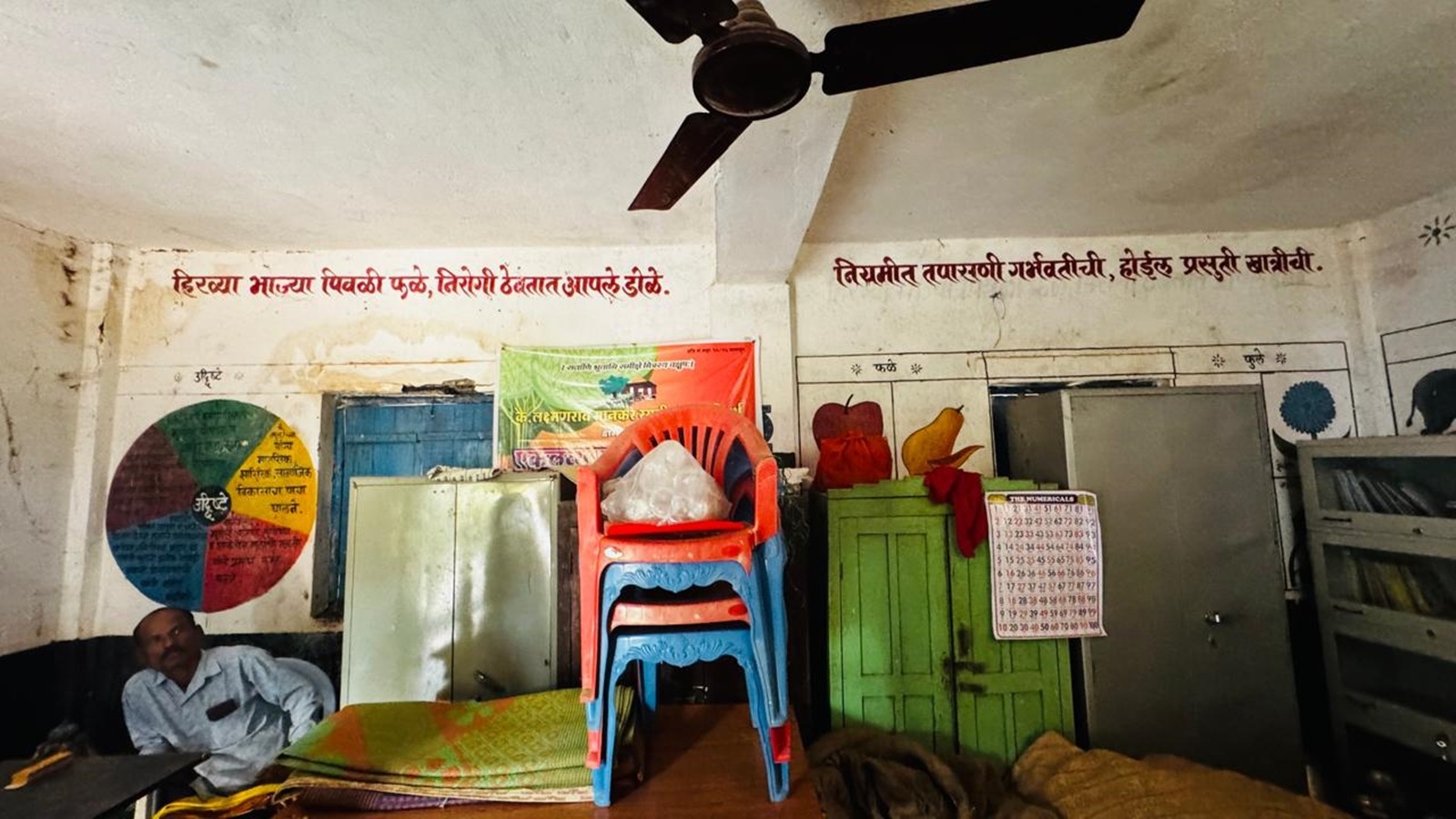
Weather ePaper Today’s Paper Journalism of Courage Home ePaper Politics Explained Opinion India Business Premium Cities UPSC Entertainment Sports World Lifestyle Tech Subscribe Sign In TrendingUPSC OfferIPL 2026US NewsPuzzles & GamesLegal NewsFresh TakeHealthResearch🎙️ Podcast Advertisement function checkAndLoadWindowSizeScript() { if (window.jQuery) { // jQuery is loaded, include your script jQuery(document).ready(function($) { // Your existing script for checking window width if (window.innerWidth) var page_w = window.innerWidth; else if (document.all) var page_w = document.body.clientWidth; if (page_w > 1024) { $(".add-left, .add-right").show(); } else { $(".add-left, .add-right").hide(); } }); } else { // jQuery is not loaded, check again after 0.2 seconds setTimeout(checkAndLoadWindowSizeScript, 200); } } // Initial call to the function checkAndLoadWindowSizeScript(); NewsCitiesMumbaiFrom abandoned govt buildings to open books: How Nagpur's villages are getting their own libraries From abandoned govt buildings to open books: How Nagpur’s villages are getting their own libraries A routine cleanup of old govt documents during a 100-day programme revealed abandoned buildings and gave Nagpur's Zilla Parishad an unexpected idea, one that has since put 100 libraries in villages that never had one Written by: Ankita Deshkar6 min readMumbaiApr 20, 2026 07:00 AM IST They were cleaning out old govt files. What they found instead became 100 libraries Make us preferred source on Google Whatsapp twitter Facebook Reddit PRINT Every day, 42-year-old Kirti Bhandarkar makes an unexpected detour on her way home. After a full day as an Anganwadi Sevika, and a 20-kilometre commute from Mahurzari village to Nagpur city, she doesn’t head back. Instead, she rides out to Fetri, a village on the outskirts of Nagpur, to spend a few quiet hours at the library. What she studies in was, until recently, a near abandoned dilapidated library, which was one of dozens that officials stumbled upon while doing something far more mundane — cleaning up old files. “The idea of making these libraries emerged during the government’s 100-day programme. One of the tasks was to organise old documents and ensure office cleanliness. During field visits, we noticed many unused structures, locked, abandoned buildings,” Nagpur Zilla Parishad CEO Vinayak Mahamuni told The Sunday Express. That chance discovery has since turned into 100 libraries across the Zilla Parishad jurisdiction. Each one a former Gram Panchayat office, community hall, Anganwadi centre or school building, now converted into a modern, equipped study space under the DREAM (Dedicated Room for Empowerment, Awareness and Motivation) Library project. Kirti is preparing for her internal examinations, a step towards becoming an Anganwadi supervisor. “I study here for around 3-4 hours after work and head back home in the evening. Studying at home is nearly impossible. We live in a joint family set up. Plus this library is equipped with basic facilities, books for all competitive examinations, wi-fi, computers, even coolers in this harsh summer. Studying here is pleasant,” she said. “We conducted a survey to identify how many such government properties existed. Buildings that were constructed but remained unused for various reasons. While government construction is usually quality-driven, older buildings often remain neglected. That’s when we started thinking about how to utilise these old structures. This idea began around April 2025,” Mahamuni said. In some cases, the renovation was straightforward. In others, it required more. “In Ramtek and Parseoni, the structures were in very poor condition, requiring repair costs of up to Rs 2.5 lakh and considerable time. But once repairs are completed, a library can be set up within 20 days,” he said. Not everyone was immediately on board. Kalpana Bhalawi, Sarpanch of Bandra village in Ramtek, said the building that now houses the library was once an old Anganwadi school that had fallen into disrepair. “It has been over one-and-a-half months since students started using the new library, but I did face some challenges initially. Earlier, villagers were not in favour of setting up a library. I had to hold multiple meetings to explain its importance,” she said. “Whether we like it or not, there is a clear gap in facilities available to children in cities and those in villages. If this library can help bridge that gap, then why not?” When The Indian Express visited the library in Lava village, located over 15 km from the city, shoes were neatly lined up on a rack outside. Inside, more than 15 students were immersed in preparation for competitive examinations. Walls were lined with bookshelves stocked according to students’ needs. Two computers had been set up, a smart TV mounted on the wall, and designated study compartments created for students. Ashwini Zodape (22) travels every day from Gondkhairi village, over 8 km away, carrying her tiffin, books, and a water bottle. “I am studying for the Maharashtra Police recruitment exam and other competitive examinations,” she said. “Officials have assured us that a similar library will be built in our village in coming few weeks. Until then, I will continue coming here.” Rajat Ramteke (24), who travels from Dabha, was also preparing for the Mahapolice Bharati examination. “I cannot study at home, the environment is just not right. Surrounded by books, studying here is easy. If needed, the books are also made available on special request.” At Fetri, the atmosphere was much the same — bookshelves, tables and chairs, students studying in silence, newspapers laid out on a table. Akshay Ajbade (24), a resident of Fetri, arrives every morning at 8 am. “I have been coming to this library for over 2.5 years now. The old facility was a bit shabby and didn’t have adequate lighting. The new one has Wi-Fi, computers, and even a smart TV. I usually go home for lunch and return to study here until 8 or 9 pm,” he said. Funds for the libraries have been mobilised through convergence, drawing from District Planning allocations, Zilla Parishad funds including cess fund, and the Tribal Sub-Plan (TSP/OTSP). In cases where repair costs exceed the Rs 7 lakh budget, particularly for severely dilapidated structures, the Gram Panchayat undertakes structural repairs, while the administration focuses on developing the interiors. NGO Sarvahitey has partnered as a knowledge contributor advising on design, layout, and book selection. “Right from design to selection of books in these libraries is governed by local needs. This helps us avoid a ‘one size fits all’ scenario. In Nagpur, we are aiming to create India’s largest ‘active rural library network’ in collaboration with ZP,” said Prem Prakash, Founder, Sarvahitey. Libraries can remain open 24/7, managed by a Village Library Committee of local representatives and youth. Each facility includes CCTV cameras, two internet-enabled computers, a smart TV, and basic amenities. “So far, 100 libraries have been completed in the jurisdiction, with plans to build 100 more,” said Mahamuni. “The model is easily replicable across the country as most villages have unused government buildings.” Ankita Deshkar is a Deputy Copy Editor and a dedicated fact-checker at The Indian Express. Based in Maharashtra, she specializes in bridging the gap between technical complexity and public understanding. With a deep focus on Cyber Law, Information Technology, and Public Safety, she leads "The Safe Side" series, where she deconstructs emerging digital threats and financial scams. Ankita is also a certified trainer for the Google News Initiative (GNI) India Training Network, specializing in online verification and the fight against misinformation. She is also an AI trainer with ADiRA (AI for Digital Readiness and Advancement) Professional Background & Expertise Role: Fact-checker & Deputy Copy Editor, The Indian Express Experience: Started working in 2016 Ankita brings a unique multidisciplinary background to her journalism, combining engineering logic with mass communication expertise. Her work often intersects regional governance, wildlife conservation, and digital rights, making her a leading voice on issues affecting Central India, particularly the Vidarbha region. Key focus areas include: Fact-Checking & Verification: As a GNI-certified trainer, she conducts workshops on debunking deepfakes, verifying viral claims, and using OSINT (Open Source Intelligence) tools. Cyber Law & IT: With postgraduate specialization in Cyber Law, she decodes the legalities of data privacy, digital fraud, and the evolving landscape of intellectual property rights. Public Safety & Health: Through her "The Safe Side" column, she provides actionable intelligence on avoiding "juice jacking," "e-SIM scams," and digital extortion. Regional Reporting: She provides on-ground coverage of high-stakes issues in Maharashtra, from Maoist surrenders in Gadchiroli to critical healthcare updates and wildlife-human conflict in Nagpur. Education & Credentials Ankita is currently pursuing her PhD in Mass Communication and Journalism, focusing on the non-verbal communication through Indian classical dance forms. Her academic foundation includes: MA in Mass Communication (RTM Nagpur University) Bachelors in Electrical Engineering (RTM Nagpur University) Post Graduate Diploma (PGTD) in Cyber Law and Information Technology Specialization in Intellectual Property Rights Recent Notable Coverage Ankita’s reportage is recognized for its investigative depth and emphasis on accountability: Cyber Security: "Lost money to a scam? Act within the 'golden hour' or risk losing it all" — A deep dive into the critical window for freezing fraudulent transactions. Public Health: "From deep coma to recovery: First fully recovered Coldrif patient discharged" — Investigating the aftermath of pharmaceutical toxins and the healthcare response. Governance & Conflict: "Gadchiroli now looks like any normal city: SP Neelotpal" — An analysis of the socio-political shift in Maoist-affected regions. Signature Beat Ankita is best known for her ability to translate "technical jargon into human stories." Whether she is explaining how AI tools like MahaCrimeOS assist the police or exposing the dire conditions of wildlife transit centres, her writing serves as a bridge between specialized knowledge and everyday safety. Contact & Follow X (Twitter): @ankita_deshkar Email: ankita.deshkar@indianexpress.com ... Read More Stay updated with the latest - Click here to follow us on Instagram
المصدر: Indian Express
| Source: Indian Express