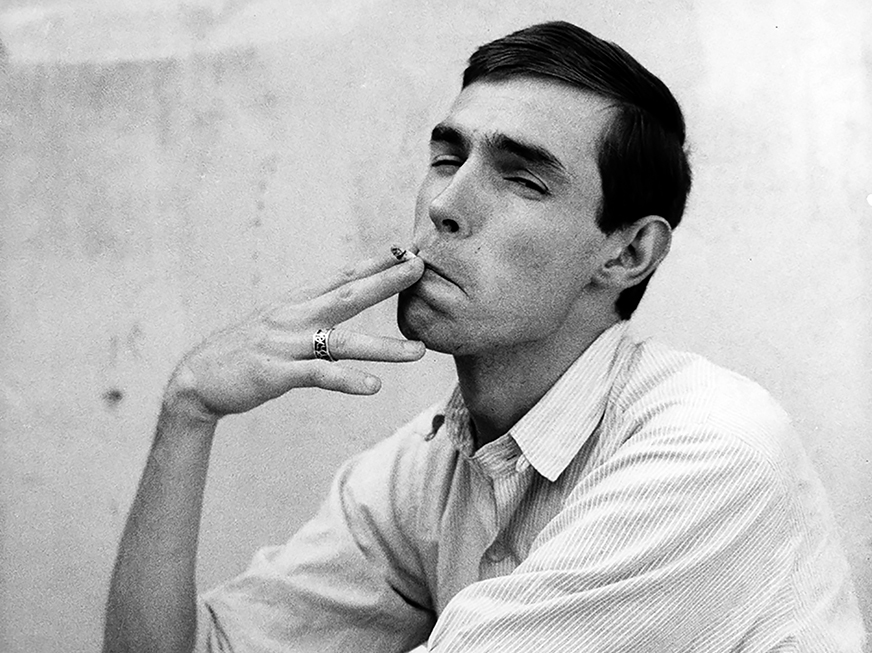
In the late summer of 1963, the photographer Peter Hujar and artist Paul Thek descended into the Capuchin Catacombs in Palermo. The two Americans had been in Italy for some time. Hujar was pursuing a course in filmmaking at Rome’s Centro Sperimentale di Cinematografia on a Fulbright scholarship, while Thek, courtesy of the gallerist Topazia Alliata, had been given use of an old tower in Sicily that August to finish paintings for an upcoming show. The pair were free from the distractions of Rome’s vibrant postwar scene where their circle included Cy Twombly, Federico Fellini and a string of beautiful Roman boys.
The walls of the underground chambers were lined with the remains of aristocrats, clergymen and merchants; toddlers were positioned in cots and cribs, and other corpses were still in their frocks and dresses. (All of the bodies preserved through dehydration and stuffed with straw and dried bay leaf.) Hujar ignored a sign forbidding photography, capturing the papery visages of the dead, as well as Thek, who was standing against a wall where a skull was hooked. Thek then opened one glass coffin and picked up what he thought was a piece of paper but turned out to be a dried thigh. Its “thingness” was oddly liberating; the notion that bodies could be used to decorate a room, he told the curator Gene Swenson, was a strange delight.
The visit, writes the critic Andrew Durbin in his mesmerising dual biography of Hujar and Thek, The Wonderful World That Almost Was, became a formative moment for the two men – lovers, friends, occasionally at loggerheads in the constellation of bright lights that composed New York’s 1960s art world – for whom death and mortality became defining features of their work. Many of the images from that day would form part of Hujar’s Portraits of Life and Death, its foreword written by Susan Sontag – herself a photographic subject of Hujar’s, and whose essay “Against Interpretation” was dedicated to Thek. Thek would go on to produce a series of “meat pieces” the following year: sculptures evoking flesh and bruised skin encased within glass vitrines and metal cages that shocked gallery-goers, and, iconically, a wax effigy of himself, The Tomb (1967).
Durbin’s Wonderful World is not, he writes, a “cradle to grave” story: Thek and Hujar are in their twenties when we first encounter them and in their forties when the book ends, in the summer of 1975, a two-decade-long period that charts the ascent of both artists, their entanglements, and the eventual rupture in their relationship. Durbin seeks to capture their lives before death, to resist the tendency to read the lives of artists who died of Aids “backward”, through the “tragic, twilight” lens of disease. The result is an exquisitely told, novelistic narrative, lifting two artists, underappreciated in life, out of the obscure depths of American art history.
Even in their multiple artistic engagements with death, their obsession with the corporeal and the fleeting, they were also consumed by its uncanny obverse: la petite mort, and the boundary-pushing possibilities of capturing, or evoking in their audiences, the life-giving forces of pleasure. “I do want some of my sexual pictures to be hot,” Hujar once said of his images depicting gay men, among them one of his most widely known portraits: Orgasmic Man (1969), a close-up of his subject mid-climax. The human body, Thek said on the occasion of his first “meat pieces” show, was the “hottest subject known to man”. During a 1966 group exhibition at the Museum of Modern Art in New York, in which a new sculpture from the collection was placed inside a Brillo box provided by Andy Warhol, Thek observed a woman masturbating in front of the sculpture, an image that would remain seared in his mind as evidence of the startling effect his work could have.
Despite their starry interlocutors – Sontag, Warhol, Linda Rosenkrantz, Fran Lebowitz, Richard Avedon – Thek and Hujar, Durbin argues, were constantly eluding mainstream recognition. Part of this neglect was due to factors beyond the pair’s control. Photography was yet to garner serious consideration as a fine art, a dismissal that frequently relegated Hujar to commercial work for fashion magazines that he found soulless and superficial. In her 1977 treatise On Photography, Sontag likened the photographer to a brute, portraiture to “rape” and photographing to a form of addiction in modern society that rendered individuals into Kodak and Hasselblad “junkies”. The book was painful reading for Hujar and his fellow image-makers, for whom Sontag was beginning to represent “the enemy”, Durbin writes.
On other occasions, Hujar and Thek’s unsung careers were the result of self-inflicted wounds – approaching dealers and gallerists with rage, a refusal to play the game with editors, critics, collectors and curators, all of whom represented a scene that was glib and empty. When introduced to Cecil Beaton, who complimented him on his reputation as a fine photographer, Hujar snidely replied, “I hear the same about you.” Thek’s large-scale installations, rooted in time and place and expensive to build and store, were harder to sell, a reality that fuelled his paranoia about dealers and gallerists who he believed were short-changing him. The children of the 1930s had escaped and transformed a conservative society only to find that the wheels of capitalism kept turning.

Reading Durbin on Hujar and Thek – forever on the fringes of the glittering centre – brought to mind Hamad Butt, recently hailed as “the YBA that the art world forgot”, whose work received its first major survey 30 years after the artist’s death from Aids-related complications. A retrospective of Hujar’s images, “Eyes Open in the Dark”, which opened in London and has just transferred to Bonn in Germany, was highly acclaimed by critics last year. Hujar is portrayed by Ben Whishaw in Peter Hujar’s Day, a 2025 film directed by Ira Sachs – while in 2024, New York’s Pace Gallery announced its representation of the estate of the “influential” and “elusive” Paul Thek, 14 years after a major retrospective at the Whitney Museum of American Art.
For artists who shared an anti-commercial streak, this recent renaissance may still have fulfilled a long-held hope. Hujar was a meticulous archivist, leaving behind 5,783 contact sheets and other ephemera at the Morgan Library in New York, of which Durbin has made extensive use in his research. Thek’s archive, similarly, is full of notebooks from the 1970s from which ample insights into the artist’s mind can be gleaned. “I want to be discussed in hushed tones,” Hujar once said.
Thek might not have had his eye on preservation and legacy in the same way. The beauty of his work, Durbin suggests, lay in its ephemeral nature: installations or “environments” that were works-in-progress when mounted and, in addition to his paintings and sculptures, often destroyed or lost as he pursued a relatively itinerant lifestyle in the 1960s and 1970s, between Europe and the United States.
Towards the end of the Sixties, he began suffering from what friends thought was a psychiatric disorder that manifested in dark moods and anxiety. An ongoing challenge was his attempt to reconcile his Christian faith – often present in his works – and his sexuality, hoping that someday he might marry a woman. Years abroad cemented his disappearance from the American art scene; he was seen as a relic, Durbin writes, of the hippie era. After his death, Sontag remarked that in the grand arc of American art history, he might only be remembered as a footnote.
Durbin’s discussions of Thek’s anti-Americanism are among the book’s most compelling sections. Viewed now, his works from the 1960s are remarkably prescient. The first meat sculptures, coming at a time before the scale of slaughter in Vietnam gained media attention, “warned of the violence lying beneath polite American society”, Durbin writes. The Tomb a few years later was a “burial chamber” for the Sixties, piercing through the decadence of the Summer of Love to draw attention to America’s hubris, the blood-soaked foundations of its empire and its actions abroad. New York was turning into a “heap of cement, asphalt and aluminium”. On the signing of the Paris Peace Accords in 1973, marking the end of direct American military involvement in Vietnam, Thek wrote, “This empire is crumbling fast even while the skyscrapers keep going up and the American experience makes me a bit sick, like blood in my mouth.” Camelot, and the pair’s joint scene, was well and truly over.
While overt political commentary might not have been present in Hujar’s work, his photos from the period seemed to gesture at the end of a moment too. A 1973 image of the Warhol superstar Candy Darling shows the actress in a hospital bed, after being diagnosed with lymphoma. Her face is made up; she is surrounded by white flowers. At her open-casket funeral some months later, Hujar snuck in a camera. A series of other hospital photographs captured friends in various stages of illness: Malcolm Morley, Sheyla Baykal, Jackie Curtis. After Curtis died from a heroin overdose in 1985, Hujar photographed her at her funeral, a mere two years before his own death following an Aids diagnosis. Sometime in the Seventies, Thek began keeping a notebook that would evolve into a novel of sorts, titled “The Wonderful World That Almost Was”. It is mainly addressed to Sontag, whom Thek hoped he would marry before she cut off contact at the end of the decade. It tells the story of his life across New York and Europe, as well as his religious reflections and other autobiographical writings. In a 1975 notebook, he referred to a “tremendous event” that was still on its way, “a world of promise, and hope, and better days,” Durbin writes.
Perhaps glimmers of this world had appeared in brief instances: in the New York of the 1950s, where Paul and Peter emerged into a new world, frequenting the San Remo Café where they could find Baldwin, Warhol, Vidal and Kerouac; summers of carefree pleasure on Fire Island and Nantucket, where life and art seemed to become one amorphous thing; down in the catacombs in Italy, where in death there seemed to be reminders of human existence’s stunning vitality and force.
Perhaps it ended when the two fell out in the mid-Seventies, a slow uncoupling years in the making. The last time they met, Hujar photographed Thek for Portraits of Life and Death, one final session. Depicting each other was an expression of love throughout their relationship. Hujar believed his images of others were, in fact, a kind of self-portrait. Hanging next to his coat rack long after they had parted ways was a painting that Thek had made of him in 1963 in Italy, a remnant of happier times. It is in these earlier moments of promise where Durbin’s story of the two men shimmers with the greatest intensity: when the dark shadows of the future are still at bay, and there is life yet to be lived.
MZ Adnan is a London-based journalist and writer
The Wonderful World That Almost Was: A Life of Peter Hujar and Paul Thek
Andrew Durbin
Granta, 496pp, £25
Purchasing a book may earn the NS a commission from Bookshop.org, who support independent bookshops
[Further reading: How Sylvia Plath dissected her pain]