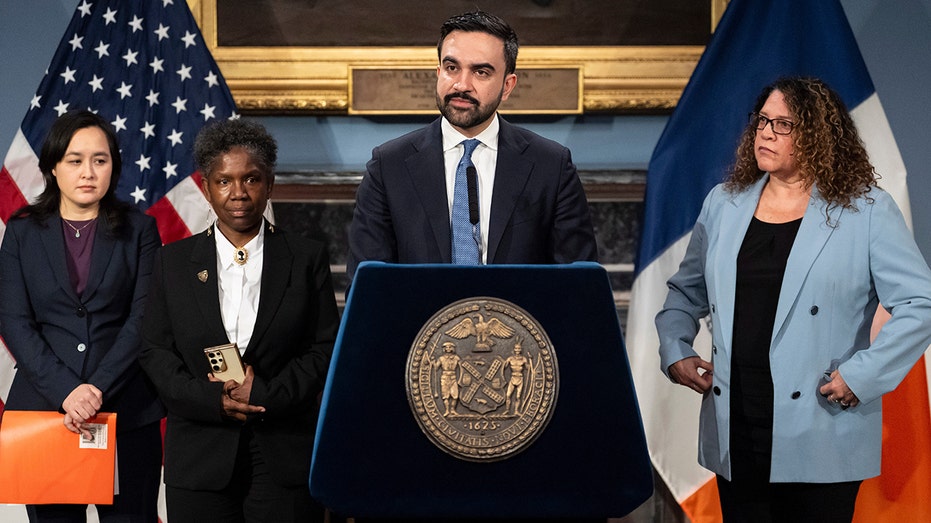
Flashback: Mamdani's history of dodging questions about where he stands on key issues
•New York City Mayor Zohran Mamdani has a history of dodging important questions about political matters in the United States and the world, as well as clarifying his own positions.Since winning the De...
•The growing divide among Democrats has grown so large that even longtime strategist James Carville proposed a schism to keep such far-left candidates from taking over the party.Where Mamdani stands on...
•"I think if you have to work to pay your bills, I think that that is one definition of being a part of the working class," Mamdani said."So someone making $250,000 a year is working class?" Garcia-Nav...
هذا الخبر من Fox News. خبر يقدم أدوات ذكاء اصطناعي للتلخيص والترجمة والاستماع.
المصدر: Fox News | Source: Fox NewsNew York City Mayor Zohran Mamdani has a history of dodging important questions about political matters in the United States and the world, as well as clarifying his own positions.
Since winning the Democratic primary and the mayoralty of New York, the self-described democratic socialist has become a national figure and has faced pushback from both Republicans and Democrats over his past rhetoric and policy proposals, with critics saying he is too radical.
Mamdani has led a wider shift in Democratic Party politics, including backing three far-left New York congressional candidates who won recent primary contests against more establishment figures. The growing divide among Democrats has grown so large that even longtime strategist James Carville proposed a schism to keep such far-left candidates from taking over the party.
Where Mamdani stands on key issues has been the subject of repeated questions in interviews, which the mayor has often dodged.
FAR-LEFT SURGE: MAMDANI-BACKED CANDIDATES OUST DEM ESTABLISHMENT INCUMBENTS
In mid-July, New York Times journalist Lulu Garcia-Navarro asked Mamdani whether he and the Democratic Socialists of America (DSA), have a definition for the working class that they say they represent.
"I think if you have to work to pay your bills, I think that that is one definition of being a part of the working class," Mamdani said.
"So someone making $250,000 a year is working class?" Garcia-Navarro asked.
"I haven’t sat at home and asked myself where it starts and stops," Mamdani answered. "What I would say is those who are working to try and afford the basic dignities of life and aren’t able to do so, I think that that is also working class. Oftentimes we’re asked how we divide this country. I think there’s only one majority in this country — it’s the working class."
When Garcia-Navarro pressed him further, saying that answer doesn’t ring true, Mamdani eventually said that he draws the line of working-class at "about a million dollars a year."
"So anyone under a million dollars a year in income is working class?" Garcia-Navarro asked.
He argued that that was not what he was trying to say, eventually lamenting that when taking questions, such as what it means to be a democratic socialist, "I think sometimes there’s a fixation on a definition of something."
Mamdani was praised earlier in July for how he managed to dodge a hypothetical question about running for president.
"If you could run for president, would you?" Jillian Superstar asked during her "360 with Jillian" podcast.
Mamdani said he thankfully never had to worry about it, referring to the fact that he was born in Uganda.
"And I think it's hard to think of a better job than this. And I know that you'll hear so many politicians say that. But my point is just like… You wake up in New York City, you go to sleep in New York City. The whole day is in New York City. What more could you want? Yeah, it's just I don't know. It is a dream," he added.
Superstar then said, "You're good. You can teach a master class on dodging questions. That was fantastic."
Iranian Supreme Leader Ayatollah Ali Khamenei, who ruled the Islamic Republic for more than three decades, was killed in an Israeli military strike in Tehran early this year, and a reporter asked Mamdani whether Iran is better off without him.
While Mamdani acknowledged the regime's "systematic repression" of its own people and that it's "killing thousands" of Iranian protesters, he did not answer whether the country was better off without the dictator.
"I've said before that the Iranian government has engaged in systematic repression of its own people, even killing thousands of Iranians who were seeking to express the most basic forms of dissent earlier this year," Mamdani responded.
"It is a brutal government, and I've also said that while I may be a young mayor, I am old enough to remember the devastating consequences of our country pursuing a war with the intent of regime change in that very same region not that many years ago," he added.
The previous week, the mayor faced backlash over his social media post condemning the U.S. and Israeli attack on Iran that led to the killing of Khamenei.
"Today’s military strikes on Iran — carried out by the United States and Israel — mark a catastrophic escalation in an illegal war of aggression," Mamdani wrote. "Bombing cities. Killing civilians. Opening a new theater of war. Americans do not want this. They do not want another war in pursuit of regime change."
CLICK HERE FOR MORE COVERAGE OF MEDIA AND CULTURE
Mamdani seemed to dodge a question in November about the House voting in favor of a resolution condemning socialism ahead of his high-stakes meeting with President Donald Trump.
That month, the House had passed a resolution condemning socialism just hours before the self-identified democratic socialist Mamdani was to arrive at the White House. The resolution passed 285-98, with 86 Democrats joining Republicans, including House Minority Leader Rep. Hakeem Jeffries, D-N.Y., who endorsed Mamdani. Two Democrats, Rep. Deborah Ross, D-N.C., and Rep. Janelle Bynum, D-Ore., voted present.
When asked what he thought about the vote, however, he replied, "Brother, I can tell you all I've been thinking about is preparing for this meeting and speaking up for New Yorkers."
Perhaps Mamdani’s most famous example of avoiding a question was him being asked about his defense of the phrase "Globalize the intifada."
Mamdani refused to condemn the phrase — which is associated with violence against Israel — throughout his campaign for mayor.
During a campaign event last year, the then-candidate avoided answering questions from WNYC’s Elizabeth Kim about the controversial rhetoric and whether he supported such language.
Kim asked Mamdani if he had "regret" over how he handled a "globalize the intifada" question during a recent interview with The Bulwark podcast at the time, where he declined to condemn the rhetoric.
Responding to Kim, Mamdani said, "I can’t speak to the media coverage of it."
Since then, however, he has distanced himself from the phrase and encouraged his supporters to distance themselves from it as well.
During an MSNBC interview, Mamdani recalled a discussion with a rabbi who said that rhetoric about globalizing the intifada gives her flashbacks to attacks on restaurants in Jerusalem, and Mamdani noted, "After having that conversation, that this is language I would discourage."
Fox News Digital contacted Mamdani's office and did not receive an immediate response.
Fox News' Hanna Panreck, Lindsay Kornick, Rachel Wolf, Rachel del Guidice and Marc Tamasco contributed to this report.
ملاحظة تحريرية | Editorial Note: نُشر هذا المقال في الأصل بواسطة Fox News. خبر (Khabr) هي منصة إعلامية أردنية مرخّصة تعمل بالذكاء الاصطناعي. نضيف قيمة تحريرية من خلال: تحليل ذكي للأخبار، ملخصات تلقائية، رواية صوتية بالذكاء الاصطناعي، ترجمة متعددة اللغات، وتدقيق الحقائق. هدفنا جعل الأخبار أكثر وضوحاً وسهولةً للقارئ العربي.
This article was originally published by Fox News. Khabr is a licensed Jordanian AI-powered news platform (Registration #82086). We add editorial value through: AI-powered news analysis, automated summaries, AI audio narration, multi-language translation (Arabic, English, French, Turkish), and AI fact-checking. Our mission is to make news more accessible and understandable for Arabic-speaking audiences worldwide.