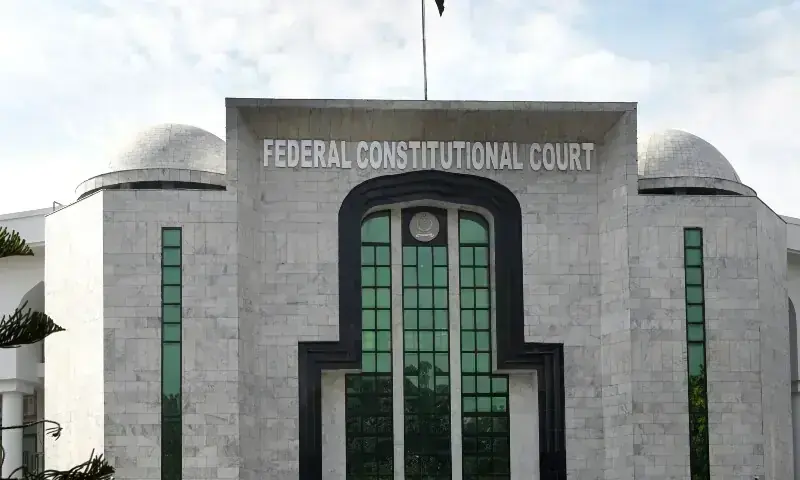
FFC directs CDA to formulate rules regularising Islamabad’s informal settlements
المصدر: Dawn | Source: DawnISLAMABAD: The Federal Constitutional Court on Thursday directed the Capital Development Authority (CDA) to finalise regulations for Islamabad’s informal settlements in petitions against the recent demolition drives in the federal capital.
The development comes amid an ongoing demolition drive launched by the CDA, which has targeted informal settlements across the federal capital, as well as historic villages like Saidpur, Malpur and Nurpur Shahan.
Thursday’s hearing was presided over by FCC Chief Justice Aminuddin Khan. During the hearing, he directed the CDA to formulate rules for regularising informal settlements in Islamabad.
Lawyer Faisal Siddiqui appeared on behalf of the petitioner, while lawyer Qasim Chohan represented the CDA. Additional Attorney General Aamir Rehman was also present at the hearing.
“Why have the regulations not been finalised yet?” Justice Khan asked the AAG during the hearing.
At this, the AAG said that “there had been a delay due to the CDA chairman being changed,” assuring the court that the draft was ready and would be approved in the next board meeting.
The petitioner’s counsel maintained that “no one can be evicted overnight.
“This is Islamabad, not Gaza,” Siddiqui said, urging the court to consider the case “not on account of mercy but as a legitimate right.”
Justice Khan, addressing the AAG, asked whether any reserved space existed for informal settlements in Islamabad, to which the AAG said that “there are no slums in the CDA Master Plan”.
“Slums established up to 1995 were recognised on humanitarian grounds,” the AAG informed the court.
At this, Siddiqui argued that “despite the 2001 and 2016 policies, authorities are evicting people from their homes.”
“If the policy exists, then what is the problem?” Justice Khan asked, to which Siddiqui said, “The issue is implementation of the policy, which can be made possible through your order.”
“No one can be evicted without being provided an alternative place,” the petitioner’s counsel said.
CDA’s legal counsel, during the hearing, maintained that the “land allotted for informal settlements in Islamabad was being misused.”
“Despite being given alternative accommodation, the residents did not vacate their previous homes,” Chohan claimed, adding that the CDA was facing difficulties in clearing the settlements.
Siddiqui argued that around 400,000 people were currently living in informal settlements. He added that the CDA Master Plan also stated that 50 per cent of Islamabad’s population lived in such settlements.
During the hearing, the AAG also also claimed that the settlements “were under mafia control”.
After hearing all sides, the court adjourned the hearing for four weeks, providing CDA time to formulate rules.
A day earlier, human rights activists, political workers, lawyers and ordinary citizens, in a meeting convened by the Human Rights Commission of Pakistan (HRCP), appealed to judges of the superior courts to uphold the 2015 Supreme Court stay order against summary evictions of informal settlements, thereby ensuring the constitutional right to housing of the urban working poor.
The HRCP, All-Pakistan Alliance for Katchi Abadis, National Commission for Justice and Peace, Awami Workers Party, Aurat March Islamabad and others noted that the CDA’s brazen anti-poor attitude reflected its failure to meet the shelter needs of the working poor.
During the meeting, it was highlighted that Islamabad remained the only city in Pakistan lacking a comprehensive framework for the recognition of informal settlements, governed in most cases by globally accepted principles of regularisation, with resettlement considered a last resort.
Additional reporting by Umer Mehtab
ملاحظة تحريرية | Editorial Note: نُشر هذا المقال في الأصل بواسطة Dawn. خبر (Khabr) هي منصة إعلامية أردنية مرخّصة تعمل بالذكاء الاصطناعي. نضيف قيمة تحريرية من خلال: تحليل ذكي للأخبار، ملخصات تلقائية، رواية صوتية بالذكاء الاصطناعي، ترجمة متعددة اللغات، وتدقيق الحقائق. هدفنا جعل الأخبار أكثر وضوحاً وسهولةً للقارئ العربي.
This article was originally published by Dawn. Khabr is a licensed Jordanian AI-powered news platform (Registration #82086). We add editorial value through: AI-powered news analysis, automated summaries, AI audio narration, multi-language translation (Arabic, English, French, Turkish), and AI fact-checking. Our mission is to make news more accessible and understandable for Arabic-speaking audiences worldwide.