EXCLUSIVE: Serbian President Vučić says support for US 'surged' under Trump, invites him to visit Belgrade
•Serbian President Aleksandar Vučić says relations between Serbia and the United States have undergone a dramatic transformation under President Donald Trump, a shift he says has changed public percept...
•"President Trump and his team so far were working very diligently and dedicatedly on the Western Balkans," Vučić said, adding that many Serbs view his administration very differently from previous U.S...
•governments."If you ask people in Serbia just to make a comparison between Clinton and Trump's administration, or Democrats to Republicans, you wouldn't believe it," Vučić said.
هذا الخبر من Fox News. خبر يقدم أدوات ذكاء اصطناعي للتلخيص والترجمة والاستماع.
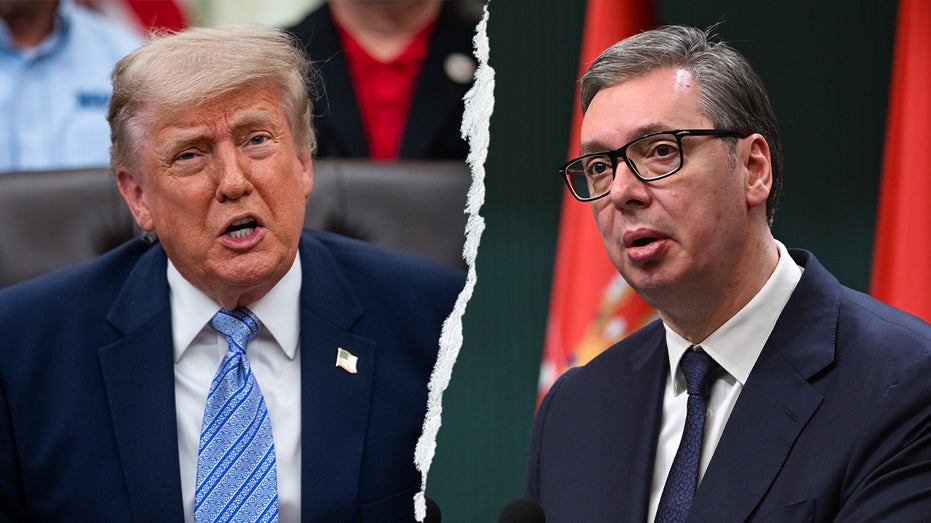
المصدر: Fox News | Source: Fox NewsSerbian President Aleksandar Vučić says relations between Serbia and the United States have undergone a dramatic transformation under President Donald Trump, a shift he says has changed public perceptions in a country where memories of the 1999 NATO bombing campaign remain deeply rooted.
In an exclusive interview with Fox News Digital, Vučić praised Trump's approach to the Balkans, arguing that the administration's focus on economic cooperation rather than political pressure resonated with many Serbs. "President Trump and his team so far were working very diligently and dedicatedly on the Western Balkans," Vučić said, adding that many Serbs view his administration very differently from previous U.S. governments.
"If you ask people in Serbia just to make a comparison between Clinton and Trump's administration, or Democrats to Republicans, you wouldn't believe it," Vučić said. "It would be 90 to 10 or 95 to 5."
FORMER TRUMP ADVISORS WAGE BALKAN CAMPAIGN AS MAGA MOVES INTO EUROPE
The comparison is particularly striking in Serbia, where many still associate the United States with NATO's 1999 bombing campaign during the Kosovo conflict, launched to stop Serbian forces' crackdown on ethnic Albanians in Kosovo and which remains one of the most consequential events in modern Serbian history.
Vučić said he recently extended an invitation to Trump to visit Serbia and predicted the American president would receive an enthusiastic welcome.
"I hope that we'll be able to host him," Vučić said. "More people will be ready to greet him and wait for him than he might even expect…I dare to say even more than hundreds of thousands of people."
The Serbian president said the improving relationship between Washington and Belgrade is increasingly centered on economics, investment and technological cooperation, and mutual conservative values.
According to Vučić, Serbia and the United States are preparing to launch a strategic dialogue that will focus on energy, infrastructure, artificial intelligence, defense cooperation and investment opportunities. Among the projects under discussion are energy infrastructure, liquefied natural gas cooperation, data centers and advanced computing technologies.
EUROPEAN LEADER PRAISES TRUMP'S 'PEACE THROUGH STRENGTH' FOR KEEPING COUNTRY SAFE FROM CONFLICT
The growing relationship comes as Serbia seeks to position itself as a regional economic hub while continuing its long-standing ambition of joining the European Union.
Vučić pointed to preparations for Expo 2027 in Belgrade with nearly 150 participating countries, as evidence of Serbia's growing international profile and economic ambitions.
Vučić, who has served as Serbia's dominant political figure since becoming prime minister in 2014 and president in 2017, pointed to the country's economic growth as evidence of its transformation. "Our GDP was 32 billion (euros) when I became the prime minister," Vučić said. "This year it's going to be over 100 billion euros., which is $120 billion."
Vučić's relationship with Trump dates back to the president's first term, when the White House brokered a series of economic normalization agreements between Serbia and Kosovo. Rather than focusing first on the politically explosive question of Kosovo's status, the Trump administration emphasized infrastructure projects, transportation links and investment aimed at improving ties between the two sides.
In September 2020, Vučić and then-Kosovo Prime Minister Avdullah Hoti signed U.S.-brokered economic agreements at the White House that included commitments to expand rail and highway connections and promote investment. Trump described the deal as a breakthrough achieved by focusing on "job creation and economic growth" rather than longstanding political disputes.
PRESIDENT ALEKSANDAR VUČIĆ: EUROPE VILIFIES TRUMP, BUT WE IN SERBIA SEE A FRIEND
Asked whether he would consider recognizing Kosovo, which declared independence from Serbia in 2008 and has been recognized by the United States under President George W. Bush and most European countries, if doing so unlocked Serbia's economic future and accelerated its path toward membership in the European Union, Vučić pushed back on the premise, arguing that economic cooperation and improved relations should come before discussions about political status.
"I'm not saying that I'm ready to violate my constitution… I have always been open to talks or compromising solutions, I have always been open to developing great economic ties and no doubt much better political ties. But I was not speaking about recognition of someone's independence," he said.
While Serbia continues to pursue membership in the European Union, the country has also maintained ties with Russia and China, a balancing act that has drawn scrutiny amid Russia's war in Ukraine and growing geopolitical tensions worldwide.
Asked whether Serbia could continue navigating between East and West in an increasingly divided world or would eventually need to choose a side, Vučić rejected the notion that countries must choose between competing geopolitical camps. Instead, he pointed to both his own visit to China and Trump's engagement with Beijing as examples of what he described as pragmatic diplomacy focused on national interests.
"President Trump didn't go there because of his vanity," Vučić said of Trump's visit to China. "He brought with him all the leading people of the United States of America for making better businesses, for earning more money for their companies."
KOSOVO ACCUSES SERBIA OF 'TERRORIST ATTACK' RESEMBLING RUSSIAN ACTIONS IN UKRAINE
Vučić said he adopted a similar approach during his own visit, arguing that leaders should prioritize economic opportunities for their citizens rather than ideological alignments. "I'm coming from a small country. I was asking for more investments and was fighting for the interests of my people," he said.
The Serbian president said the same pragmatic approach should guide efforts to resolve ongoing conflicts in both Ukraine and the Middle East.
"It's always better to have thousands of days of negotiations than one day of war," he said.
Asked about tensions involving Iran and the wider conflict in the Middle East, Vučić reiterated Serbia's support for Israel, a position that increasingly distinguishes Belgrade from some European governments.
"I am the president of the country that is one of the very rare countries in Europe that is not hesitating to cooperate and collaborate with Israel," he said. "And it is proud to say this publicly and openly."
Vučić warned about what he described as rising antisemitism around the world.
"From time to time, I'm very much afraid to see a lot of antisemitic slogans and antisemitic banners," he said.
"The Serbian president said Serbia has resisted those trends and pledged that it would continue to do so under his leadership."
"It does not happen in Serbia, and it won't happen as long as I'm the president."
ملاحظة تحريرية | Editorial Note: نُشر هذا المقال في الأصل بواسطة Fox News. خبر (Khabr) هي منصة إعلامية أردنية مرخّصة تعمل بالذكاء الاصطناعي. نضيف قيمة تحريرية من خلال: تحليل ذكي للأخبار، ملخصات تلقائية، رواية صوتية بالذكاء الاصطناعي، ترجمة متعددة اللغات، وتدقيق الحقائق. هدفنا جعل الأخبار أكثر وضوحاً وسهولةً للقارئ العربي.
This article was originally published by Fox News. Khabr is a licensed Jordanian AI-powered news platform (Registration #82086). We add editorial value through: AI-powered news analysis, automated summaries, AI audio narration, multi-language translation (Arabic, English, French, Turkish), and AI fact-checking. Our mission is to make news more accessible and understandable for Arabic-speaking audiences worldwide.