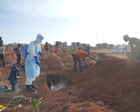
play Live Sign upShow navigation menuNavigation menuNewsShow more news sectionsAfricaAsiaUS & CanadaLatin AmericaEuropeAsia PacificMiddle EastExplainedSportOpinionVideoMoreShow more sectionsFeaturesEconomyHuman RightsClimate CrisisInvestigationsInteractivesIn PicturesScience & TechnologyPodcastsTravelSponsored Contentplay Live Click here to searchsearchSign upNews|EbolaEbola outbreak in DR Congo becomes deadliest in country’s historyA top UN official says ‘speed, scale, and solidarity’ needed ‘before this virus gets even further ahead of us’. xwhatsapp-strokecopylinkgoogleAdd Al Jazeera on GoogleinfoRed Cross volunteers in the Democratic Republic of the Congo carry the body of an Ebola victim on June 8, 2026 [AFP]By Al Jazeera Staff and ReutersPublished On 17 Aug 202617 Aug 2026The Ebola outbreak in the Democratic Republic of the Congo (DRC) has killed 2,325 people, surpassing the death toll from the 2018-2020 outbreak to become the deadliest in the country’s history. The confirmed number of people infected with the virus has risen to 4,945, including 101 new cases detected in the previous 24 hours, the DRC’s National Public Health Institute said in its latest report on Sunday. “The outbreak is the fastest growing on record,” Tom Fletcher, the United Nations humanitarian chief, said in a statement on Friday. “We need speed, scale, and solidarity before this virus gets even further ahead of us.” The outbreak, the DRC’s 17th, was already the biggest in the country’s history in terms of number of cases – a milestone reached in late July. The latest government data shows that the total number of deaths has surpassed the 2,299 deaths recorded in the 2018-2020 outbreak, which was previously the country’s worst on record. “Ebola is winning in the Democratic Republic of the Congo. We cannot let the virus outrun our response,” Fletcher said as he outlined the latest efforts to contain the virus. On Wednesday, World Health Organization Director-General Tedros Adhanom Ghebreyesus said that at its current pace, the outbreak is on track to eclipse the West African Ebola outbreak of 2014 to 2016, a crisis that killed more than 11,000 people and accelerated the push to develop a vaccine. The current outbreak is caused by the Bundibugyo species of Ebola virus, which has no approved vaccines or treatments. The outbreak has gained momentum since it was declared on May 15, as weak health infrastructure, the region’s remoteness, and ongoing conflict near the DRC’s borders with South Sudan, Uganda, and Rwanda have hindered response efforts. The proportion of people dying from the outbreak after a confirmed infection, known as the case fatality ratio, has risen from about 20 percent in early June to 46 percent, according to government data, meaning nearly one in every two confirmed cases is now deadly. “Normally, as an outbreak progresses, the case fatality ratio should fall as contact tracing improves and patients are identified and treated earlier,” said Thomas Parisch, a public health specialist deployed to the DRC with medical charity Doctors Without Borders, known by its French initials MSF. “Instead, we’re still seeing many cases detected very late, when treatment is less likely to succeed, with many identified only after they die in the community.” A small number of experimental vaccines and therapies are being evaluated, while global health authorities assess whether existing Ebola treatments could offer protection. Evidence so far is limited to animal studies. Advertisement AboutAboutShow moreAbout UsCode of EthicsTerms and ConditionsEU/EEA Regulatory NoticePrivacy PolicyCookie PolicyCookie PreferencesAccessibility StatementSitemapWork for usConnectConnectShow moreContact UsUser Accounts HelpAdvertise with usStay ConnectedNewslettersChannel FinderTV SchedulePodcastsSubmit a TipPaid Partner ContentOur ChannelsOur ChannelsShow moreAl Jazeera ArabicAl Jazeera EnglishAl Jazeera Investigative UnitAl Jazeera MubasherAl Jazeera DocumentaryAl Jazeera BalkansAJ+Our NetworkOur NetworkShow moreAl Jazeera Centre for StudiesAl Jazeera Media InstituteLearn ArabicAl Jazeera Centre for Public Liberties & Human RightsAl Jazeera ForumAl Jazeera Hotel PartnersFollow Al Jazeera English:
المصدر: Al Jazeera English
| Source: Al Jazeera English
ملاحظة تحريرية | Editorial Note:
نُشر هذا المقال في الأصل بواسطة Al Jazeera English.
خبر (Khabr) هي منصة إعلامية أردنية مرخّصة تعمل بالذكاء الاصطناعي.
نضيف قيمة تحريرية من خلال: تحليل ذكي للأخبار، ملخصات تلقائية، رواية صوتية بالذكاء الاصطناعي، ترجمة متعددة اللغات، وتدقيق الحقائق.
هدفنا جعل الأخبار أكثر وضوحاً وسهولةً للقارئ العربي.
This article was originally published by Al Jazeera English.
Khabr is a licensed Jordanian AI-powered news platform (Registration #82086).
We add editorial value through: AI-powered news analysis, automated summaries, AI audio narration, multi-language translation (Arabic, English, French, Turkish), and AI fact-checking.
Our mission is to make news more accessible and understandable for Arabic-speaking audiences worldwide.