DU’s Master of Operational Research programme not in UGC list, likely to get MSc tag, again
•Weather ePaper Today’s Paper Journalism of Courage Home ePaper India Cities UPSC Premium Entertainment Politics Sports World Explained Opinion Business Lifestyle Tech Subscribe Sign In TrendingUPSC Of...
•(Operational Research), which had been in place for nearly four decades before it was changed in 2019,” he added.
•Make us preferred source on Google Whatsapp twitter Facebook Reddit PRINT For years, graduates of the University of Delhi’s Master of Operational Research (MOR) programme have found themselves caught...
هذا الخبر من Indian Express. خبر يقدم أدوات ذكاء اصطناعي للتلخيص والترجمة والاستماع.
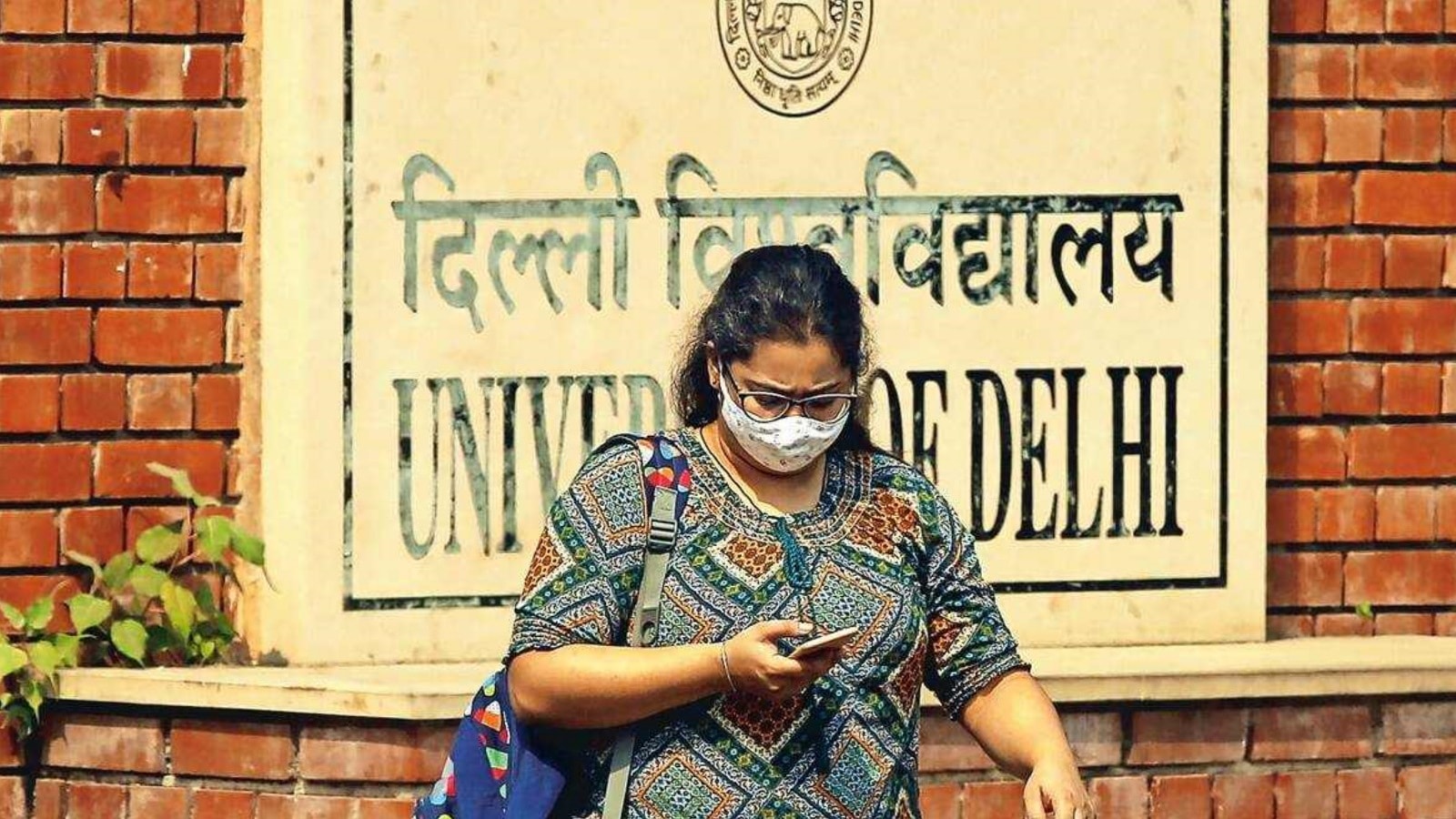
Weather ePaper Today’s Paper Journalism of Courage Home ePaper India Cities UPSC Premium Entertainment Politics Sports World Explained Opinion Business Lifestyle Tech Subscribe Sign In TrendingUPSC OfferIPL 2026US NewsPuzzles & GamesLegal NewsFresh TakeHealthResearch🎙️ Podcast Advertisement function checkAndLoadWindowSizeScript() { if (window.jQuery) { // jQuery is loaded, include your script jQuery(document).ready(function($) { // Your existing script for checking window width if (window.innerWidth) var page_w = window.innerWidth; else if (document.all) var page_w = document.body.clientWidth; if (page_w > 1024) { $(".add-left, .add-right").show(); } else { $(".add-left, .add-right").hide(); } }); } else { // jQuery is not loaded, check again after 0.2 seconds setTimeout(checkAndLoadWindowSizeScript, 200); } } // Initial call to the function checkAndLoadWindowSizeScript(); NewsCitiesDelhiDU's Master of Operational Research programme not in UGC list, likely to get MSc tag, again DU’s Master of Operational Research programme not in UGC list, likely to get MSc tag, again Dept seeks retrospective relief for students who got a degree without MSc tag Written by: Vidheesha Kuntamalla5 min readNew DelhiApr 15, 2026 01:09 AM IST “In view of these concerns, the department has proposed reverting to the earlier nomenclature of M.Sc. (Operational Research), which had been in place for nearly four decades before it was changed in 2019,” he added. Make us preferred source on Google Whatsapp twitter Facebook Reddit PRINT For years, graduates of the University of Delhi’s Master of Operational Research (MOR) programme have found themselves caught in a technical bind — holding a degree that, despite its academic rigour and industry relevance, was not in the University Grants Commission’s (UGC) approved degrees list. Now, the univister is mulling renaming the programme, The Indian Express has learnt. The Department of Operational Research, said sources, has formally proposed that the “Existing Nomenclature: Master of Operational Research” be revised to “MSc (Operational Research)” under the Faculty of Mathematical Science, a title already recognised by the UGC. The issue is particularly striking given the legacy of the programme, which was launched in 1963. At the time, the students — following completion of the programme — were given an MSc degree. However, after 2019, the current title was adopted even as it was not in the approved degrees’ list as notified by the UGC vide Gazette Notification of 2014. The transition happened with the adoption of the Choice Based Credit System (CBCS), under which the programme was revised and renamed. The updated syllabus and title were approved by the Academic Council and Executive Council in July 2019. The department, The Indian Express has learnt, had recently written to the university, seeking intervention after graduates began encountering hurdles tied directly to the degree’s name. It noted that students who had completed the programme “are facing difficulties in pursuing their future academic and professional endeavours,” owing to the absence of the degree title in the UGC’s official list. “The nomenclature was changed a few years ago, but there were technical issues. It was not part of the UGC’s approved list of degrees. Students also flagged that they were facing difficulties in job applications, especially in government exams and organisations that specifically require an MSc degree,” said Kishor Kumar Aggarwal, Head of the Department of Operational Research. “In view of these concerns, the department has proposed reverting to the earlier nomenclature of M.Sc. (Operational Research), which had been in place for nearly four decades before it was changed in 2019,” he added. The department has also requested retrospective relief. It has urged that “all degrees awarded under the nomenclature ‘Master of Operational Research’ be declared equivalent to MSc (Operational Research) for all academic and professional purposes” — a move that would safeguard the interests of students. The proposal to change the name has already moved through several layers of approval — from the Departmental Council to the Committee of Courses, and through the Dean of the Faculty of Mathematical Sciences, before being cleared by the competent authority on January 2, 2026. It will be placed at the Academic Council — the university’s apex decision-making body — next week. Crucially, the department has clarified that “this change only pertains to the nomenclature with no modification in the curriculum, duration and eligibility conditions of the programme.” The significance of such a change is also reflected in how the degree is perceived beyond DU. A faculty member from IIT Bombay’s Department of Industrial Engineering and Operational Research, who has been working in the field for over two decades, said, “Many openings for jobs or further research would require either an MTech or an MSc, most institutes would not appreciate the value of an Operational Research course without an MSc tag. At IIT Bombay, we have been running the Operational Research course since 2009 and it has always been offered under an MSc. So this change would definitely have an impact on the opportunities students might get going forward.” The programme at DU follows a two-year, four-semester structure designed to build strong theoretical foundations before moving into specialisation and application. In the first year, the curriculum focuses on core analytical subjects such as linear programming, and inventory management. The second year shifts towards advanced and applied learning, with courses in mathematical programming, reliability, and software engineering, among others. A key component is the final-semester industrial project, where students work with companies to solve real operational problems. As described on the university’s website, the programme “prepares students from different backgrounds for rewarding careers as operational research analysts, data scientists and consultants.” It offers “a unique blend of technical courses, practical consulting skills and real world problem solving experience,” it states. Central to this design is hands-on industry engagement: “The cornerstone of the programme is the Industrial Project where every student is matched with an industry partner to consult on a significant operational issue faced by the company.” Vidheesha Kuntamalla is a Senior Correspondent at The Indian Express, based in New Delhi. She is known for her investigative reporting on higher education policy, international student immigration, and academic freedom on university campuses. Her work consistently connects policy decisions with lived realities, foregrounding how administrative actions, political pressure, and global shifts affect students, faculty, and institutions. Professional Profile Core Beat: Vidheesha covers education in Delhi and nationally, reporting on major public institutions including the University of Delhi (DU), Jawaharlal Nehru University (JNU), Jamia Millia Islamia, the IITs, and the IIMs. She also reports extensively on private and government schools in the National Capital Region. Prior to joining The Indian Express, she worked as a freelance journalist in Telangana and Andhra Pradesh for over a year, covering politics, rural issues, women-centric issues, and social justice. Specialisation: She has developed a strong niche in reporting on the Indian student diaspora, particularly the challenges faced by Indian students and H-1B holders in the United States. Her work examines how geopolitical shifts, immigration policy changes, and campus politics impact global education mobility. She has also reported widely on: * Mental health crises and student suicides at IITs * Policy responses to campus mental health * Academic freedom and institutional clampdowns at JNU, South Asian University (SAU), and Delhi University * Curriculum and syllabus changes under the National Education Policy Her recent reporting has included deeply reported human stories on policy changes during the Trump administration and their consequences for Indian students and researchers in the US. Reporting Style Vidheesha is recognised for a human-centric approach to policy reporting, combining investigative depth with intimate storytelling. Her work often highlights the anxieties of students and faculty navigating bureaucratic uncertainty, legal precarity, and institutional pressure. She regularly works with court records, internal documents, official data, and disciplinary frameworks to expose structural challenges to academic freedom. Recent Notable Articles (Late 2024 & 2025) 1. Express Investigation Series JNU’s fault lines move from campus to court: University fights students and faculty (November 2025) An Indian Express investigation found that since 2011, JNU has appeared in over 600 cases before the Delhi High Court, filed by the administration, faculty, staff, students, and contractual workers across the tenures of three Vice-Chancellors. JNU’s legal wars with students and faculty pile up under 3 V-Cs | Rs 30-lakh fines chill campus dissent (November 2025) The report traced how steep monetary penalties — now codified in the Chief Proctor’s Office Manual — are reshaping dissent and disciplinary action on campus. 2. International Education & Immigration ‘Free for a day. Then came ICE’: Acquitted after 43 years, Indian-origin man faces deportation — to a country he has never known (October 2025) H-1B $100,000 entry fee explained: Who pays, who’s exempt, and what’s still unclear? (September 2025) Khammam to Dallas, Jhansi to Seattle — audacious journeys in pursuit of the American dream after H-1B visa fee hike (September 2025) What a proposed 15% cap on foreign admissions in the US could mean for Indian students (October 2025) Anxiety on campus after Trump says visas of pro-Palestinian protesters will be cancelled (January 2025) ‘I couldn’t believe it’: F-1 status of some Indian students restored after US reverses abrupt visa terminations (April 2025) 3. Academic Freedom & Policy Exclusive: South Asian University fires professor for ‘inciting students’ during stipend protests (September 2025) Exclusive: Ministry seeks explanation from JNU V-C for skipping Centre’s meet, views absence ‘seriously’ (July 2025) SAU rows after Noam Chomsky mentions PM Modi, Lankan scholar resigns, PhD student exits SAU A series of five stories examining shrinking academic freedom at South Asian University after global scholar Noam Chomsky referenced Prime Minister Narendra Modi during an academic interaction, triggering administrative unease and renewed debate over political speech, surveillance, and institutional autonomy on Indian campuses. 4. Mental Health on Campuses In post-pandemic years, counselling rooms at IITs are busier than ever; IIT-wise data shows why (August 2025) Campus suicides: IIT-Delhi panel flags toxic competition, caste bias, burnout (April 2025) 5. Delhi Schools These Delhi government school grads are now success stories. Here’s what worked — and what didn’t (February 2025) ‘Ma’am… may I share something?’ Growing up online and alone, why Delhi’s teens are reaching out (December 2025) ... Read More Stay updated with the latest - Click here to follow us on Instagramالمصدر: Indian Express | Source: Indian Express
ملاحظة تحريرية | Editorial Note: نُشر هذا المقال في الأصل بواسطة Indian Express. خبر (Khabr) هي منصة إعلامية أردنية مرخّصة تعمل بالذكاء الاصطناعي. نضيف قيمة تحريرية من خلال: تحليل ذكي للأخبار، ملخصات تلقائية، رواية صوتية بالذكاء الاصطناعي، ترجمة متعددة اللغات، وتدقيق الحقائق. هدفنا جعل الأخبار أكثر وضوحاً وسهولةً للقارئ العربي.
This article was originally published by Indian Express. Khabr is a licensed Jordanian AI-powered news platform (Registration #82086). We add editorial value through: AI-powered news analysis, automated summaries, AI audio narration, multi-language translation (Arabic, English, French, Turkish), and AI fact-checking. Our mission is to make news more accessible and understandable for Arabic-speaking audiences worldwide.