Dubai achieves global first with breakthrough gene therapy for adult SMA patient
•Dubai: Dubai has marked a major global medical breakthrough by successfully administering a newly licensed gene therapy to an adult patient with Spinal Muscular Atrophy (SMA), becoming the first locat...
•The patient had spent most of his life in a wheelchair with limited therapeutic options.
•His case represents only the second time worldwide that an adult SMA patient has received this advanced one-time gene therapy, according to the manufacturer, Novartis.Get updated faster and for FREE:...
هذا الخبر من Gulf News. خبر يقدم أدوات ذكاء اصطناعي للتلخيص والترجمة والاستماع.
المصدر: Gulf News | Source: Gulf NewsDubai: Dubai has marked a major global medical breakthrough by successfully administering a newly licensed gene therapy to an adult patient with Spinal Muscular Atrophy (SMA), becoming the first location outside the United States to do so.
The treatment was delivered to a 22-year-old Egyptian patient at Medcare Royal Specialty Hospital. The patient had spent most of his life in a wheelchair with limited therapeutic options. His case represents only the second time worldwide that an adult SMA patient has received this advanced one-time gene therapy, according to the manufacturer, Novartis.
Get updated faster and for FREE: Download the Gulf News app now - simply click here.
The milestone signals a turning point in the treatment of SMA, a rare genetic neuromuscular disorder that leads to progressive muscle weakness and can severely impact mobility, breathing and swallowing. Historically, gene therapy for SMA has been largely restricted to infants and children under the age of two, leaving adult patients with few effective options.
Older patients
This latest development changes that trajectory, opening the door for broader access to advanced therapies among older patients.
SMA is caused by a faulty or missing SMN1 gene, which is essential for producing a protein that supports motor neuron survival. Without it, patients experience gradual and often severe muscle degeneration.
Dr Shanila Laiju, Group CEO of Medcare Hospitals, said expanding treatment capabilities to adults could transform outcomes for thousands of patients.
“We believe that achieving the capabilities to provide SMA treatment to adults will rewrite the life stories of thousands of patients in the region and beyond. Expanding access to advanced therapies for older patients is a meaningful step toward equity in care,” she said.
Highly complex
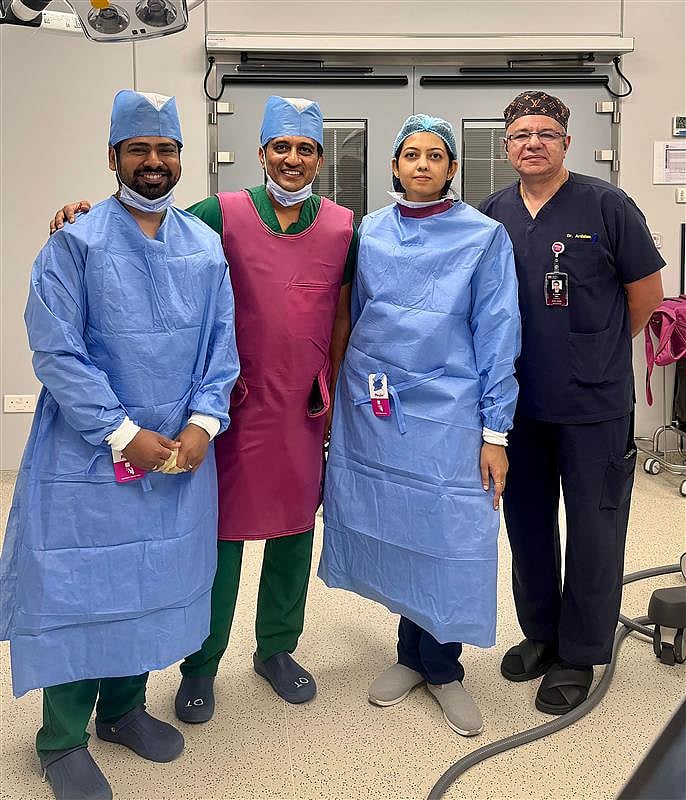
The procedure itself was highly complex, requiring a coordinated, multidisciplinary approach due to the patient’s prior spinal fusion surgery for scoliosis, a common complication in SMA cases that alters spinal anatomy and makes access to the spinal canal particularly challenging.
Despite these complexities, the medical team successfully administered the one-time therapy, known as Itvisma, which works by delivering a functional copy of the SMN1 gene directly into the cerebrospinal fluid, targeting the root cause of the disease.
Dr Vivek Mundada, Clinical Lead of the Gene Therapy Unit, described the achievement as a significant advancement in expanding access to cutting-edge care.
“For years, adults with SMA were told they had aged out of curative options. A one-time intrathecal gene therapy changes that conversation entirely. This is a life-changing treatment and opens new possibilities for many patients who were previously left without hope,” he said.
He added that the UAE’s progressive health care ecosystem has played a key role in enabling such advancements, positioning Dubai as an emerging global hub for rare disease treatment and gene therapy.
Meaningful treatment
Dr Sagar Kawale, an adult neurologist involved in the case, said the development represents a broader shift in how SMA is treated worldwide.
“This is a shift in how we approach SMA care. We are now able to offer meaningful treatment options to adult patients who were previously excluded. It opens the door for many more patients to benefit from gene therapy,” he said.
The patient, who was diagnosed at just 18 months old, had previously relied on regular intrathecal injections as part of a lifelong treatment plan. The transition to a one-time therapy marks a significant improvement in both quality of life and long-term care.
“The experience was very positive. The team was extremely supportive, and the procedure itself was smooth and painless. I am relieved that I no longer need to undergo repeated injections,” he said.
Gene therapy
The latest case builds on earlier milestones in gene therapy, including the successful treatment of younger patients and the expansion of eligibility criteria beyond traditional limits.
Globally, SMA affects approximately 1 to 2 in 100,000 people, while Duchenne muscular dystrophy (DMD), another genetic condition treated through similar therapies, impacts around one in 3,500 boys. Since 2020, more than 190 SMA patients and 20 DMD patients have been treated with advanced gene therapies in Dubai, attracting patients from across the Middle East, Europe, Asia and Africa.
The breakthrough further reinforces Dubai’s growing reputation as a leading destination for advanced medical innovation and specialised care, particularly in the field of rare genetic diseases.
ملاحظة تحريرية | Editorial Note: نُشر هذا المقال في الأصل بواسطة Gulf News. خبر (Khabr) هي منصة إعلامية أردنية مرخّصة تعمل بالذكاء الاصطناعي. نضيف قيمة تحريرية من خلال: تحليل ذكي للأخبار، ملخصات تلقائية، رواية صوتية بالذكاء الاصطناعي، ترجمة متعددة اللغات، وتدقيق الحقائق. هدفنا جعل الأخبار أكثر وضوحاً وسهولةً للقارئ العربي.
This article was originally published by Gulf News. Khabr is a licensed Jordanian AI-powered news platform (Registration #82086). We add editorial value through: AI-powered news analysis, automated summaries, AI audio narration, multi-language translation (Arabic, English, French, Turkish), and AI fact-checking. Our mission is to make news more accessible and understandable for Arabic-speaking audiences worldwide.