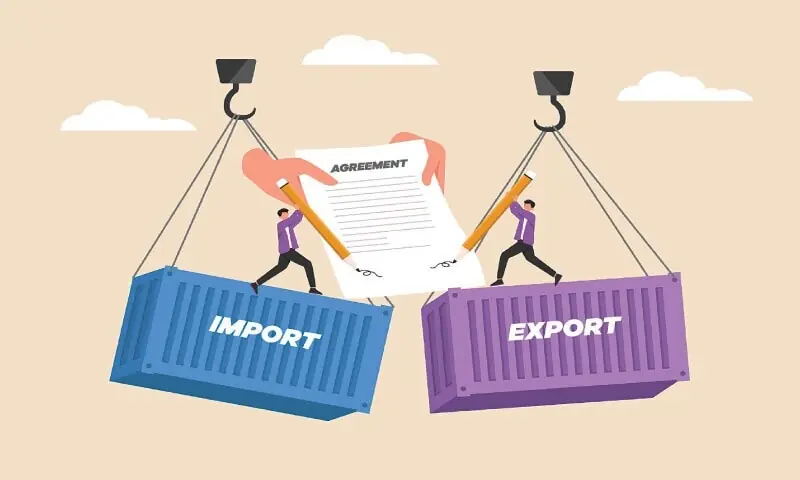
Pakistan’s external trade balance continues to widen beyond normal cyclical swings, pointing instead to deeper structural constraints that have accumulated over decades. Despite periodic policy interventions and short-term stabilisation efforts, the underlying pattern remains unchanged: import growth consistently outpaces export earnings, leaving the economy dependent on external inflows to bridge a persistent gap.
During the first 11 months of the current fiscal year, the trade deficit widened by 17.48 per cent year-on-year to $34.76 billion from $29.58bn in the corresponding period of the previous fiscal year. Export earnings declined by 5.61pc to $27.91bn, while imports rose 5.94pc to $62.66bn.
Earlier, in the entire last fiscal year, the trade deficit widened by 9pc to $26.3bn from $24.1bn a year ago. Although exports rose 4.7pc to $32.1bn, imports increased even faster by 6.6pc to $58.4bn, demonstrating a persistent pattern in which import growth outpaces export earnings.
Energy remains perhaps the single largest reason Pakistan struggles to achieve a trade surplus. The country imports large quantities of crude oil, petroleum products, LNG, coal, and industrial fuels. During the first 11 months of FY26, petroleum imports exceeded 14m metric tonnes, up 7pc in volume from a year earlier.
Our external trade imbalance is rooted in the very structure of the economy, which relies excessively on borrowing and remittances and fails to address structural issues
More importantly, the import bill surged 13.7pc to a record $14.9bn. Even though exports fell by 5.6pc during the same period, a substantial share of foreign exchange earnings continued to be absorbed by energy purchases, deepening the trade deficit. Economic growth itself often widens the imbalance because rising industrial activity increases demand for imported energy.
Our manufacturing sector also relies heavily on imported machinery, chemicals, raw materials, and intermediate goods. The textile industry, despite being the country’s export backbone, depends on imported machinery, dyes, chemicals, and specialised fibres. In FY25, textile machinery imports increased by 61.5pc to $241.2m, while power-generation equipment imports rose 47.8pc to $616.2m.
The pharmaceutical, engineering, automobile, and technology industries exhibit similar dependence on imported components. As a result, producing exports frequently requires substantial imports first, limiting net foreign-exchange gains.
A second structural challenge is Pakistan’s narrow export base. Textiles and textile-related products continue to dominate exports. In FY25, textile exports reached $17.89bn, up 7.39pc from the previous year. And, during the first 10 months of FY26, textile exports totalled $15.03bn, a modest 1.3pc increase from $14.83bn a year earlier. Textiles accounted for approximately 59.6pc of Pakistan’s $25.21bn total merchandise exports during this period.
While the sector remains a major source of foreign exchange, excessive dependence on a single industry leaves Pakistan vulnerable to fluctuations in global demand, competition, and commodity prices. Countries such as South Korea and China reduced external vulnerabilities by diversifying into electronics, machinery, advanced manufacturing, and technology-intensive exports. Pakistan has yet to make a similar transition.
The technological content of Pakistan’s exports also remains relatively low. Globally, the highest export revenues are generated by sectors such as semiconductors, industrial equipment, aerospace components, medical devices, and software-intensive products. Pakistan’s presence in these industries remains limited.
The IT and IT-enabled services sector has shown encouraging growth. Exports reached a record $3.8bn in FY25, up 18pc. During the first 10 months of FY26, IT exports rose to approximately $3.3bn, a 12pc increase from $2.95bn a year earlier. However, the sector still represents only around 11–12pc of total merchandise and services exports. Even with sustained double-digit growth, Pakistan remains far behind more diversified export economies in high-value technology sectors.
Demographics add another layer of pressure. Pakistan’s annual population growth rate of 2.55pc continues to increase demand for fuel, machinery, vehicles, medicines, electronics, and consumer goods. Unless export capacity expands at a similar pace, import demand naturally grows faster than export earnings, placing persistent pressure on the trade balance.
Consumer and business preferences further reinforce import dependence. Imported products often enjoy a reputation for superior quality, particularly in electronics, automobiles, industrial equipment, and luxury goods. During the first nine months of FY26, imports of fully built-up motor vehicles rose 31pc to $263 million.
Pakistani exporters also face longstanding obstacles, including high energy costs, infrastructure deficiencies, logistics inefficiencies, regulatory complexity, limited research and development spending, and shortages of skilled labour. According to the Global Talent Competitiveness Index 2025, Pakistan ranked 124th, down from 109th in 2023 and below India, Bangladesh, and Sri Lanka. Moreover, the cost of doing business is estimated to be roughly 34pc higher than in many regional competitors, reducing export competitiveness.
Global competition is simultaneously becoming more intense. Countries such as Vietnam, Bangladesh, India, Indonesia, and Mexico continue to attract investment in export-oriented manufacturing through stronger infrastructure, larger industrial ecosystems, and more integrated supply chains.
As the hybrid government prepares the FY27 budget, the challenge is not merely to narrow the trade deficit in the short term but to address the structural weaknesses that produce it year after year. A durable improvement requires reducing dependence on imported energy, expanding domestic industrial capacity, diversifying exports, improving productivity, and strengthening Pakistan’s competitiveness in global markets.
Published in Dawn, The Business and Finance Weekly, June 8th, 2026