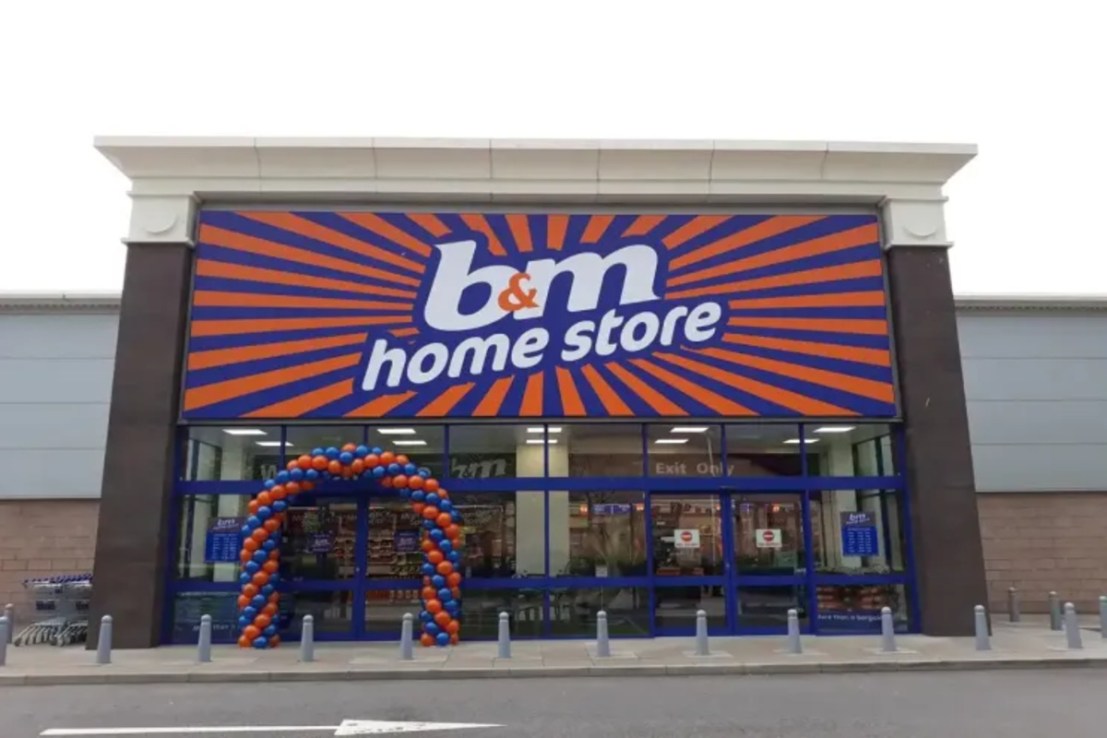
A series of updates from London-listed retailers has light on the battle for sales between online and traditional outlets, with household spending under pressure, writes Michael Hunter.
FTSE 250 retailer B&M has revealed a drop of almost a half in annual profit in what it called a “difficult year”.
It was the most eye-catching piece of news in a series of updates from London-listed retailers on Wednesday.
They highlighted the battle underway in the sector between traditional shops like B&M and their own digital sales offering, alongside new web-only retailers such as Peeko, and one long standing former high-street stalwart, Debenhams, that has now moved entirely online.
B&M reported a decline of over 47% in group profit before tax of £227m for the year to 28 March, from revenue of £5.8bn, by 3.6 per cent.
Tjeerd Jegen, the discount homeware and grocery chain’s chief executive, called it “a difficult year that saw profits fall due to a challenging market and execution issues”.
He added that the 700-store chain launched a turnaround plan in October designed to “restore like-for-like sales growth at B&M UK”.
The company also has around 150 outlets in France.
B&M boss confident it can offset rising energy costs
For the year, like-for-like sales, or those from stores open at least a year, were down by 0.1 per cent.
Jegen added: “The past six months has seen us sharpen our pricing, improve on-shelf availability in best-selling brands and revamp our in-store promotions.”
Latest offers include Visage Pour Homme after shave for £3.99 and eight-pack Duracell AA batteries for £4.50. A box of 200 Yorkshire tea bags costs £5.79.
Jegen also said B&M was “confident we can offset rising energy costs in the year ahead through cost mitigation, the benefits of which will flow through to our bottom line once we have returned B&M UK like-for-like sales to growth”.
The firm began in Blackpool in 1978 and now employs around 35,000 people serving around 4m shoppers a week. It was part of the FTSE 100 before losing its place on the top tier in 2024 after a four year spell on the index.
Competition among retailers has been intense as hard-pressed consumers cut discretionary spending during recent bouts of inflation, led by spiralling energy costs and rising inflation sparked by Russia’s invasion of Ukraine in 2024.
The war in Iran waged by the US and Israel this year has stoked the latest rises on global oil prices, which will feed through in a similar way.
As unavoidable costs rise, there was some striking research out this week from Vanquis, the banking firm which specialises in providing credit for consumers who may not qualify for it elsewhere.
It found that almost a third of respondents to its Financial Wellbeing Index rely on credit to cover everyday costs. It found energy bills were up 17% over two years.
The research found that groceries were identified by 25 per cent of respondents as one of the most common triggers for wiping out savings, followed by car repairs at 19 per cent and utility bills at 17 per cent.
Retailers face pressure from digital rivals
With budgets under such pressure, Wednesday also brought fresh insight into the challenges traditional retailers face from new purely digital rivals.
It came from Huddled, a London-listed firm which runs the Peeko website offering discounted surplus supplies from a range of suppliers.
Revenue was £4.2m in the first quarter of 2026. That was down from £4.4m in the same period a year ago, reflecting a “strategic decision to moderate volume while structural issues were addressed.”
The stand-out numbers were the number of customers using the site. It received 86,000 orders between January and April, at an average value of £37 and with a product margin per order of £17.
Huddled describes Peeko as “an online Costco”. It is offering Comfort Professional Sensitive Classic Fabric Cleaner in 4.8 litre packs for £6.99. Boxes of 24 Mars Bars cost £12.99.
Martin Higginson, Huddled’s chief executive, said: “We have a great value proposition, next-day delivery, genuine customer loyalty, and the margins to justify scaling. The hard part is done. What comes next is the exciting part.”
Boohoo Group, the owner of the Debenhams brand, also issued an update which chimed with these recent trends.
Debenhams was once a well-established presence across the UK high street. As a department store chain, It dated back to 1778 and a drapers’ shop in London’s West End, at 44 Wigmore Street, which changed its name from Flint & Clark in 1813 when William Debenham invested in it.
By the 2020s, the business was struggling. Boohoo bought the brand for £55m in January 2021, in a deal which did not include any of the shops or their staff. By then, there were 118 department stores left. They had all closed by the end of May that year.
Now, Debenhams is described by its parent as “Britain’s online department store”.
Boohoo said today that in the first quarter to the end of May, “momentum in the Debenhams Group multi-year turnaround accelerated”. Gross Merchandise Value rose by 0.5% year-on-year, with trading in May “particularly strong”.
Boohoo also runs a website under its own name alongside the PrettyLittleThing brand.
It said today that gross margins in the first quarter to May hit 53.5 per cent, up from 52.1 per cent in the year before. Returns fell by about 5 per cent. It cut exceptional costs by 72 per cent and capital expenditure by 54 per cent year-on-year.
Dan Finley, chief executive said: “Debenhams Group has returned to growth, and Q1 marks the inflection point we have been working towards.
“This is the result of the heavy lifting of our multi-year turnaround: the move to an asset light marketplace model, the warehouse consolidation, the cost reset, and the rebuild of every brand on a single proprietary platform.”
The mixed fortunes on display for London-listed retailers reveal the challenges faced by an industry worth around £490bn in annual sales to the UK economy in 2025. It is also the largest private sector for employment, responsible for around 3m jobs.
Investors across the City will be watching closely, seeking to separate the winners from the losers from a massive industry in flux.
Wednesday’s news flow was well-received. B&M’s shares rose 17 per cent to 199p, Huddled added 7 per cent to 0.78p and Boohoo was up over 11 per cent to 21p.
Analysis of B&M’s results from Jonathan Pritchard at Peel Hunt, said they “were a beat versus our and consensus expectations” with earnings around “2% clear of hopes”.
He added: “There are a lot of things going on at B&M, and some of the ‘back to basics’ plans are clearly having an impact.”