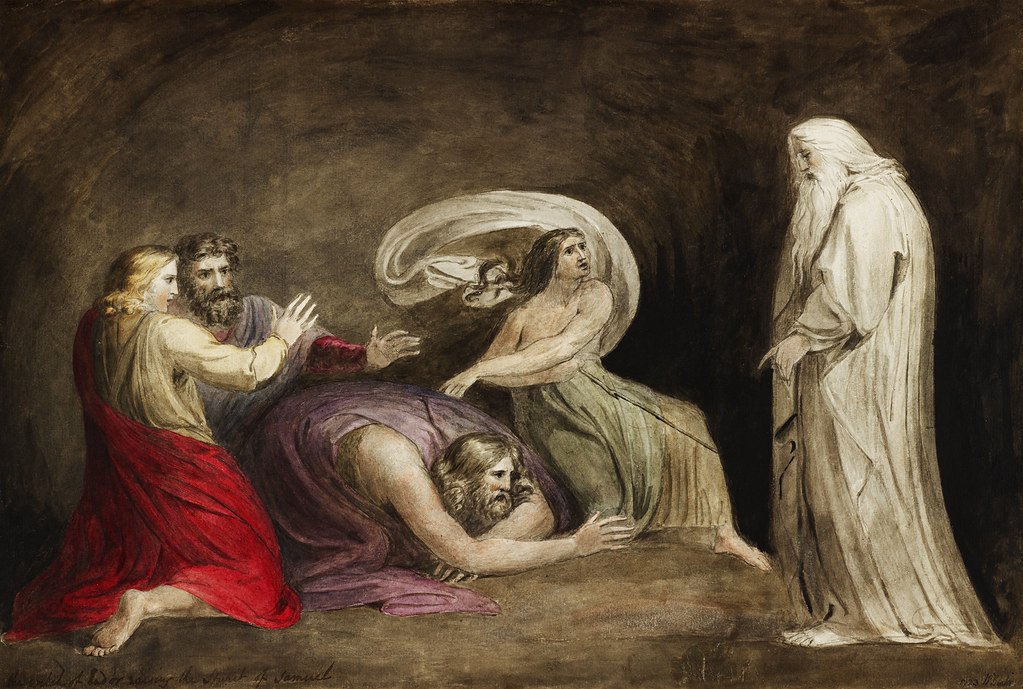
One of the most controversial mysteries in the Bible has finally been solved after two new sermons were discovered in long lost manuscripts.
A 12th-century manuscript preserved in Poland has yielded two previously unknown sermons penned by St Augustine, shedding new light on one of scripture's most contentious passages.
Professor Christian Tornau from the University of Würzburg made the unexpected find in 2024 whilst deciphering texts for the Bad Doberan Monastery Association.
The manuscript, originally from Bad Doberan Abbey, now resides at its daughter monastery in Pelplin and has finally been deciphered.
Both sermons address the Old Testament account of King Saul and the Witch of Endor from Samuel 1:28, a narrative that has divided Jewish and Christian scholars for generations.
The passage depicts a medium apparently conjuring the deceased prophet Samuel, who then foretells Saul's death in battle.
The biblical episode recounts how Saul, facing the Philistines and receiving no divine guidance, sought help from a necromancer.
"Saul believes himself to be in a hopeless situation shortly before a battle against the Philistines. God does not listen to his prayers. He turns to a witch," Professor Tornau explained.

At the king's behest, the woman summoned what appeared to be Samuel's spirit, who prophesied Saul's imminent death.
This account has long troubled Christian and Jewish scholars grappling with a fundamental question: "How can an omnipotent God allow this or is he not really omnipotent?"
The debate has centred on whether the apparition represented trickery, demonic deception, or a genuine divine warning to the doomed king.
In the newly discovered texts, Augustine wrestled with these competing interpretations before reaching his own conclusion.
LATEST DEVELOPMENTS
- Archaeologists make remarkable biblical disovery which could solve mystery in story of Moses
- Science breakthrough: Bible mystery finally solved as geologists make major Garden of Eden river discovery
- Doomsday message revealed in Dead Sea Scrolls after researcher cracks 2,000-year-old case

St Augustine eventually determined that the Witch of Endor possessed no genuine authority over the dead.
Should Samuel have truly appeared, Augustine reasoned, this could only have occurred through divine permission rather than any magical capability the medium might claim.
The theologian delivered the first sermon during a Sunday service, concluding with the theological dilemma and various interpretations.
"It was not until the second sermon on the following Wednesday that the options were weighed up," Professor Tornau noted.

Researchers observed that Augustine refrained from imposing a definitive answer on his listeners, instead presenting the arguments and allowing his congregation to draw their own conclusions.
This characteristic approach reflected Augustine's broader pedagogical method, frequently presenting multiple viewpoints before letting audiences form their own judgements.
Given that works have previously been wrongly attributed to the saint, the researchers undertook rigorous verification.
Professor Tornau collaborated with Dr Clemens Weidmann from the Corpus Scriptorum Ecclesiasticorum Latinorum to scrutinise the manuscripts.

A summer school convened in Vienna during autumn 2025 brought together 20 Latin specialists to assess the texts' authenticity. Their verdict was unanimous: the sermons were genuine.
"The style, humour and content also clearly indicate that the sermons in the manuscripts were actually written by Augustine," Professor Tornau said, pointing to distinctive features that confirmed the theologian's authorship.
Reconstructing the manuscript's journey through history presented considerable difficulties for the research team.
"Firstly, the creation of such a manuscript in the 12th century is unusual. A copy at the beginning of the 8th or 9th century would be more typical," Professor Tornau observed.
Evidence suggests the document may trace back to an earlier volume once held at Amelungsborn Abbey in Lower Saxony, where an old catalogue lists a text matching the Pelplin manuscript's headings and contents.
However, the Thirty Years' War destroyed Amelungsborn's library, rendering definitive confirmation impossible.
Scholars believe a medieval copyist transcribed the sermons from an older source that has since vanished.
A critical edition of the texts is anticipated by the end of 2026.
Our Standards: The GB News Editorial Charter