China’s Huawei touts chip design breakthrough in bid to defy U.S. sanctions
•SHANGHAI — Chinese tech giant Huawei said Monday that it had achieved a breakthrough that would allow it to make cutting-edge chips within five years, touting the news as a significant milestone in Be...
•technology restrictions.
•With the United States and China vying for global dominance in artificial intelligence, U.S.
هذا الخبر من NBC News. خبر يقدم أدوات ذكاء اصطناعي للتلخيص والترجمة والاستماع.
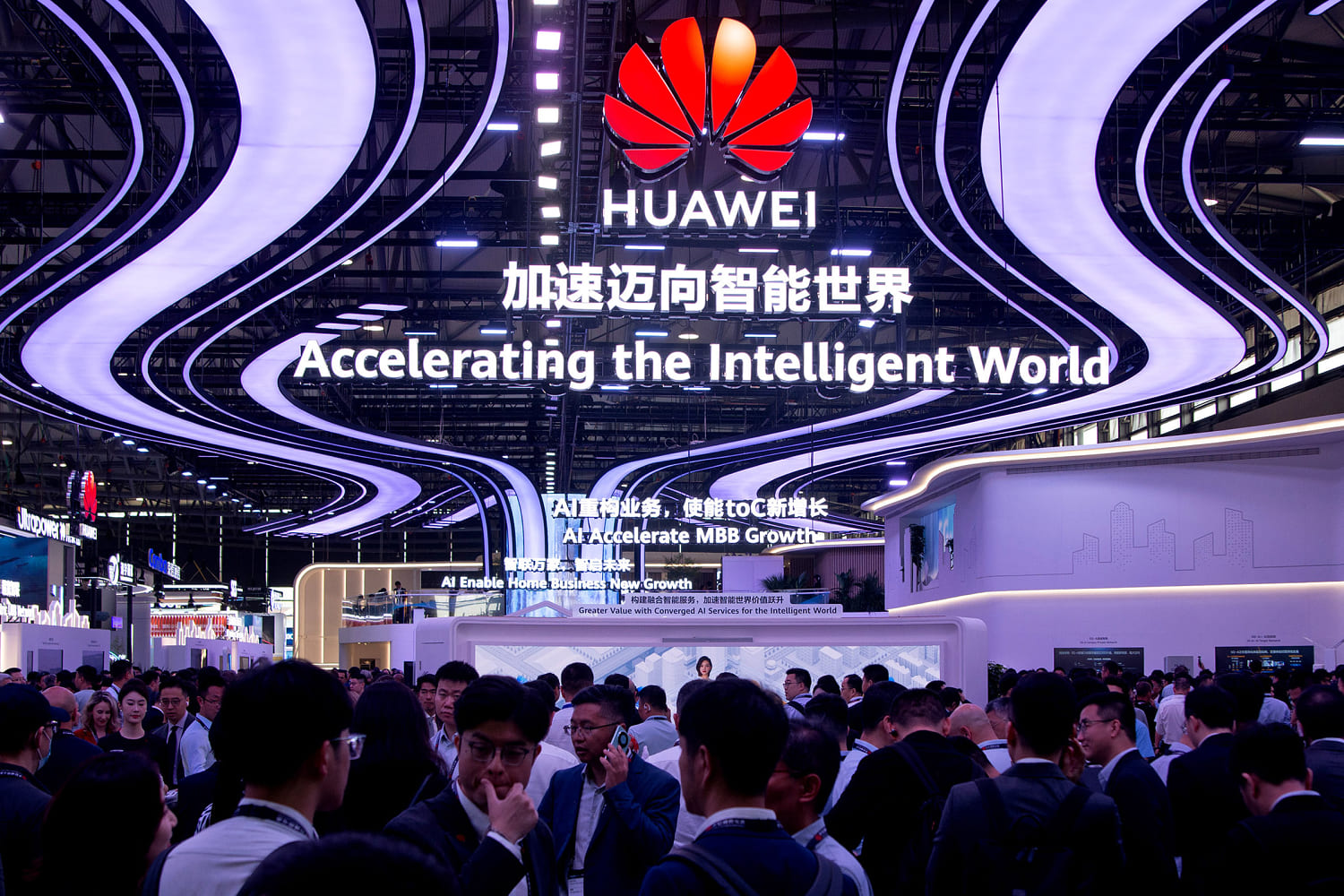
SHANGHAI — Chinese tech giant Huawei said Monday that it had achieved a breakthrough that would allow it to make cutting-edge chips within five years, touting the news as a significant milestone in Beijing’s effort to circumvent U.S. technology restrictions. With the United States and China vying for global dominance in artificial intelligence, U.S. sanctions that began in 2019 have largely cut Huawei off from global makers of semiconductor chips, the tiny brains that power everything from smartphones to computers to cars. Washington has also limited Beijing’s access to chip design software and semiconductor manufacturing equipment such as lithography machines, leading the Chinese government to invest billions into developing its own semiconductor supply chain. Huawei said Monday at a tech conference in Shanghai that by 2031, its high-end chips would have transistor density equivalent to 1.4-nanometer processes, which is considered the industry’s cutting edge. That compares with the 7 nanometers China’s most advanced chipmaking capability is currently thought to be, and the 2-nanometer manufacturing technology used by Taiwan-based TSMC, the world’s leading maker of advanced chips. TSMC, which makes chips for American tech giant Nvidia, says it plans to start mass production with a 1.4-nanometer process in 2028. He Tingbo, president of Huawei‘s semiconductor business, said in a speech that Huawei came up with a breakthrough “LogicFolding” design for its future Kirin chips. This means that rather than achieving performance gains by shrinking transistors — a process requiring extreme ultraviolet lithography machines that China can’t access — Huawei is folding traditional 2D circuits into 3D vertical skyscrapers, essentially stacking chips on top of each other. Huawei, which did not provide any independent performance data to support its announcement, on Monday also debuted a new principle called the Tau Scaling Law, which focuses on cutting the time it takes data to move through chips by folding and stacking them. That’s a departure from Moore’s Law, which has long guided the industry with the idea of fitting more transistors onto tinier chips but is widely seen as approaching its limits. “The industry will face these problems sooner or later,” He, who is known in the Chinese tech industry as Huawei’s “chip queen,” told reporters through a translator after her speech. “We have confidence in this path because we have practice as proof.” The new methodology isn’t without challenges, He said. The traditional tools are not yet sufficient for full-scale free logic design, she said, and thermal management remains a critical issue since the components are stacked vertically. “Cost, power, heat and system integration remain major challenges” for Chinese tech, according to analyst Brady Wang, associate director at Counterpoint Research. “In the short term, China may narrow the gap with global leaders, but a technology gap with the most advanced nodes will still remain,” he told the Reuters news agency. But with the paradigm shift from Moore’s Law to the Tau Scaling Law (nicknamed “Her’s Law” after He), Huawei could bypass the shortage of lithography machines and move one step closer to self-reliance in the global chip race. On Chinese social media platform Weibo, the hashtag #HuaweiSemiconductorFieldNewBreakthrough has generated 40 million views and counting. Some commenters described it as the “DeepSeek moment” for China’s chip industry, referring to an AI model released by a Chinese start-up last year that was said to match or outperform leading American models at a fraction of the cost. Others said U.S. sanctions had encouraged Chinese innovation. “The more sanctions there are from the West, the more breakthroughs China will make!” one Weibo user wrote. After the U.S. restrictions sent it into “survival mode,” Huawei made a comeback in 2023 with the launch of its Mate 60 series of smartphones, whose surprisingly advanced, China-produced 5G chip raised questions about whether the restrictions were still working. In September last year, Huawei announced a three-year road map for building AI chips, effectively filling the void left by Nvidia being shut out of the China market. Though the Trump administration said late last year that Nvidia could sell its powerful H200 chip to certain Chinese companies, no orders have been made. Nvidia CEO Jensen Huang, who traveled with President Donald Trump to China this month for a summit with Chinese leader Xi Jinping, told CNBC last week that his company had “largely conceded” the Chinese chip market to Huawei. But on Saturday, he suggested that the Chinese market would still be a significant source of long-term demand, telling reporters in Taiwan that China was part of the $200 billion market he had forecast for Nvidia’s new “Vera” central processing units. Chinese state media argued after the Huawei announcement Monday that the U.S. and China should find ways to cooperate when possible. “China does not deny the existence of competition, but such competition must be moderate and healthy, aimed at mutual advancement rather than zero-sum games,” read a commentary posted on a social media account associated with CCTV, China’s state-run broadcaster. A Chinese Foreign Ministry spokesperson said last week that Trump and Xi had agreed during their summit in Beijing to launch an intergovernmental dialogue on AI. The U.S. and China “should work together to promote the development and governance of AI,” Guo Jiakun told reporters, “and to ensure that AI better serves the progress of human civilization.” Janis Mackey Frayer and Dawn Liu reported from Shanghai, and Jennifer Jett from Hong Kong.المصدر: NBC News | Source: NBC News
ملاحظة تحريرية | Editorial Note: نُشر هذا المقال في الأصل بواسطة NBC News. خبر (Khabr) هي منصة إعلامية أردنية مرخّصة تعمل بالذكاء الاصطناعي. نضيف قيمة تحريرية من خلال: تحليل ذكي للأخبار، ملخصات تلقائية، رواية صوتية بالذكاء الاصطناعي، ترجمة متعددة اللغات، وتدقيق الحقائق. هدفنا جعل الأخبار أكثر وضوحاً وسهولةً للقارئ العربي.
This article was originally published by NBC News. Khabr is a licensed Jordanian AI-powered news platform (Registration #82086). We add editorial value through: AI-powered news analysis, automated summaries, AI audio narration, multi-language translation (Arabic, English, French, Turkish), and AI fact-checking. Our mission is to make news more accessible and understandable for Arabic-speaking audiences worldwide.