Not only the big letters on the building have changed; someone made sure the name on a small maintenance van now reads “Trump Kennedy Center”. But the renaming of the Kennedy Center – Washington DC’s cultural heart – is just one part of a reinvention both chaotic and sinister, and on a recent visit I felt the city offered a series of eerie contradictions. There’s the plainly farcical: a Trump arts centre is about as credible as Trump University. But then there are fear-inducing architectural gestures reminiscent of fascism: just as Hitler saw the Arc de Triomphe in Paris and decided he needed a much larger one himself, so Trump has been inspired by Napoleon’s edifice. Above all, the atmosphere seems forlorn. It had been the morning of the Cherry Blossom ten-mile run, a usually festive annual occasion, for which the bridge across to Arlington is closed for traffic; now people were lying down on the pavement to photograph the iconic view from the Lincoln Memorial to America’s most important shrine to the military, the Arlington National Cemetery – for that view might disappear forever, if Trump succeeds in having his gigantic triumphal arch built. The latter constitutes visual vandalism, not so much literal destruction, as with the East Wing of the White House, which many people recall fondly as the entrance by which they visited as tourists. Meanwhile, national guardsmen are aimlessly wandering across the National Mall, some parts of which have been closed off behind gigantic signs declaring that DC is being made “safe and beautiful”.
Trump’s manic desire to leave a mark on the built environment – it was recently reported that he is planning to bypass Congress to get his arch built – is not new. Just before Christmas 2020, in the dying days of his first administration, he had taken time off pushing the Big Lie about having won the election to issue an executive order entitled “Promoting Beautiful Federal Civic Architecture”. The order made “classicism” the preferred style for new federal buildings, stopping just short of banning modernism. It is largely forgotten that this attempt at a government formulating aesthetic imperatives – justified in the name of “beauty”, a Trumpian watchword but also one popular with other far-right leaders such as the Netherlands’ Thierry Baudet – came with a set of prescriptions of how US history was to be understood. The President’s “1776 Commission” mandated a correct reading of the past, to be fed directly into patriotic education across the country. The historians appointed by Trump proposed highly sanitised versions of events, with slavery and other pesky details sidelined. The Commission’s work was quickly shelved by Biden, as was the executive order – until Trump effectively re-issued it on the very first day of his second term.
And yet: plenty of Trump’s own buildings are not “classical” at all; rather, they feature a bland form of modernism as an exterior, while boasting a nouveau riche fever fantasy of Versailles on the inside, what the critic Kate Wagner has called “regional car dealership rococo”. Anyone who has seen images of the inside of Trump Tower or witnessed the transformation of the Oval Office since January 2025 cannot help but be reminded of what Peter York, in his hilarious, horrifying book about dictators’ homes, codified as the how-to for the contemporary tyrant: “big it up”, “go repro”, and adopt what the decorator Nicky Haslam once termed “Louis-the-Hotel style” – which means: make everything shiny and give a vague impression of being French.
As so often the case in Trump’s first term, the gesture about architecture felt more like wanting to put a prop in place, for the sake of instant consumption as opposed to any kind of coherent long-term plan: the president frequently used cartoonish images – seemingly made for TV audiences – to show that something important had happened. At a press conference in January 2017, an enormous pile of papers had “proved” that the real estate developer turned reality TV star had properly divested from his business; in 2020, another pile demonstrated conclusively that there really existed a “beautiful” healthcare plan (even today there is no such thing).

This logic of props and surface impressions is still evident in today’s increasingly Trumpified DC: what has changed is really only facades, although that constitutes another eerie parallel with Nazi architecture. The latter prioritised the need to visually overwhelm visitors to Hitler’s planned “world capital”, Germania, over buildings functioning properly behind the enormous facades. It is well known that Hitler had once sought to become an architect; it is not so well known that he was primarily interested in interior and stage design, and that many of Albert Speer’s planned edifices worked best as backdrops to a choreography of uniform and uniformed masses. It is within this logic that Trump is so obsessed with the reflecting pool in front of the Lincoln Memorial. It is widely known that its structural problems need to be fixed, but Trump just wants a quick surface job (making it “American-flag blue”). It is also within this logic that banners with Trump’s glowering face have been hung on the Department of Justice and the Department of Labor. Thus, slapping his name and visage on everything is both a sign of a personality cult designed to provide an intimidating background, and the extension of a marketing strategy Trump has pursued for decades (recall Trump steaks, perfume, sneakers, a fake university, etc). It’s surface über alles.
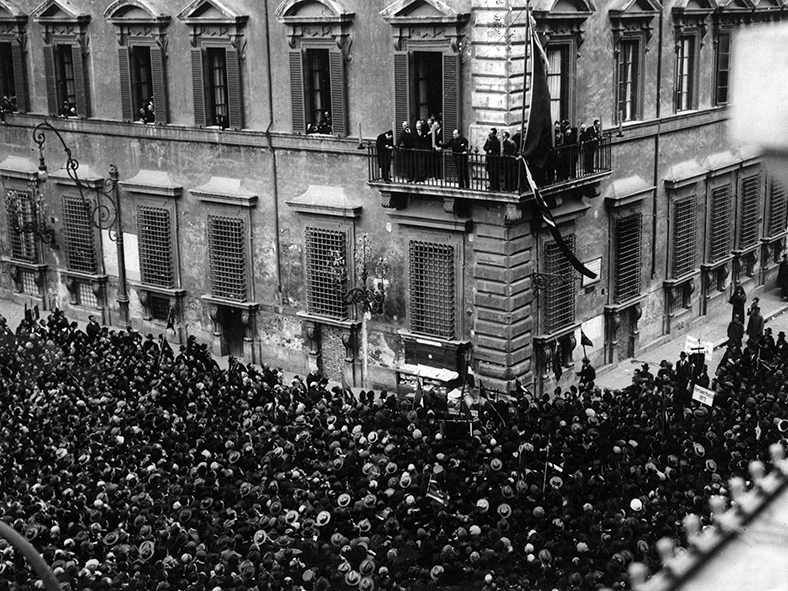
But, as is true of Trump 2.0 in general – in contrast with the first term – there are now also much more coherent plans to bring about lasting change. And there is a Maga-adjacent personnel committed to realising them in the National Civic Art Society, which has long been pushing traditional architecture as the path to “harmony” and “beauty”. Banners could simply be taken down if there were regime change; just as after the fall of Mussolini Italians demanded basta con i balconi – “enough of balconies”, a symbol of the fascist leader addressing the masses from above – Americans may decide: that’s it with banners.
So Trump and his harmony-loving anti-modernist allies seek a permanent transformation: he wants to create an enormous ballroom in the White House, with a bunker – including a “state-of-the-art hospital” – underneath and a “drone port” and spaces for plenty of snipers above. There is supposed to be a “Garden of Heroes” featuring what by all accounts will be kitschy statues of historical figures (a continuation of the 1776 Commission’s ill-fated work), and, of course, the triumphal arch with a winged, gilded statue vaguely reminiscent of Lady Liberty, eagles, and for good measure, lions (an iconography that screams: royalty!).
Absolutely none of these projects has any real function other than glorifying Trump; even the ballroom just recreates the kind of space Trump likes at Mar-a-Lago, where crowds can be carefully curated and serve to provide adulation. They exhibit grotesque proportions; any actual connoisseur of classicism – as opposed to the Trumpist architects invested in cartoonish Disney versions of the classical – would reject them out of hand. Consultations with the public have yielded uniformly negative reactions; polls show clear majorities opposing Trump’s designs.
Then again, the projects do fulfil one other function: they create ample opportunities for corruption. Donors to the ballroom can stay anonymous if they wish; meanwhile, the promise that the edifice would be “free” for US taxpayers – initially Trump claimed he would fund the whole thing himself – is being broken in classic Trumpian bait-and-switch fashion. Republicans, apparently aware of the ballroom’s importance for Trump’s famously fragile psyche, now propose to appropriate $1bn for the “East Wing modernisation”.
The vandalism agenda also proceeds: as the architect Belmont Freeman has pointed out, the prospect of demolishing brutalist buildings in Washington – another pet issue for the Civic Art crowd – is not just about rejecting a style about which reasonable people can disagree; it also about discrediting the very social-democratic aspirations which the modernist edifices of the Department of Education and the Department of Housing once signified. The government is not there to help you; the government is there to generate pictures fit for glossy magazine covers.
As real government functions are replaced by frivolous l’état, c’est Trump projects, the area around what is fast becoming the Mar-a-Lago of the north has turned into a vast building site. Not just the gigantic hole where the East Wing stood (promptly declared by Trump lawyers to be a “national security risk” in order to overcome resistance by courts to erect a new building without approval from Congress), but also Lafayette Square, the renovation of which – again in the name of making DC “safe and beautiful” – is undertaken, just like the pool job, by a contractor who faced no rival bids and who has apparently also been paid a vastly inflated price.
Like other aspiring autocrats, the government is bypassing regular procurement processes in the name of “urgency” and mysterious “emergencies”. The end result is that, right now, no citizen can get anywhere near the president’s house. This situation is reminiscent of Viktor Orbán’s redesign of the square in front of the Hungarian parliament – also all in the name of restoring a proper sense of Hungarian history, but with the side effect of making protest impossible for an extended period, on a site that had traditionally served as a locus for opposition.
It is not unusual that aspiring autocrats pay special attention to the built environment: gigantic edifices signal that a regime is there to stay and adversaries have been vanquished; large construction budgets are an excellent means to keep cronies happy. Favoured styles – take the Ottoman-Seljuk-style promoted by Erdoğan, for instance – communicate what the leader understands as the correct reading of national history and provides guidance as to who constitutes “the real people” (a favourite expression of today’s populists, including Trump). But others are more careful not to engage in a personality cult – or at least not make it so obvious. After all, they want to keep the look of democracy, and, in any case, concentrating all attention on oneself can backfire if a government is not doing too well. Trump, with his curious mixture of frivolous self-promotion and a quasi-fascist aesthetics of domination, has had no compunction when it comes to making it all about himself. He might soon enough face his moment of basta con le sale da ballo.
Jan-Werner Müller is a political philosopher at Princeton University. His latest book is Street, Palace, Square: The Architecture of Democratic Spaces (Allen Lane)
[Further reading: Vladimir Putin’s nightmares have come true]