• Ex-finance minister Hafeez Pasha says foreign inflows could encourage disproportionate investment in real-estate
• 1970s oil imbroglio marked the beginning of labour emigration to Gulf, while current crisis could spell its end
• PIDE sees around a million workers’ livelihoods being affected if conflict prolongs
ONLINE listings for properties in Punjab districts like Mandi Bahauddin and Gujrat yield images of Spanish-style villas, fully decked out with opulent fittings and European design flourishes.
This stylised approach to construction is quite deliberate and reflects the social status that comes with having a ‘Kamanay Wala’ (earning member) abroad. In many families, at least one offspring is abroad, creating an alternative source of income that, in many cases, has reduced the incentive to further develop the district’s fertile agricultural land for those that still dwell there.
Mandi Bahauddin particularly is one of many districts where household prosperity is closely tied to money sent from overseas.
Saying that remittances are Pakistan’s lifeline is no exaggeration. Released in May, the State of Pakistan’s Economy Half-Year Report 2025-26 projects remittances at up to $42 billion this fiscal year, compared to exports of $30.5bn.
At the macroeconomic level, remittances help keep the current account deficit in check. At the household level, they act as an essential safety net, providing direct cash support to families.
However, cash in hand at the household level tends to drive spending rather than investment in productive activities.
Pakistan’s reliance on remittances has laid the foundation for a form of ‘Dutch disease’, where the economy depends on inflows that fuel demand rather than production. The State Bank reports also note that remittances increase currency in circulation, as recipients convert inflows into physical cash for day-to-day expenditures.
Data from the Household Integrated Economic Survey FY25 shows that remittances have risen from five per cent to 7.8pc as a source of household income. While this helps households smooth spending during periods of economic stress, it also increases their exposure to external shocks that can suddenly disrupt these inflows.
Remittances and real estate
Research by the Pakistan Institute of Development Economics indicates that a significant share of remittances is channelled into property and real estate. Anecdotally and empirically, this holds up; the dominant motive behind the decision to migrate is to improve the socio-economic status of the family, which investments in property demonstrate.
Nor is Pakistan unique in this regard. India, the world’s largest recipient of remittances, received $136bn in FY25, more than three times Pakistan’s inflows. Non-resident Indians have also become increasingly active in the property market. According to the India Brand Equity Foundation, their share of real-estate investment has risen from 10-12pc in 2019 to a possible all-time high of 20pc in 2025.
While property investments are a common feature of remittances, Pakistan faces another conundrum. Former finance minister Hafeez Pasha argues that Pakistan’s real-estate sector neither contributes adequately to tax revenues nor operates fully within the formal economy, yet continues to attract a disproportionate share of investment.
“About a decade ago, investment in industry and manufacturing was two and a half times that of real estate. Today, you have the strange situation that real estate is over twice that of industry,” he says, though not solely because of remittances.
There are six real estate and property-related taxes, he notes, yet total revenue collection amounts to only 0.2pc of GDP, despite a potential of around 0.8pc. Urban immovable property tax collection in Karachi, for example, generates roughly ten times less revenue than Mumbai in dollar terms because of severe under-taxation, he adds.
Oil giveth, oil taketh
One oil shock’s legacy, involving the US’s long-standing entanglement with oil markets and support for Israel, was the start of Pakistan’s emigration story. This was also the start of the country’s reliance on remittances.
But another such oil shock, involving similar geopolitical players, may well mark the beginning of the end of the Pakistanis-in-Gulf fairy-tale.
In 1973, Arab members of Opec imposed an oil embargo on the US in retaliation for its support for Israel. The resulting shock saw prices jump from around $3 to nearly $12 per barrel.
The sudden influx of petrodollars supercharged growth across the Gulf, triggering massive infrastructure projects that required large volumes of blue-collar labour.
In Pakistan, this coincided with a period of sweeping nationalisation under Zulfikar Ali Bhutto, which pushed unemployment higher at a time when passage to Gulf countries was relatively easy to obtain.
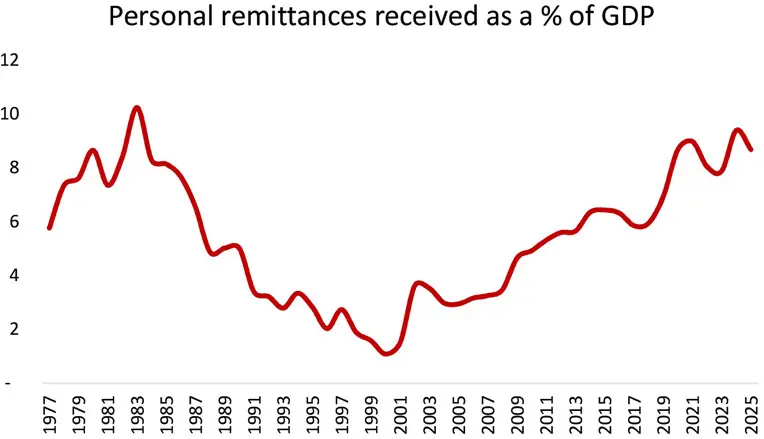
Hence, Pakistani labour moved in large numbers to the region, driving remittances to a peak as a percentage of GDP in 1983. The ratio fell steadily through the late 1980s and 1990s as oil prices fell, Gulf countries cut construction projects, and demand for Pakistani labour declined.
Pakistan’s nuclear tests in 1998 led to sanctions. Pakistan froze foreign currency accounts, trapping diaspora savings deposited in Pakistani banks and eroding confidence in formal channels, leading to a boom in hawala/hundi.
Then came 9/11, leading to a global crackdown on informal channels. Pakistan also became a front-line state in the ‘War on Terror’, leading to the lifting of sanctions. The drive by the authorities in recent years to regularise and incentivise remittances has led to flows back into formal channels.
Returning labour
External shocks — particularly movements in oil prices and developments in the Gulf — have historically shaped Pakistan’s remittance story. The Middle East accounts for roughly 55pc of Pakistan’s remittances and absorbs between 700,000 and 800,000 new Pakistani workers each year.
The ongoing conflict involving Iran, the United States and Israel has damaged infrastructure, disrupted energy markets and introduced fresh uncertainty across the region, reducing demand for Pakistani labour.
A recent policy viewpoint by the Pakistan Institute of Development Economics estimates that if the conflict is prolonged, around half a million Pakistani workers may be unable to secure overseas employment this year, while another half a million could be forced to return home.
Such a reversal would have serious implications for Pakistan’s labour market, particularly in KP and Punjab, where overseas migration traditionally absorbs nearly one-third of new labour-force entrants. The flow of money that transformed villages, financed homes and underpinned aspirations for generations may no longer be as certain as it once seemed.
Published in Dawn, June 4th, 2026