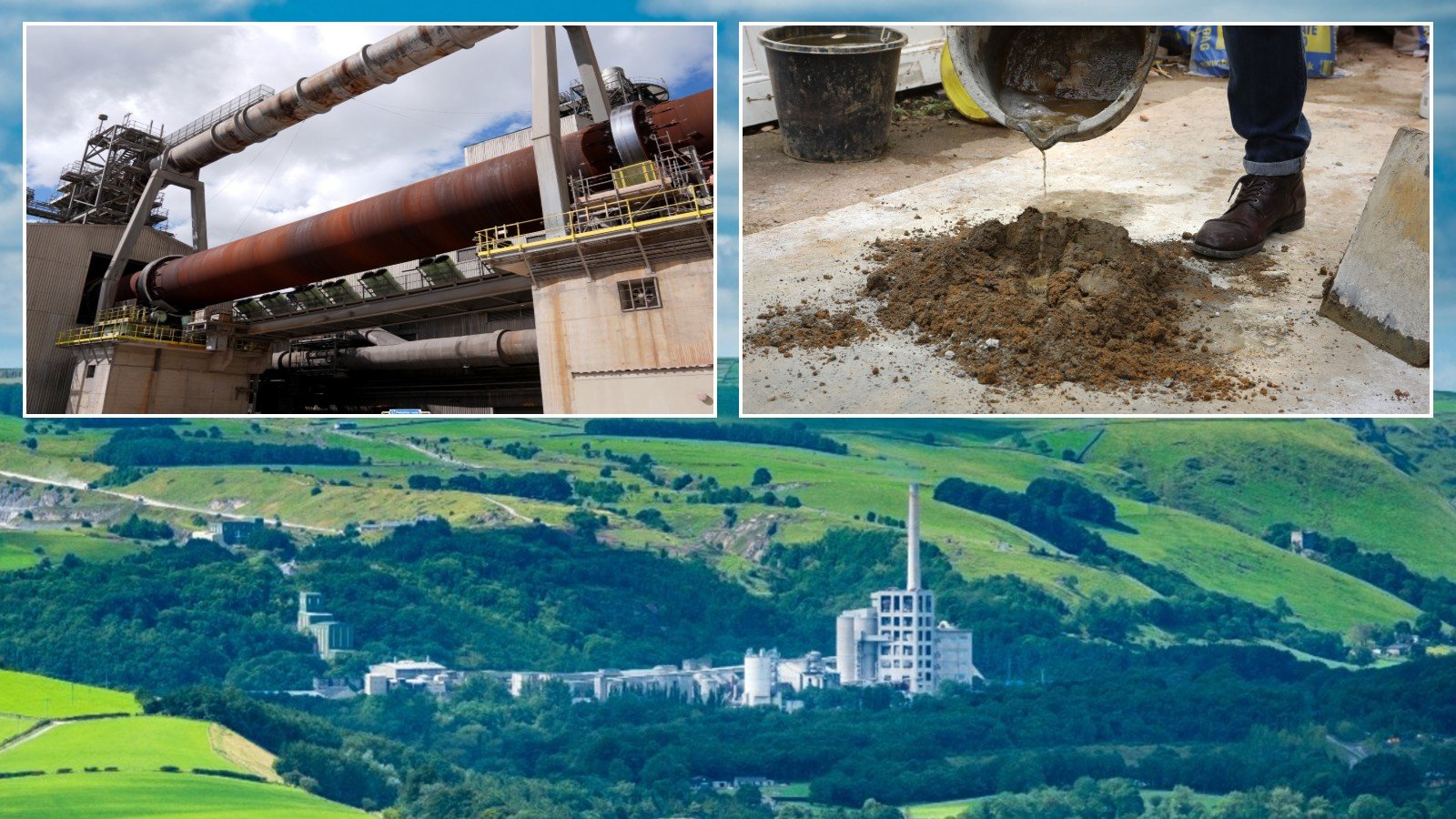
British cement production is at its lowest level since 1950 as the sector battles high energy prices and carbon charges, a major manufacturer has warned.
Cement giant Breedon said that “urgent action” was needed “to secure the future of domestic cement production”.
Imports now account for a third of UK sales and often originate from countries with weaker climate rules and lower carbon levies, the company says.
Breedon, which has 350 sites across the country, called for more help with energy costs and greater protection from foreign competitors.
Cement is a carbon-intensive industry, contributing to up to eight per cent of global emissions. It requires high-temperature kilns, while the manufacturing process itself releases CO2.
Breedon supplies around two million tonnes of cement each year from its UK and Irish operations.
It runs Hope, Britain’s largest cement plant, in the Peak District National Park.
The Derby-based firm says that, with the right support, UK cement has the opportunity “to be a global exemplar for greening heavy industry”.

But it warned that domestic producers “face structurally uncompetitive industrial electricity costs and uneven carbon regulations compared to foreign importers”.
It has updated its Back British Cement campaign that calls for a “level playing field” for UK manufacturers.
It says that while there has been “good engagement” with the Government, there was still work to be done.
It has asked for cement to be better supported by industrial electricity compensation schemes and called for cement and concrete to be recognised as strategic materials in Government procurement.
LATEST DEVELOPMENTS:
- North Sea is a 'very good basin with lots of oil and gas' but has been 'extremely poorly managed'
- Turbines as tall as the Eiffel Tower threaten to cast shadow over 'holy island' off UK coast
- Andy Burnham warned 'bottle tax' could KILL 4,750 jobs and put British beer at risk
A ‘carbon border adjustment mechanism’, or CBAM, is being introduced in January.
This will see many imported materials – including cement – attract a charge to reflect their carbon cost. Breedon wants the CBAM strengthened ahead of its implementation and to “ensure imported cement faces equivalent carbon costs to UK producers”.
It also wants alignment on UK and EU carbon pricing. Further, it has called for more support for carbon capture schemes.
These see harmful emissions trapped and stored safely, usually under the seabed.
They are viewed as vital if the country is to maintain high-carbon industries while reaching Net Zero emissions.

A huge carbon capture scheme, Peak Cluster, is planned to deal with cement firms in the Peak District.
Rob Wood, Chief Executive of Breedon, said: “Our Back British cement campaign advocates for a level playing field for the domestic cement industry, including effective carbon border measures, to support UK construction, economic growth and national resilience.
“We believe domestic cement producers should be allowed to compete fairly with overseas manufacturers, who do not face the same high energy prices and carbon taxes.”
Mike Pearce, Chief Executive of Breedon GB, said action was needed now to stem the tide of imports.
He said: “Without urgent action to address industrial electricity cost disparities and uneven carbon frameworks, the dependence on imported cement - often from jurisdictions with weaker carbon regimes - will accelerate, whereas a robust British cement industry has the opportunity to be a global exemplar for greening heavy industry.
“Procuring more British cement for Government-backed projects, whether infrastructure or housing, rather than imports, can also make a significant difference to job security and supporting communities across the country.”

A Government spokesman said the cement sector was eligible for its Supercharger scheme, which sees firms exempted from paying a range of costs and network charges on electricity bills.
Other manufacturers could qualify for the British Industrial Competitiveness Scheme, which reduces electricity costs by up to a quarter.
The Government has pledged to liaise with companies once the CBAM is in operation, “to ensure the decarbonisation of our industrial sectors is carried out in a fair and managed way”.
A spokesman said: “We recognise the cement sector faces challenges, which is why we are acting through our Supercharger scheme, cutting electricity costs for hundreds of our most electricity-intensive businesses, including Breedon.”
Our Standards: The GB News Editorial Charter