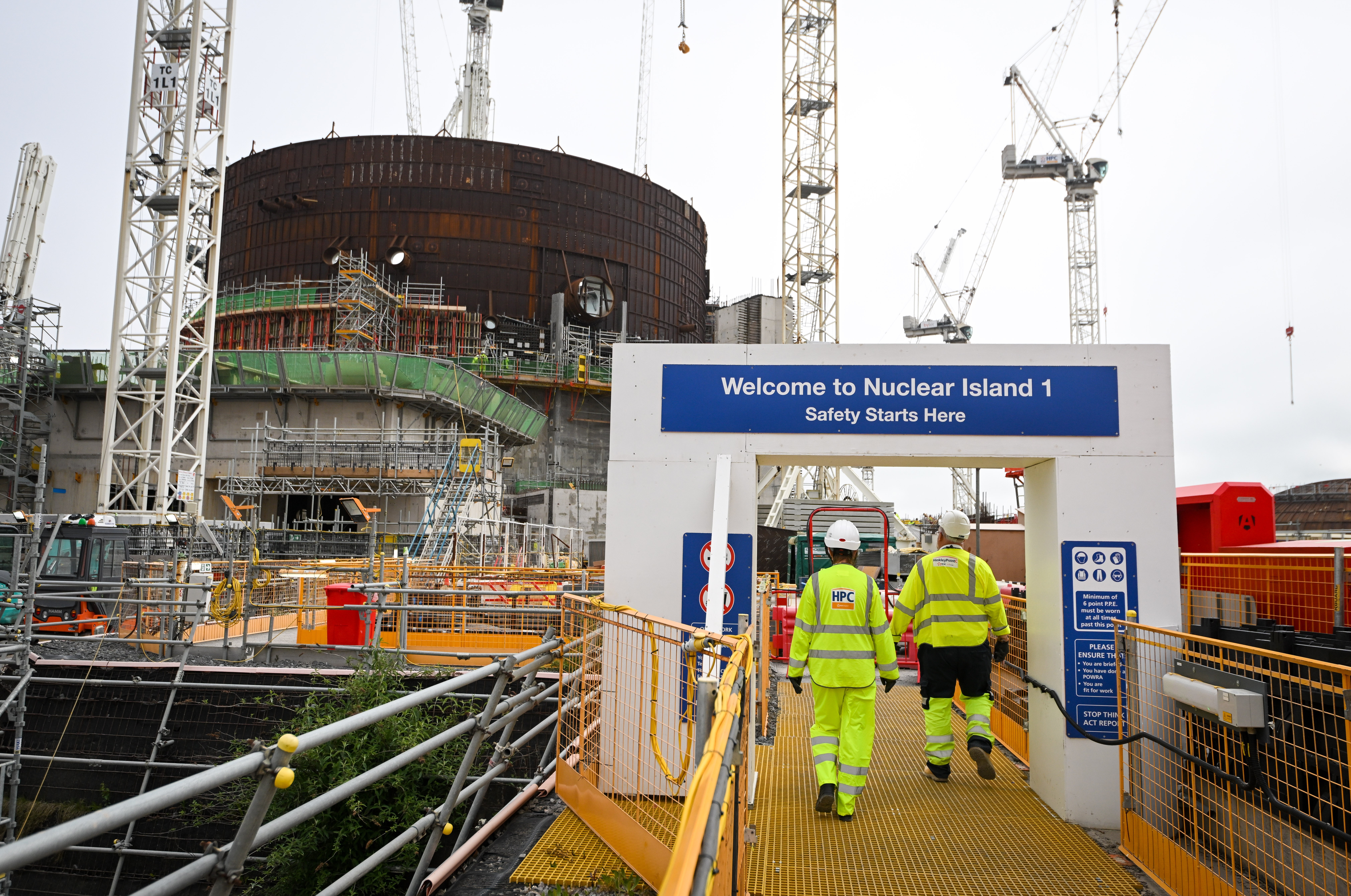
Britain's flagship nuclear plant could face years of delays because of demands to protect fish
•Britain's flagship £35billion nuclear power plant could face years of delays in an ongoing row over fish.
•Construction on Hinkley Point C, the UK’s first new nuclear power station in more than three decades, began in 2018, but its start date has been repeatedly pushed back.The plant, being built by energy...
•EDF could be asked to fund the creation of hundreds of acres of salt marsh by flooding farmland next to the Bristol Channel, creating new habitats for fish to breed.
هذا الخبر من GB News. خبر يقدم أدوات ذكاء اصطناعي للتلخيص والترجمة والاستماع.
المصدر: GB News | Source: GB NewsBritain's flagship £35billion nuclear power plant could face years of delays in an ongoing row over fish.
Construction on Hinkley Point C, the UK’s first new nuclear power station in more than three decades, began in 2018, but its start date has been repeatedly pushed back.
The plant, being built by energy giant EDF, is now embroiled in a row with government quango Natural England over safeguards for fish in the Severn Estuary, from where it would draw water to cool its reactors.
EDF could be asked to fund the creation of hundreds of acres of salt marsh by flooding farmland next to the Bristol Channel, creating new habitats for fish to breed.
TRENDINGStoriesVideosYour SayBut this would delay the Somerset project by around five years, it is understood.
Because nuclear power is vital for Net Zero it would throw the nation’s carbon reduction targets off course.
EDF branded Natural England’s position “an example of a disproportionate regulatory approach”.
The plant says it has already spent £700 million in mitigation measures, including £500 million on bespoke intake heads that will slow the flow of seawater and £150 million on a recovery and return system for fish that are caught in the pipes.
It has spent a further £50 million an acoustic fish deterrent, branded a “fish disco”, that keeps them away from the intake.
Tests earlier this year suggested this was “highly effective”. But government advisory body Natural England had said that these plans are not enough, it is understood.
Campaigners say the cooling system risk killing large number of migratory fish, including twait shad, salmon and cod.
Although Natural England says it is not stipulating any course of action, insiders close to the matter say all other options have been rejected – leaving the salt marsh as the only solution.
LATEST DEVELOPMENTS
- Global warming threshold ‘to be breached in four years’
- BP relegates Net Zero division as it pivots back towards oil and gas
- Britain’s North Sea future ‘hangs in the balance’ as windfall tax 'drives firms abroad'
Without the approval of Natural England concerning the use of the waterway, EDF says it will not be legally allowed to turn on the plant.
It highlighted the issue in a letter to local communities, writing: “Despite positive engagement with environmental regulators in recent months, we are now aware that Natural England have a view that more compensation should be required and secured in advance of operations.
“I would stress that this is in the context of Hinkley Point C now having more fish protection in place than any other power station in the world.
“We are concerned that Natural England's current position is an example of a disproportionate regulatory approach identified for reform by the recent Nuclear Regulatory Taskforce report and would be effectively impossible before the plant is operational.”
The Environment Agency had estimated that the number of fish expected to be killed each year would be around 44 tonnes – equivalent to the catch from a small trawler.
But EDF says this figure was reached without taking the fish deterrent into account, and believes the true number would be far smaller.
The case highlights the issue of regulation when it comes to major infrastructure.
Last year, the Government commissioned the Fingleton report to look into nuclear construction.
The review recommended a reset of the regulatory system to speed up delivery and to cut costs.
It advocated a less risk-averse approach, including loosening some environmental and safety constraints.
Author John Fingleton highlighted the fish issue at the power plant, saying: “Hinkley Point C will have more fish protection measures than any other power station in the world.” He said it was an example of “overly cautious regulation”.
A spokesperson for Hinkley Point C said: "Hinkley Point C’s planning permission required three separate fish protection systems and all three are being successfully delivered. This will give the project more fish protection than any other power station in the world, at a cost of more than £700m.
“One of the three fish protection systems is an innovative British designed 'acoustic fish deterrent'. Tests by Swansea University show that it works well and engagement with environmental groups has been positive.
“As a result, the project believes further compensation measures should not be required. This matters to communities up and down the Severn who opposed plans to create 900 acres of saltmarsh compensation on farms and other land."
Natural England denied it was blocking the power plant, insisting it was working alongside EDF to ensure the project happened legally.
It pointed out that the Severn estuary was “globally unique” and said “any short-term costs to protect its ecosystem are an investment in its future”.
“Claims that Natural England is blocking the project, acting disproportionately, changing its position, or ignoring evidence are incorrect,” it said.
“Our advice has been consistent and measured and has not changed.”
It denied it was ordering a salt march be constructed but pointed out EDF was legally obliged either to ensure impacts were fully mitigated or to secure appropriate compensation.
It added: “We are working to enable the project, not obstruct it.”
Dave Slater, Regional Director for Natural England said: "Development and nature are not competing interests.
“Building the UK's largest nuclear power station is a major undertaking which brings significant environmental challenges and we are playing our part in finding solutions to enable this vital infrastructure development to go ahead while improving environmental outcomes.
“The findings on the effectiveness of the Acoustic Fish Deterrent are encouraging, and Natural England is continuing to work closely with EDF to deliver this incredibly important project, while meeting its legal obligations.”
Our Standards: The GB News Editorial Charter

ملاحظة تحريرية | Editorial Note: نُشر هذا المقال في الأصل بواسطة GB News. خبر (Khabr) هي منصة إعلامية أردنية مرخّصة تعمل بالذكاء الاصطناعي. نضيف قيمة تحريرية من خلال: تحليل ذكي للأخبار، ملخصات تلقائية، رواية صوتية بالذكاء الاصطناعي، ترجمة متعددة اللغات، وتدقيق الحقائق. هدفنا جعل الأخبار أكثر وضوحاً وسهولةً للقارئ العربي.
This article was originally published by GB News. Khabr is a licensed Jordanian AI-powered news platform (Registration #82086). We add editorial value through: AI-powered news analysis, automated summaries, AI audio narration, multi-language translation (Arabic, English, French, Turkish), and AI fact-checking. Our mission is to make news more accessible and understandable for Arabic-speaking audiences worldwide.