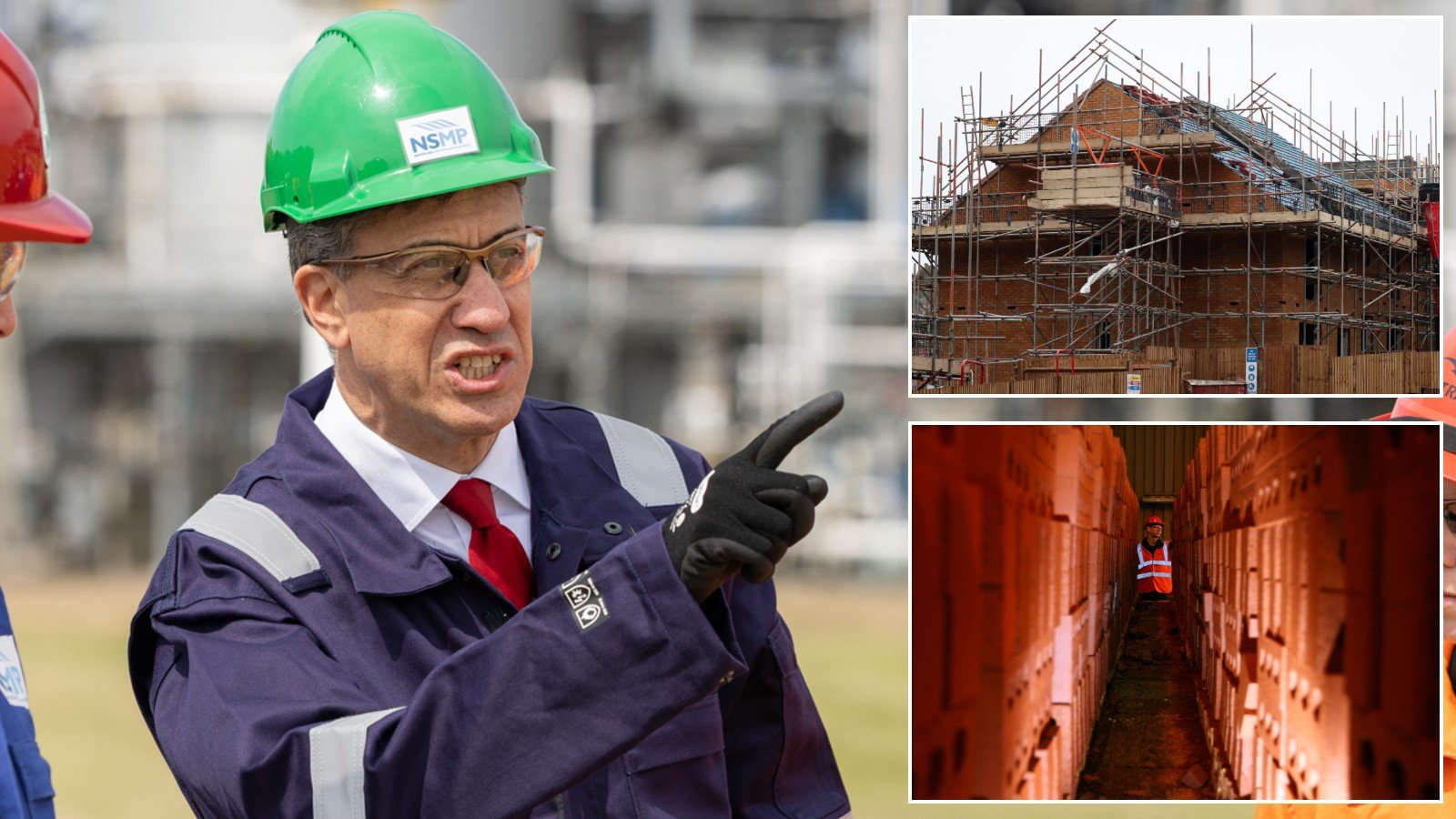
Britain's brick industry risks being KILLED OFF due to 'factually wrong' Net Zero standards - 'Provable nonsense!'
•Britain's brick industry is facing disaster because Net Zero carbon standards underestimate how long-lasting they are, experts have warned.
•Under current guidelines, bricks are given a lifespan of 60 years.
•But most will endure far beyond that, argues think tank Create Streets, meaning this benchmark makes them appear more “high carbon” than is the case.
هذا الخبر من GB News. خبر يقدم أدوات ذكاء اصطناعي للتلخيص والترجمة والاستماع.
المصدر: GB News | Source: GB NewsBritain's brick industry is facing disaster because Net Zero carbon standards underestimate how long-lasting they are, experts have warned.
Under current guidelines, bricks are given a lifespan of 60 years.
But most will endure far beyond that, argues think tank Create Streets, meaning this benchmark makes them appear more “high carbon” than is the case.
This could lead to builders eschewing bricks in favour of materials that actually have a larger carbon footprint, its report, Bricks Are Best, says.
TRENDINGStoriesVideosYour SayThe founder of the think tank, Nicholas Boys Smith, said its report “shows how a catastrophically stupid and factually incorrect imposition of Net Zero policy risks destroying the entire industry”.
A standard of at least 120 years would be more appropriate, he said, explaining: “It appears to be a philosophical misunderstanding of what it is to build sustainably – these are things that endure, things that are resilient.”
For years, building regulations had focused on the energy use of a home after it was built.
But with houses growing ever more efficient, whole-life, or embodied, carbon represents a growing share of a home’s total lifetime emissions.
Building work is set to increasingly take into account the “whole life carbon” of materials, a calculation that measures their carbon footprint across their lifespan.
In the UK, this is based upon the Royal Institution of Chartered Surveyors’ (RICS) Whole Life Carbon Assessment standard, which assumes a 60‑year reference period for most building projects.
This standard was based on European regulations and is widely used. But Create Streets, a research institute that advises community groups and councils on planning and developing urban housing, says it is the wrong benchmark for bricks.
“Unless we change direction, we are going to kill the British brick industry,” it says.
It states that current whole-life carbon standards “are factually wrong in their treatment of Britain’s most popular building material, bricks, and are leading to perverse outcomes”.
Embodied carbon limits are not currently regulated, but industry experts predict that this will change, with backing for the shift coming from major housebuilders and industry bodies.
London already requires whole-life cycle carbon assessments for major developments under its London Plan and some local authorities are developing upfront carbon policies for residential schemes.
The Government says it is currently considering how to approach the issue of embodied carbon.
LATEST DEVELOPMENTS:
- Andy Burnham's promises and inherited black holes to cost taxpayers more than £250 BILLION
- Ed Miliband's Net Zero plans suffer blow as heat pump rollout stalls and climate change fears wane
- Bereaved parents lay children's shoes outside Parliament in protest of 'cliff-edge' state support
The Minerals Product Association, the trade body that covers cement and concrete, said the same issues applied to its materials, which are “designed to last for generations”.
It called the 60-year standard “arbitrary” and based upon “assumptions that don't stand up to scrutiny”.
Mr Boys Smith, a visiting professor in architecture at the University of Strathclyde who has advised successive Governments, described assigning bricks a 60-year lifespan as a “simple but incredibly serious error”.
Although bricks need energy to create – the kilns have to hit temperatures of more than 1,000C – they are more long-lasting than many other materials, he said.
“They are literally sustainable because they endure,” he said.
He said the 60-year standard implied the building would be torn down and rebuilt after that time period. But the report estimates that 40 per cent of English houses are built of bricks that are more than 60 years old, with 27 per cent more than 80 years old and 15 per cent more than 110 years old.
It states that these estimates are likely conservative. “Assuming that brick buildings will only last 60 years is provable nonsense,” said Mr Boys Smith.
“By falsely doing so, industry standards are systematically and incorrectly making bricks appear much more ‘high carbon’ than they really are.
“The price is being paid in British manufacturing and British jobs.”
The industry employs almost 8,000 workers directly, with thousands more involved in supply chains, quarrying and logistics. It is worth £1.3billion to the economy.
The sector is already facing difficulties, including high energy prices and pressure from abroad. Domestic production has fallen from 2 billion bricks in 2022 to 1.3 billion in 2024 – a 32 per cent drop.
Mr Boys Smith said the damage caused by the 60-year standard was “happening, and it’s happening right now”.
He said: “When developers and builders are under economic pressure, they will not take any risks they don’t need to.
“If you believe putting bricks on will make a project less likely to go through or get signed off, you are not going to use them.”
Create Streets warns that losing production capability would “be practically irreversible: once kilns close and specialist knowledge disperses, restarting production becomes economically unviable”.
It points out that Britain already imports nearly 20 per cent of its bricks, amounting to more than 500 million in 2022. That year, this added nearly 300,000 tonnes of CO2 from import costs.
“This directly contradicts the supposed environmental rationale for discouraging brick use,” the report finds.
“The strategic folly is clear: destroying a domestic industry that produces a popular, durable, low-maintenance product in favour of dependency on imports shipped thousands of miles is the opposite of resilience, sustainability or economic sense.”
It points out that since 2003 carbon emissions from the sector have fallen by 47 per cent, with more reductions expected.
But it needed stability to be able to invest in the cleaner technology required. “Current carbon standards are factually wrong for brick buildings,” it says.
“UK and international wholelife carbon methodologies apply a default 60-year lifespan for all homes, including brick housing.
“This is incorrect: many British homes are brick buildings over 100 years old. They are still performing as intended.
“If we are serious about restricting carbon in the long-term, rather than just meeting an arbitrary 2050 Net Zero target, the 120-year standard should be formally included within whole-life-cycle assessments.”
The report was funded by Ceramics UK, although Create Streets said the trade body did not have any control over its content. Separately, the Mineral Products Association said that the current standards did not reflect reality.
Executive Chairman Chris Leese said: “Carbon policies should be based on how buildings perform in the real world, not on assumptions that don't stand up to scrutiny.
“Current standards that measure the carbon impact of brick buildings based on just a 60-year lifespan simply don’t reflect reality.
“The same challenge applies when buildings use blocks and other concrete products used alongside brick in the homes, schools and infrastructure we depend on every day. These materials support thousands of skilled jobs across Britain and are designed to last for generations.
“The choice of building materials shouldn’t be made solely on how much carbon they take to produce, but how long they last and the performance benefits they provide over their lifetime.
“Homes built with bricks and blocks offer durability, fire resilience and protection from flooding, while helping to keep indoor temperatures more stable during extreme weather.
“As new building standards evolve, they must recognise the long-term value of materials that have a proven track record of serving communities well for decades.
“Getting that balance right will support British manufacturing, boost housing delivery and help ensure we continue building homes that stand the test of time.”
The RICS said that the 60-year reference period was not meant to represent the expected lifespan of a building. Rather, it said, it provided a standard reference point, in order to allow comparisons.
It said that the 60-year time frame had been based upon existing European regulations rather than created by the RICS. It was a standard adopted worldwide.
It also said that the Create Streets report was based on the assumption that buildings constructed from brick would last for many decades. But this is not always the case, it points out, saying there are many instances when timber proves a better option for carbon savings.
A spokesman for the Government said that there was no Government regulation on embodied carbon in new buildings although it was “considering the best way forward” in measuring and reducing this carbon.
He said: “No decisions have been made on this.
“We are currently considering the right approach to embodied carbon in new buildings, and will ensure that any plans do not unfairly impact brick builders.”
The Government said it recognised that embodied carbon “can account for a significant portion of a building’s whole life carbon emissions”.
Our Standards: The GB News Editorial Charter


ملاحظة تحريرية | Editorial Note: نُشر هذا المقال في الأصل بواسطة GB News. خبر (Khabr) هي منصة إعلامية أردنية مرخّصة تعمل بالذكاء الاصطناعي. نضيف قيمة تحريرية من خلال: تحليل ذكي للأخبار، ملخصات تلقائية، رواية صوتية بالذكاء الاصطناعي، ترجمة متعددة اللغات، وتدقيق الحقائق. هدفنا جعل الأخبار أكثر وضوحاً وسهولةً للقارئ العربي.
This article was originally published by GB News. Khabr is a licensed Jordanian AI-powered news platform (Registration #82086). We add editorial value through: AI-powered news analysis, automated summaries, AI audio narration, multi-language translation (Arabic, English, French, Turkish), and AI fact-checking. Our mission is to make news more accessible and understandable for Arabic-speaking audiences worldwide.