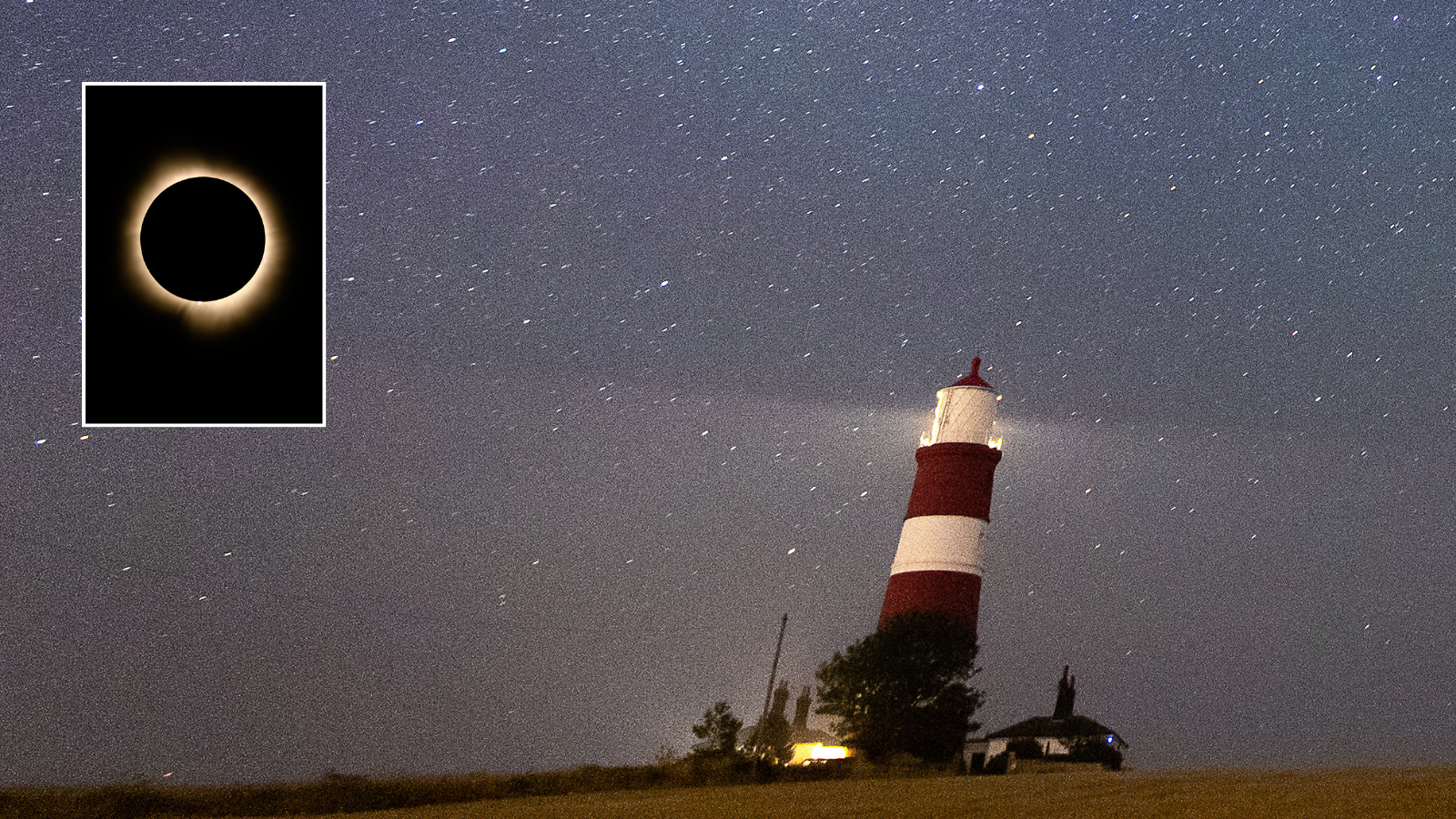
Stargazers across Britain are in for a remarkable evening on Wednesday, with two spectacular celestial events set to unfold within hours of each other.
A deep partial solar eclipse, the largest to grace UK skies since the total eclipse of 1999, will be followed by the peak of the annual Perseid meteor shower, widely regarded as the finest regular display of shooting stars.
Though the two phenomena are entirely unconnected, their near-simultaneous timing creates what astronomer Dr Becky Smethurst described as "the perfect cosmic coincidence of events."
The Moon will block more than 90 per cent of the Sun during the early evening, before darkness falls and conditions become ideal for watching the Perseids streak across the sky.
The eclipse will unfold between 6.17pm and 8.06pm tomorrow, with the Moon reaching its maximum coverage of the Sun at approximately 7.13pm.
Over 90 per cent of the solar disc will be hidden from view, the greatest proportion blocked above Britain since the famous total eclipse 27 years ago.
It will also be the most complete eclipse visible from the UK for the next 54 years, with a comparable event not expected until 2081.
A full total eclipse will not occur over British skies until 2090.


The Sun will sit low on the western horizon during the event as it approaches setting, meaning observers may notice the sky dimming noticeably as the Moon slides across the solar surface.
The Royal Greenwich Observatory has cautioned the public that ordinary sunglasses offer nowhere near enough protection for viewing the eclipse safely.
Imo Bell, a planetarium astronomer at the observatory, said: "It's not a total eclipse, but over 90 per cent is really exciting. We're not going to get one this good for a really long time."
She stressed that preparation is essential, recommending purpose-built solar eclipse glasses that filter out so much light "you can't see anything through them except the Sun."
LATEST DEVELOPMENTS
- Octopus Energy offers FREE electricity to customers who cut usage during this week's solar eclipse
- When and where to watch spectacular solar eclipse across Britain this week
- Britons urged to use common kitchen utensil to watch nation's greatest solar eclipse in decades

Ms Bell advised finding a spot with a clear view towards the western horizon, free from obstructions such as buildings or hills, since the Sun will be close to setting throughout the eclipse.
Met Office meteorologist Tom Morgan said southern and eastern parts of England offer the best prospects for clear skies, while Glasgow, Belfast and western Scotland face the thickest cloud cover.
"I'd say high pressure is going to be generally keeping it mostly dry away from the very far north west of the UK, where there could be some rain," he told reporters.
He added that most of England and Wales have "a fairly reasonable prospect" of catching the spectacle.

Those in Reykjavik, Iceland, and several Spanish cities including Bilbao, Valencia and Zaragoza will witness a total eclipse, with the Moon fully obscuring the Sun.
Although the Perseid meteor shower and the solar eclipse are entirely separate astronomical phenomena, their convergence on the same evening offers an unusually rich programme for skywatchers.
The Perseids, widely considered the best annual meteor shower, will reach their peak on Wednesday night, just as darkness descends following the eclipse.
Dr Becky Smethurst, an astronomer, described the pairing as "the perfect cosmic coincidence of events."

Once the Sun dips below the horizon and the eclipse draws to a close, observers should be able to turn their attention skyward to catch the shooting stars streaking overhead.
With the eclipse finishing shortly after 8pm and night falling soon after, conditions should transition seamlessly from one spectacle to the next, making it a truly exceptional evening for British astronomy enthusiasts.
Our Standards: The GB News Editorial Charter