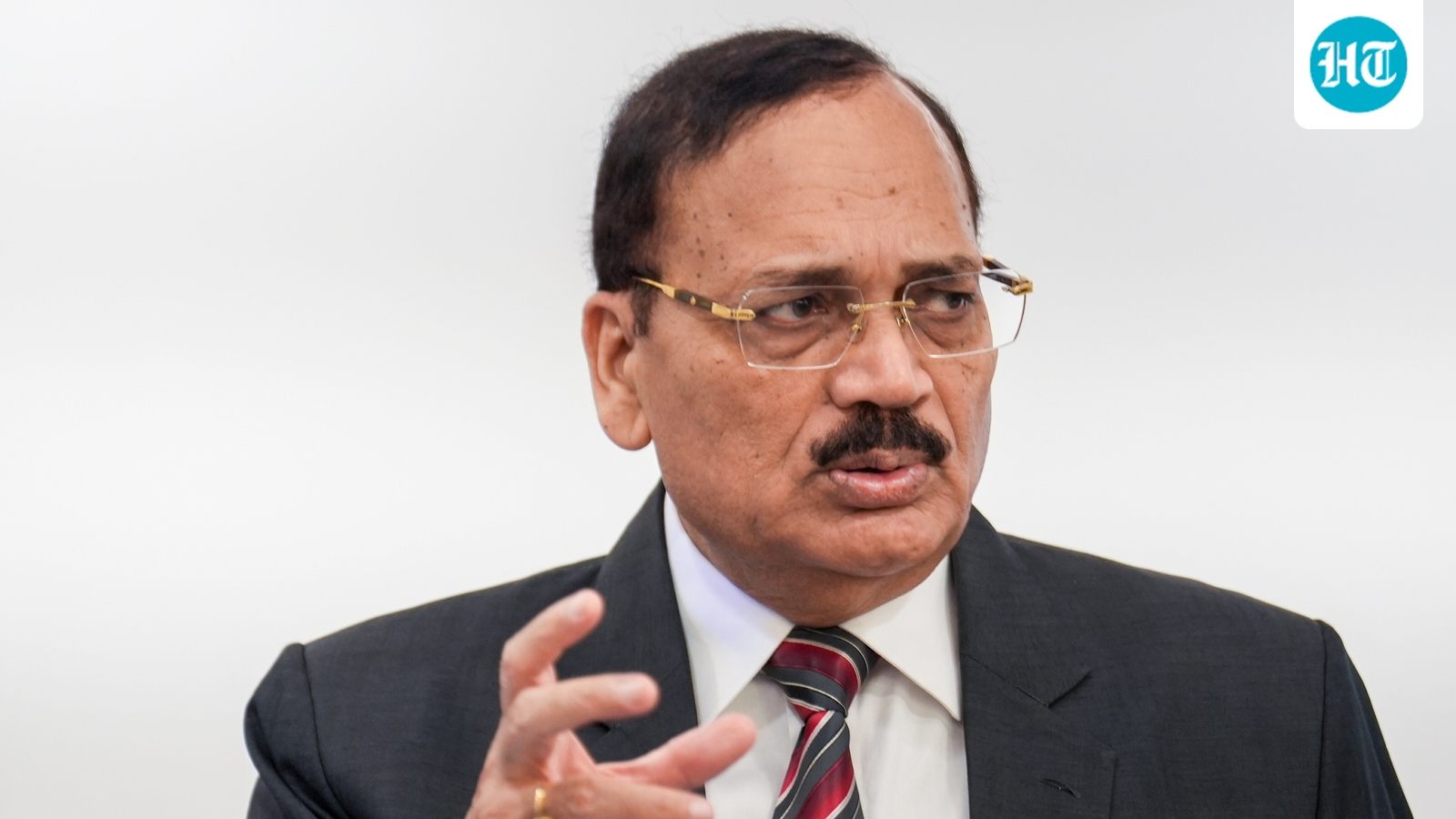
E-PaperSubscribeSubscribeEnjoy unlimited accessSubscribe Now! Get features like The Supreme Court’s nine-judge Constitution Bench judgment on what constitutes an “industry” under the Industrial Disputes Act, 1947, raises an important question that the judgment itself does not answer with sufficient clarity: does the Chief Justice of India’s reformulation of the 1978 Bangalore Water Supply test command a majority of the nine-judge bench? CJI Surya Kant’s opinion is expressly authored “on behalf of himself, and justices Sharma, Aradhe and Pancholi” – making four judges. (PTI)The operative portion, read out on August 20, was understood as a 5:4 verdict, with CJI Surya Kant and justices Satish Chandra Sharma, Alok Aradhe, Vipul M Pancholi and PS Narasimha forming the majority on the need to refine the law. But the judgment released subsequently reveals a more complicated picture. The CJI’s opinion is expressly authored “on behalf of himself, and justices Sharma, Aradhe and Pancholi” – making four judges. The detailed judgment released a day later however depicts that Justice Narasimha does not actually concur with the CJI’s reformulation. His opinion describes and engages with the CJI’s proposed approach, but ultimately says that the reference need not be answered on merits because the Industrial Disputes Act has been repealed and replaced by the Industrial Relations Code. He expressly favours allowing pending disputes to continue under Bangalore Water Supply rather than creating a new test for them. That leaves the judgment with an unusual numerical problem: four judges favour the CJI’s reformulation; four reject it; and the tie-breaker judge does not answer the substantive question. The judgment does not expressly explain how this translates into a majority holding on the new test. The CJI’s opinion represents a substantial departure from the expansive approach in Bangalore Water Supply & Sewerage Board Vs A Rajappa, the 1978 seven-judge judgment that evolved the “triple test”. The new approach retains the basic ingredients of organised activity and employer-employee cooperation, but gives greater prominence to the nature and character of the activity and its commercial character. The CJI’s opinion says that the nature of the activity and employer-employee cooperation have to be examined together and that commercial character cannot simply be disregarded. Also Read I ‘Jodi’ -- a match made for trademark trouble? SC weighs matrimonial app dispute The judgment also makes clear that the absence of a profit motive does not automatically take an activity outside the definition. What matters is whether the activity bears the indicia of an organised economic or commercial enterprise. Activities wholly divorced from commercial or economic character would ordinarily fall outside Section 2(j). This is plainly a new formulation, intended to recalibrate the 1978 test. But the opinion is explicitly a four-judge opinion. There is no indication in its opening that Justice Narasimha is joining it on this substantive question. That distinction matters because the four other judges are unequivocal in rejecting the reformulation. Justices BV Nagarathna and Dipankar Datta hold that Bangalore Water Supply correctly laid down the law. Justice Joymalya Bagchi expressly says he agrees with Justices Nagarathna and Datta that the triple test continues to determine the scope of “industry”. The result, therefore, is not neatly a 5:4 division on the substantive question. Justice Narasimha’s opinion is the crucial piece in understanding the ambiguity. He recognises that the reference was justified when it was made. He also records the CJI’s proposed shift towards the nature of the activity and commercial character. Indeed, he says the CJI has suggested that industrial activity cannot be wholly divorced from commercial character and that the triple test could be “calibrated”, introducing commerciality as the primary test. But that is not the same as saying he accepts the CJI’s new test. On the contrary, Justice Narasimha’s decisive conclusion is that the reference no longer needs to be answered because the statutory provision under scrutiny has ceased to exist. The Industrial Disputes Act was repealed with effect from November 21, 2025, and the Industrial Relations Code came into force in its place. His conclusion is particularly significant, as it indicated that Bangalore Water Supply should continue to govern pending disputes under the repealed law, rather than the court creating “a third set of principles” applicable only to those cases. He says the new Code must be interpreted independently. Justice Narasimha goes even further in his criticism of the need for reformulation. He notes that if the nine-judge bench itself declares that its new interpretation of Section 2(j) will have no bearing on Section 2(p) of the new Code, then the exercise of reformulating the old test becomes largely academic. Also Read I ‘Having regard to age’: 105-year-old murder convict given Supreme Court relief to ‘live’ as free man So where does Justice Narasimha stand? He agrees with the CJI on the validity of the reference and the treatment of the old and new laws, but does not clearly join the CJI in holding that Bangalore Water Supply requires substantive reformulation. That is why simply adding Justice Narasimha to the CJI’s four-judge opinion and calling the result “5:4” is difficult to reconcile with the text of the judgment. On the other side, justices Nagarathna, Datta, Bhuyan and Bagchi are substantially aligned in preserving the 1978 position. Justice Nagarathna says Bangalore Water Supply does not require interference or modification and considers the reference itself unnecessary. Justice Bagchi is even more explicit. He agrees with the CJI and Narasimha that the reference was validly made, but says he is unable to agree with the CJI’s reformulation of the triple test and instead concurs with Justices Nagarathna and Datta that the original test correctly determines the scope of “industry”. This creates the central paradox. There is, however, considerable agreement on the practical consequence. The CJI’s judgment says the reformulated principles will not disturb cases that have already attained finality or proceedings presently pending before courts and tribunals. Such matters are to continue under the Bangalore Water Supply test. The bench is also unanimous that the Industrial Relations Code, 2020 must be interpreted independently. The CJI expressly says Bangalore Water Supply cannot be treated as the “sheet anchor” for interpreting the new Code and leaves all questions under the new regime open. That gives the judgment practical stability despite its internal numerical ambiguity. But the larger jurisprudential question remains. If the CJI’s reformulation is intended to be the authoritative new interpretation of Section 2(j), where is the fifth judge who supplies the majority? Justice Narasimha’s opinion does not clearly provide that vote. He describes the CJI’s reasoning but ultimately declines to answer the reference on merits and favours retaining Bangalore Water Supply for pending cases. Also Read I Centre to reconsider UGC equity rules termed ‘vague’ by Supreme Court The judgment therefore produces a curious outcome: a four-judge opinion reformulating the law, four judges rejecting that reformulation, and one judge declining to answer the substantive question because the statute has been repealed. That may ultimately require clarification because a nine-judge Constitution Bench was convened precisely to bring certainty to an area of law that had remained unsettled for decades. Instead, on the most fundamental question of the new test’s majority status, the judgment leaves the arithmetic- and consequently the precise precedential status of the CJI’s reformulation — less than clear. Utkarsh Anand is the National Legal Editor at Hindustan Times, where he leads the newspaper's coverage of the Supreme Court, constitutional law, the judiciary and the Union law ministry. He joined Hindustan Times in 2020 after stints at Press Trust of India (PTI), The Indian Express and CNN-News18, and has over two decades of experience reporting on law, governance and public policy. His work has focussed on some of India's most consequential constitutional and legal developments, including the Supreme Court's judgments on Article 370, marriage equality, decriminalisation of homosexuality, the Babri Masjid dispute, electoral reforms and judicial appointments. He specialises in making complex legal proceedings and judgments accessible to readers while examining their wider social and political impact. Beyond daily reportage, Utkarsh has led investigative projects and enterprise reporting that have shaped public debate and prompted institutional responses. His work has received several journalism awards, including the Ramnath Goenka Excellence in Journalism Award. As National Legal Editor, he has also played a key role in expanding Hindustan Times' legal journalism footprint, mentoring reporters and strengthening coverage across platforms. A Chevening South Asia Journalism Programme Fellow, Utkarsh regularly writes analyses on the judiciary and constitutional issues, and his reporting is widely followed by lawyers, judges, policymakers, academics and readers seeking clarity on India's evolving legal landscape.Read More
المصدر: Hindustan Times
| Source: Hindustan Times
ملاحظة تحريرية | Editorial Note:
نُشر هذا المقال في الأصل بواسطة Hindustan Times.
خبر (Khabr) هي منصة إعلامية أردنية مرخّصة تعمل بالذكاء الاصطناعي.
نضيف قيمة تحريرية من خلال: تحليل ذكي للأخبار، ملخصات تلقائية، رواية صوتية بالذكاء الاصطناعي، ترجمة متعددة اللغات، وتدقيق الحقائق.
هدفنا جعل الأخبار أكثر وضوحاً وسهولةً للقارئ العربي.
This article was originally published by Hindustan Times.
Khabr is a licensed Jordanian AI-powered news platform (Registration #82086).
We add editorial value through: AI-powered news analysis, automated summaries, AI audio narration, multi-language translation (Arabic, English, French, Turkish), and AI fact-checking.
Our mission is to make news more accessible and understandable for Arabic-speaking audiences worldwide.