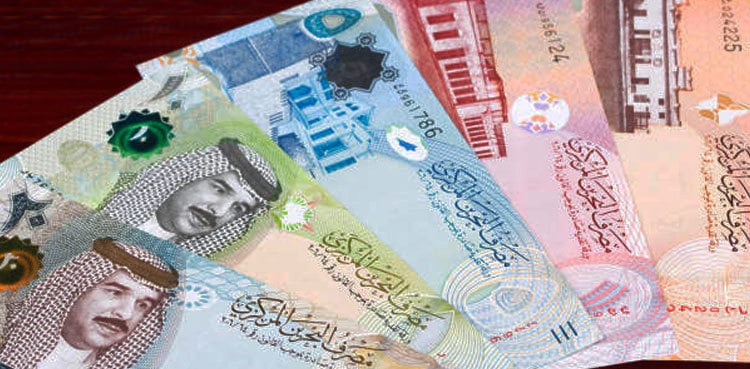
Karachi/Manama, March 28, 2026: The Bahraini Dinar (BHD) is trading at 740.56 Pakistani Rupee (PKR) today according to major currency exchanges. The rate has shown limited movement in recent days, holding near the 740 level after a modest recovery from the recent low of 739.61 PKR, while remaining within the broader gradual softening trend observed since the January peak of 745.46 PKR.
The exchange rate has eased progressively over recent months: 743.48 PKR (Dec 13), 743.46 PKR (Dec 20), 743.03 PKR (Dec 27), 742.92 PKR (Jan 03), 742.76 PKR (Jan 10), 742.53 PKR (Jan 17), 741.86 PKR (Feb 07), 741.68 PKR (Feb 14), 741.38 PKR (Feb 21), 741.04 PKR (late Feb–early March), before dipping to 739.61 PKR and stabilizing around 740.56 PKR. This pattern underscores the ongoing relative weakness of the Pakistani rupee against the stable, dollar-pegged Bahraini dinar amid divergent economic pressures.
The Bahraini dinar remains firmly fixed to the US dollar at the longstanding rate of 1 USD = 0.376 BHD, a policy the Central Bank of Bahrain has maintained since 2001. This peg continues to deliver predictability and low volatility, with the dinar’s value moving closely in line with the dollar and primarily influenced by global oil price developments and Bahrain’s fiscal position. The Pakistani rupee, managed under a floating regime by the State Bank of Pakistan, experiences greater variability shaped by domestic inflation trends, trade and current account balances, foreign exchange reserve levels, external debt dynamics, remittance inflows, and policy interventions.
The ongoing US-Israel war with Iran, now in its second month since it began on February 28, 2026, continues to exert significant influence on regional currencies and economies. The conflict has triggered repeated missile and drone exchanges, strikes on infrastructure (including missile bases, industrial sites, and nuclear-related facilities), and major disruptions in the Strait of Hormuz. These events have caused sharp swings in global oil prices, with Brent crude surging well above $110 per barrel at peaks due to supply fears, tanker attacks, and partial blockades, before partial pullbacks amid diplomatic signals. Bahrain and other Gulf states have faced direct impacts, including strikes on facilities and heightened security concerns, while Pakistan grapples with amplified imported inflation from elevated energy costs, reserve pressures, and austerity measures.
At the current rate of 740.56 PKR, the softer dinar (in PKR terms) generates several cross-border economic effects, now amplified by the regional conflict. Bahraini exporters benefit from a marginal price advantage in international markets, while Pakistani goods such as textiles, rice, and agricultural products become slightly more expensive for Bahraini buyers. In Pakistan, the lower rupee cost of any available Bahraini or Gulf energy imports offers only limited relief against the dominant oil price shock and broader energy supply disruptions. Remittances from the large Pakistani workforce in Bahrain continue to lose purchasing power in rupee terms compared with stronger-dinar periods, adding strain on household budgets during this time of elevated living costs. Pakistani exporters to Bahrain may find their products marginally more price-competitive, although overall trade volumes face challenges from logistics disruptions, Gulf instability, and reduced regional demand caused by the conflict.
The Bahraini Dinar (BHD), introduced in 1965, is subdivided into 1,000 fils and issued by the Central Bank of Bahrain. Its dollar peg has kept it among the world’s highest-valued currencies; it is denoted by BD or ب.د. The Pakistani Rupee (PKR), established in 1948, is managed by the State Bank of Pakistan and divided into 100 paisa (coins discontinued). It is commonly represented as ₨ or Rs and remains subject to volatility driven by macroeconomic conditions and external shocks such as the ongoing Iran conflict.