Back to Earth: What happens to the Artemis II astronauts now?
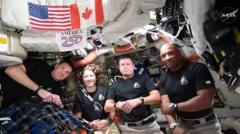
Back to Earth: What happens to the Artemis II astronauts now?9 minutes agoShareSaveAdd as preferred on GoogleNASAThe Artemis II mission crew talked to media, their families and even President Donald Trump from spaceThe Artemis II crew have safely returned home after re-entering Earth's atmosphere at 25,000mph (40,000km/h), splashing down off the coast of California.They have travelled deeper into space than any humans before them - just over 4,000 miles more than the record of 248,655 set by Apollo 13 in 1970.Astronauts are highly trained to cope with the physical and mental strain of space. Although it might seem like it would be a difficult experience to endure, astronauts talk about being in space as the highlight of their lives and say they would return in an instant.In a press conference before landing, Christina Koch said the inconveniences, such as freeze-dried food or a toilet without much privacy, were worth it.Nasa does not release details about the crew members' health or private lives, but here's what's likely to happen to Reid Wiseman, Christina Koch, Victor Glover and Jeremy Hansen now they're back.NASAArtemis crew used eclipse viewers to observe a solar eclipse during the lunar fly-byThey'll immediately be seen by doctorsOn arrival they will be immediately examined by doctors on the US warship sent to retrieve them. Then they will be flown ashore by helicopter before being taken by plane to Nasa's Johnson Space Center in Houston.Spending time in space will have been physically gruelling for the Artemis II crew.Without the tug of gravity, muscle and bone mass shrinks in space. The most affected muscles are those that help maintain posture in the back, neck and calves. Astronauts have strict exercise requirements but it can't stop all wastage. After just two weeks, muscle mass can fall by as much as 20%.But remember, around 700 people have been into space before, including low Earth orbit. The time the Artemis II...المصدر: BBC News | Source: BBC News
ملاحظة تحريرية | Editorial Note: نُشر هذا المقال في الأصل بواسطة BBC News. خبر (Khabr) هي منصة إعلامية أردنية مرخّصة تعمل بالذكاء الاصطناعي. نضيف قيمة تحريرية من خلال: تحليل ذكي للأخبار، ملخصات تلقائية، رواية صوتية بالذكاء الاصطناعي، ترجمة متعددة اللغات، وتدقيق الحقائق. هدفنا جعل الأخبار أكثر وضوحاً وسهولةً للقارئ العربي.
This article was originally published by BBC News. Khabr is a licensed Jordanian AI-powered news platform (Registration #82086). We add editorial value through: AI-powered news analysis, automated summaries, AI audio narration, multi-language translation (Arabic, English, French, Turkish), and AI fact-checking. Our mission is to make news more accessible and understandable for Arabic-speaking audiences worldwide.