Archaeology breakthrough as back-to-back heatwaves expose breathtaking lost sites across Wales
•Extreme heat and drought in Wales have uncovered numerous hidden archaeological sites.
•The Royal Commission reports findings from prehistoric to First World War structures, visible due to vegetation patterns.
•Aerial surveys are being conducted to document these sites before rainfall erases the newly revealed marks.
المصدر: GB News | Source: GB NewsA prolonged period of extreme heat and minimal rainfall has exposed a wealth of hidden archaeological remains across the Welsh landscape.
The country has received roughly five per cent of its typical July precipitation, following successive heatwaves and an unusually dry spring stretching back to April.
The parched conditions have triggered drought in some areas and scorched grasslands from coast to coast, causing long-buried ancient sites to materialise as distinctive patterns in the vegetation.
According to the Royal Commission on the Ancient and Historical Monuments of Wales, the revealed sites span thousands of years of history, from prehistoric burial monuments and fortifications to Roman-era structures and First World War military training features.
TRENDINGStoriesVideosYour SaySome of these marks had not been visible for "two or three decades," the commission said.
These ghostly outlines appear because plants growing above ancient ditches and foundations can access richer nutrients and deeper moisture reserves than surrounding vegetation, producing bands of greener growth that contrast sharply with the dried-out landscape around them.
Such marks are visible only from above and can vanish rapidly once rain returns.
Dr Toby Driver, an archaeologist with the commission, has been conducting aerial surveys from Haverfordwest and Caernarfon airports throughout June and July in a race to document the sites before conditions shift.
He noted that what once required waiting five to seven years for "a record heatwave summer for aerial archaeology" now occurs "every year."
The national archive for the Welsh historic environment has published photographs from Dr Driver's reconnaissance flights.
Among the most striking finds is a rectangular Neolithic long barrow near Welshpool in Powys, its cropmarks indicating a burial monument approximately 5,000 years old.
Further north in Conwy, Dr Driver's flights captured fresh details of Roman-era buildings buried beneath the ground at Caerhun Roman fort, adding to existing knowledge of the site.
LATEST DEVELOPMENTS
- Lost 17th century garden revealed after Britain's record-breaking heatwave
- More than 12,000 languages were spoken after last Ice Age before extinction wiped out communities
- Archaeologists find ‘amazing’ Roman coin revealing Britain’s breakaway emperor
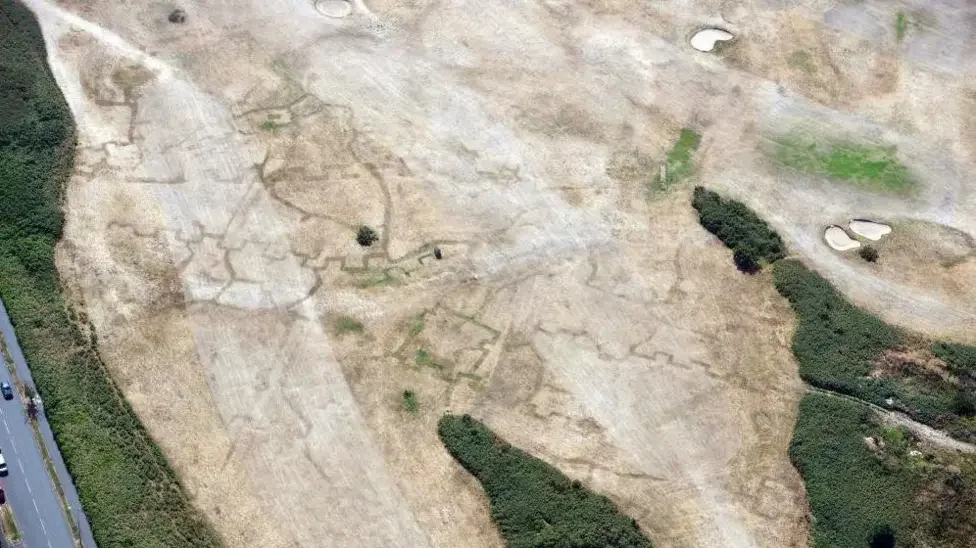
Perhaps the most visually dramatic discovery was a set of First World War practice trenches lying beneath a golf course at Deganwy, also in Conwy.
The parchmarks, patterns left in dried-out turf, traced the outlines of the training earthworks with remarkable clarity.
The commission noted that eastern and north-eastern Wales had been particularly arid since mid-May, whilst western and southern regions remained comparatively green until late June's heatwaves scorched grasslands nationwide.
Near Llandysul in south Ceredigion, ripening crops revealed a previously unrecorded Iron Age or Romano-British farmstead, identifiable by its distinctive double-ditched enclosure, a site that had gone entirely undocumented until now.
Dr Driver described the flying conditions as demanding.
He said: "This year has been pretty windy across Wales, so some of the longer trips to record cropmarks have made for challenging flying."
He explained that whilst some features are immediately obvious from the air, others are so faint in the severely parched ground that digital enhancement is required.
"In these cases we digitally rebalance the colour bands of the image, really making the archaeology 'pop' and reveal previously hidden details," he said, noting that these processed images appear in black and white.
The findings underscore how increasingly frequent extreme summers are transforming aerial archaeology from an occasional opportunity into an annual endeavour.
Our Standards: The GB News Editorial Charter


→Extreme heat and drought in Wales have uncovered numerous hidden archaeological sites.
→The Royal Commission reports findings from prehistoric to First World War structures, visible due to vegetation patterns.
ملاحظة تحريرية | Editorial Note: نُشر هذا المقال في الأصل بواسطة GB News. خبر (Khabr) هي منصة إعلامية أردنية مرخّصة تعمل بالذكاء الاصطناعي. نضيف قيمة تحريرية من خلال: تحليل ذكي للأخبار، ملخصات تلقائية، رواية صوتية بالذكاء الاصطناعي، ترجمة متعددة اللغات، وتدقيق الحقائق. هدفنا جعل الأخبار أكثر وضوحاً وسهولةً للقارئ العربي.
This article was originally published by GB News. Khabr is a licensed Jordanian AI-powered news platform (Registration #82086). We add editorial value through: AI-powered news analysis, automated summaries, AI audio narration, multi-language translation (Arabic, English, French, Turkish), and AI fact-checking. Our mission is to make news more accessible and understandable for Arabic-speaking audiences worldwide.