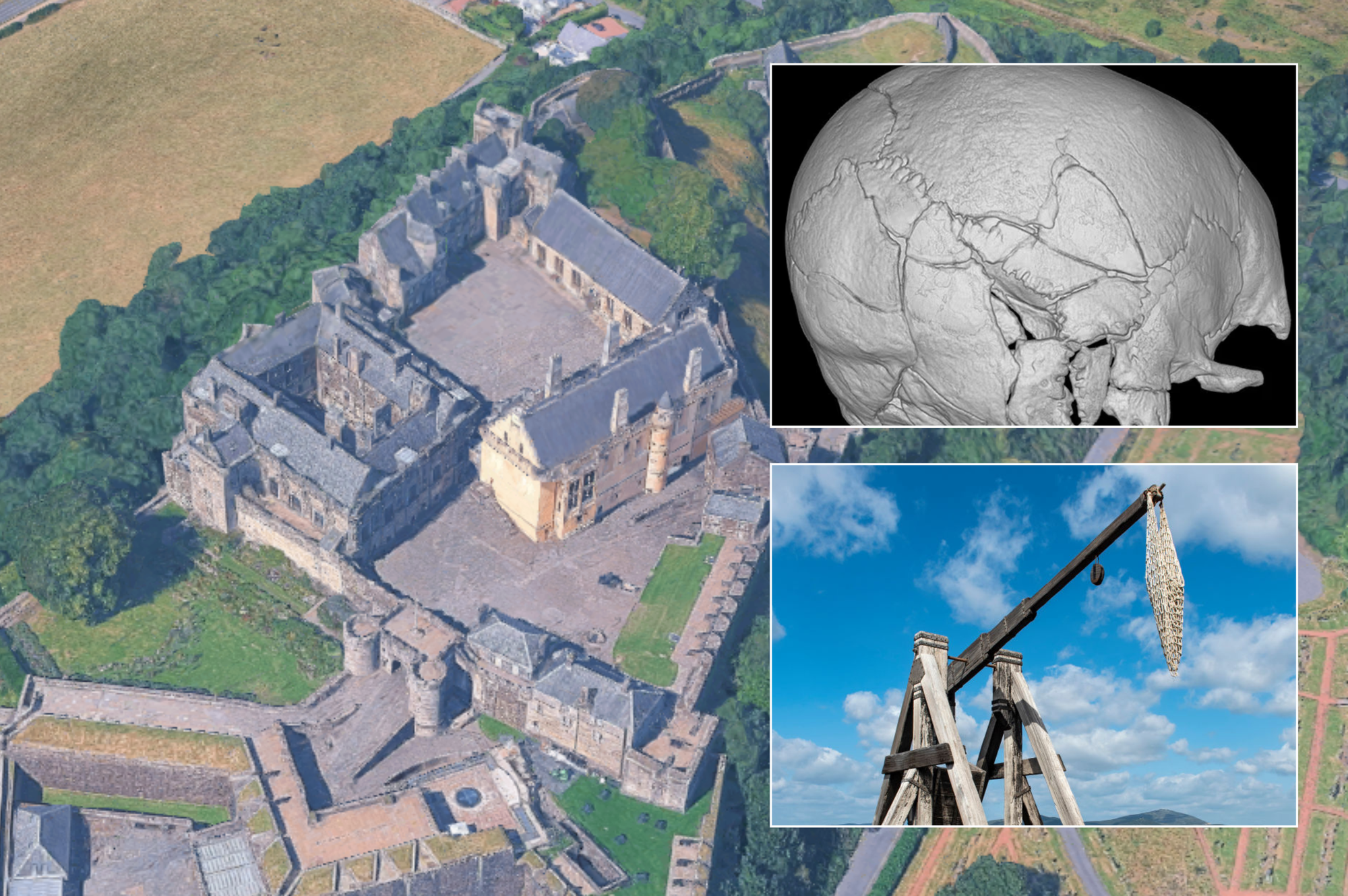
Archaeologists may have discovered the first-ever victim of a trebuchet attack more than 700 years ago.
The victim appears to be a medieval man who was unearthed beneath the royal chapel at Stirling Castle.
Dr Jo Buckberry, an archaeologist at the University of Bradford, made the discovery while re-examining a set of roughly 700-year-old remains known as Skeleton 150, which were originally found at the site in 1997.
Her analysis revealed a staggering 167 fractures across the young man's body, injuries so severe and so unusual for the period that she believes they point to a direct hit from a siege engine.
The weapon was potentially Edward I's enormous trebuchet known as "War Wolf", which was deployed during the 1304 siege of Stirling Castle.
A specialist in medieval warfare, Dr Buckberry immediately recognised that the injuries were unlike anything she had previously encountered in the era.
She said: "Every single rib on both sides has at least one fracture. The whole shoulder complex is crushed. The skull alone has over 60 fractures."
The man, aged in his 20s or early 30s, would have suffered instantaneous death.
Dr Buckberry likened his injuries to those seen in modern-day explosions or "a really high-speed car crash".

A particularly telling clue was a deep zig-zag fracture in one of his upper arm bones.
She said: "The reason it's weird is that it's a high-velocity injury, and you just don't get high velocity in the medieval period."
Dr Buckberry collaborated with Dr Patrick Randolph-Quinney, a biological anthropologist at Uppsala University, to map the fractures in detail using microscopy, radiography, micro-CT and 3D scanning.
Their analysis pointed to a single, devastating impact striking the back of the skull and right shoulder while the man stood with his arms bent before him.
A direct trebuchet hit was considered more likely than falling masonry, which would not have been travelling at comparable speed.
LATEST DEVELOPMENTS
- 'Nothing like it!' Archaeologists think mysterious pit with human remains could be Iron Age 'hot tub'
- Incredible find of extinct human remains on seabed floor fuels claims of real-life biblical giants
- Scientific breakthrough finally uncovers how 'first bird' learnt to fly 150 million years ago

Radiocarbon dating placed the skeleton at between approximately 620 and 770 years old.
The year 1304 falls close to the centre of that range, the very year Edward I subjected Stirling, the final stronghold of Scottish resistance, to a three-month bombardment.
During the siege, Edward's engineers constructed War Wolf, among the largest trebuchets ever built.
According to Historic Environment Scotland, the weapon is thought to have launched a projectile weighing around 140kg into the castle's curtain wall.
The defending garrison reportedly attempted to surrender upon seeing the fearsome machine, but the king would have none of it.

Dr Buckberry said: "He basically refused to let them surrender until he'd actually played with his toy."
She cautioned that certainty about Skeleton 150's cause of death remains elusive.
However, his burial within the castle walls rather than beyond the fortifications would be consistent with a siege.
She said: "We can't say it was definitely War Wolf. But it's a tantalising glimpse into what may have happened."
The research was funded by Historic Environment Scotland, which manages Stirling Castle.
Our Standards: The GB News Editorial Charter