Anguished families left to identify Venezuela quake victims at makeshift morgue
•Anguished families left to identify Venezuela quake victims at makeshift morgueImage source, AFP via Getty ImagesImage caption, Families face long waits at a port facility transformed into a morgue in...
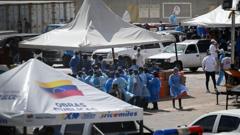
•The scale of the disaster has overwhelmed local services, forcing institutions to improvise.With little infrastructure left standing nine days after the tremors, bodies have been put outside or in tem...
•Some stare blankly into space, others check their phones, reading the news or answering messages.Just a few metres away, armed personnel from the Bolivarian Armed Forces control access to the site."I'...
هذا الخبر من BBC News. خبر يقدم أدوات ذكاء اصطناعي للتلخيص والترجمة والاستماع.
Anguished families left to identify Venezuela quake victims at makeshift morgueImage source, AFP via Getty ImagesImage caption, Families face long waits at a port facility transformed into a morgue in La GuairaByNorberto ParedesBBC News Mundo, Reporting fromLa Guaira, VenezuelaPublished18 minutes agoWarning: This story contains distressing detailsAt a port storage facility transformed into a makeshift morgue in La Guaira, the same scene repeats itself again and again.Families - many of whom have already spent days searching hospitals, shelters and rubble - wait hours to try and confirm the deaths of their loved ones.As the death toll of Venezuela's twin earthquakes surpasses 2,600, officials face the challenge of not only recovering victims, but identifying them. The scale of the disaster has overwhelmed local services, forcing institutions to improvise.With little infrastructure left standing nine days after the tremors, bodies have been put outside or in temporary tents.Under the blazing sun, dozens of families wait with a mixture of anguish and dread.Image source, BBC MundoImage caption, Families try to identify their loved ones from images cycling across two television screensRows of chairs have been placed inside and outside Los Silos, where sadness is contagious. No one speaks. Some stare blankly into space, others check their phones, reading the news or answering messages.Just a few metres away, armed personnel from the Bolivarian Armed Forces control access to the site."I'm afraid of what I'm going to see in there, but it's the only way to end this agony," a woman says before passing through the gate.She has been searching for her nephew for nearly a week. "I've looked for him everywhere: in the building, in the hospitals, I've spoken to everyone… and no one knows anything."Image source, BBC MundoImage caption, Medical and forensic personnel work alongside bodies, covered with plastic bagsInside, the smell of...المصدر: BBC News | Source: BBC News
ملاحظة تحريرية | Editorial Note: نُشر هذا المقال في الأصل بواسطة BBC News. خبر (Khabr) هي منصة إعلامية أردنية مرخّصة تعمل بالذكاء الاصطناعي. نضيف قيمة تحريرية من خلال: تحليل ذكي للأخبار، ملخصات تلقائية، رواية صوتية بالذكاء الاصطناعي، ترجمة متعددة اللغات، وتدقيق الحقائق. هدفنا جعل الأخبار أكثر وضوحاً وسهولةً للقارئ العربي.
This article was originally published by BBC News. Khabr is a licensed Jordanian AI-powered news platform (Registration #82086). We add editorial value through: AI-powered news analysis, automated summaries, AI audio narration, multi-language translation (Arabic, English, French, Turkish), and AI fact-checking. Our mission is to make news more accessible and understandable for Arabic-speaking audiences worldwide.