As the regional war launched by the United States and Israel against Iran intensifies, fears are mounting that the conflict’s frontlines could widen. Tehran has already placed the Arab Gulf states within missile range and disrupted global trade by closing the Strait of Hormuz—moves intended to raise the political and economic cost of the campaign against it.
Expanding the battlefield has long been central to Iran’s strategy, relying on Iraq, Yemen, and Lebanon as buffers. But with U.S. strikes now reaching deep inside Iranian territory, questions are emerging about the effectiveness of Tehran’s regional assets—particularly the Popular Mobilization Forces (PMF) in Iraq and Hezbollah in Lebanon. As these groups operate along the Syrian border, attention has turned to how Damascus will navigate this volatile landscape.
Damascus Signals Its Readiness
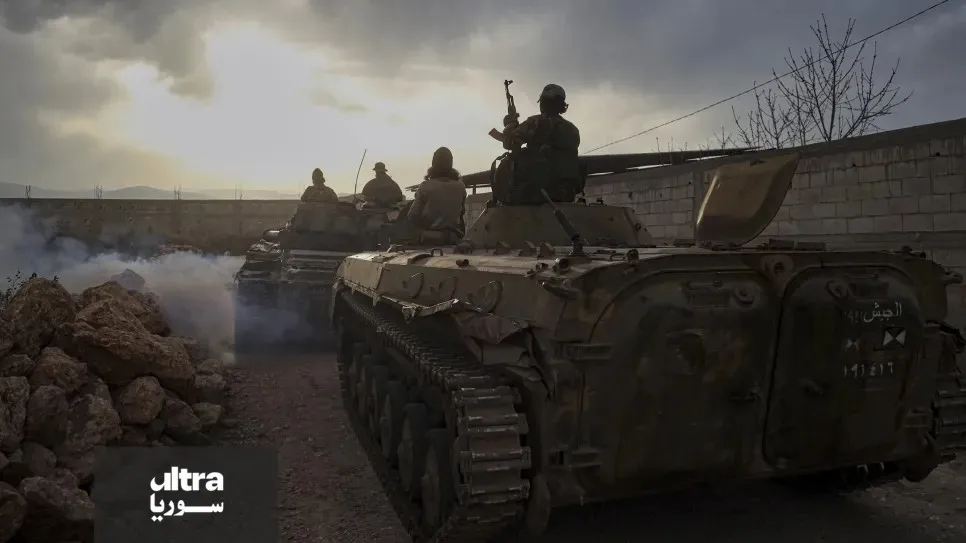
Syria has responded directly to the shifting military environment by reinforcing its border deployments. According to the Ministry of Defense, the new units—armored vehicles, rocket launchers, reconnaissance teams, and anti-smuggling forces—are part of a preventive effort to secure the frontier amid the escalating confrontation with Iran.
Israel’s intensifying campaign against Hezbollah has heightened concerns that Syrian territory could be pulled into the conflict. Hezbollah has previously used Syrian soil to launch missiles, providing Israel with a pretext for cross-border strikes. Meanwhile, clashes in March 2025 between Syrian forces and Hezbollah elements have revived fears that the border could ignite unintentionally.
Some circles close to Hezbollah suggest that the Syrian Army may eventually be drawn into the war. They argue that Damascus—now aligned with the international coalition—could be pressured to support U.S. efforts to neutralize Hezbollah through ground operations. These assessments gained momentum after President Ahmed al-Sharaa publicly backed Lebanese President Joseph Aoun’s push to disarm Hezbollah, and expressed support for Iraqi and Lebanese government initiatives to remove cross-border security threats—a clear reference to militias such as the PMF.
Sliding Toward Confrontation
Tensions spiked when projectiles fired from Lebanese territory landed in Serghaya, in the western Damascus countryside. Syria’s military operations command noted that the incident coincided with the arrival of Hezbollah reinforcements near the border.
Lebanese military analyst Hisham Jaber rejects the notion that Hezbollah intentionally targeted Syrian territory, arguing that such an action offers the group no strategic benefit. He points instead to frequent skirmishes in the area involving smugglers and local clans. Still, security assessments indicate that Hezbollah has mobilized fighters out of concern that Syria might launch a surprise operation to disrupt its defensive systems ahead of Israeli strikes. Damascus, for now, remains publicly silent as it weighs the risks of escalation.
Political and Military Calculations
Damascus understands that entering a military confrontation to disarm Hezbollah would come at an enormous cost. Syria is also unwilling to position itself—directly or indirectly—as an auxiliary front for Israel. No Arab state has taken such a stance against Iran, let alone against a neighboring country like Lebanon.
Militarily, Syria is exposed. Its air defenses remain limited, and its territory lies well within range of Iranian missile platforms. Any move to pressure Hezbollah would likely prompt Tehran to include Syrian targets in its retaliation.
Jaber also notes that Turkey and the Gulf states—Syria’s current partners—would strongly oppose such an intervention and would exert significant pressure on Damascus to avoid it. A unilateral military move would also risk deepening Syria’s internal political and social fractures.
Political and military assessments converge on one point: Damascus is unlikely to pursue any escalatory path against Lebanon. While Syrian artillery may respond if incidents like the Serghaya shelling recur, such actions would remain limited and defensive.
By maintaining this posture, Syria aims to safeguard its national security and preserve its regional standing—avoiding entanglement in a high-risk conflict whose consequences could be unpredictable and potentially catastrophic.
This article was translated and edited by The Syrian Observer. The Syrian Observer has not verified the content of this story. Responsibility for the information and views set out in this article lies entirely with the author.
The post Amid Regional Escalation: Will the War Spill Into Syrian Territory? first appeared on The Syrian Observer.