America at 250 is riven with doubt and pessimism — but with glimmers of hope
•Americans have a bleak outlook on the nation’s future ahead of its 250th birthday next month, with most saying the U.S.
•has already seen its best days and a record-low number saying they are extremely proud to be Americans, according to a new NBC News poll.
•Overall, the survey — sponsored by More Perfect, a nonpartisan nonprofit dedicated to advancing democracy — shows that Americans believe their country has achieved many of the goals of its founders, b...
هذا الخبر من NBC News. خبر يقدم أدوات ذكاء اصطناعي للتلخيص والترجمة والاستماع.
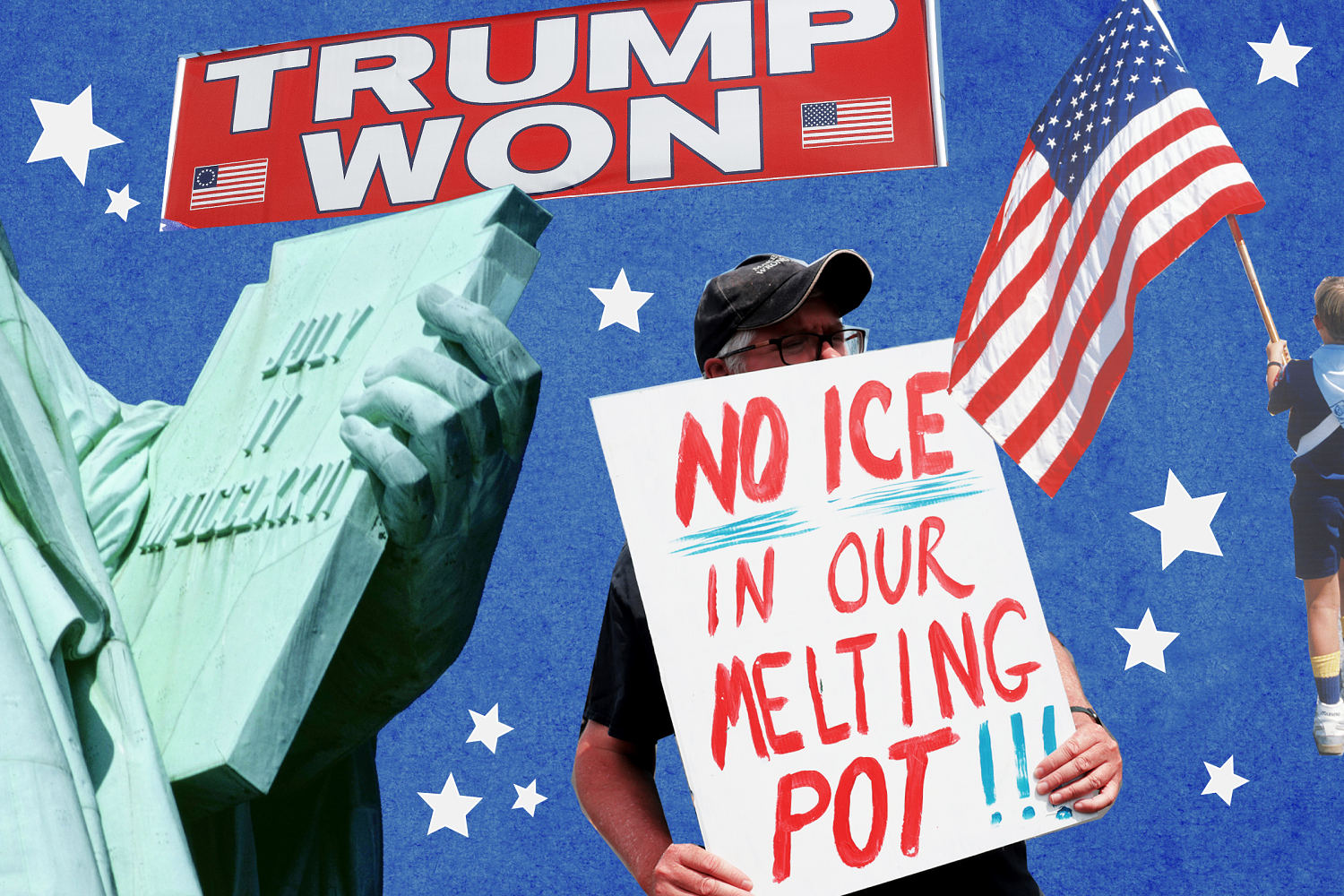
Americans have a bleak outlook on the nation’s future ahead of its 250th birthday next month, with most saying the U.S. has already seen its best days and a record-low number saying they are extremely proud to be Americans, according to a new NBC News poll. Overall, the survey — sponsored by More Perfect, a nonpartisan nonprofit dedicated to advancing democracy — shows that Americans believe their country has achieved many of the goals of its founders, but it is now falling short in living up to certain central tenets of the democratic experiment. They are split almost evenly over whether the Constitution has stood the test of time. And they have little faith in their institutions — including the federal government, the media and the high-tech industry. Even the military, which ranks highest among the institutions tested and retains the confidence of most Americans, has seen a pronounced drop in support. But Americans also share core values and are willing to engage each other on their differences, according to the survey, which includes 3,000 U.S. adults contacted by phone and text message from May 29 through June 7. Contemplating the results, Democratic pollster Jeff Horwitt of Hart Research Associates, who conducted the survey alongside Republican pollster Bill McInturff of Public Opinion Strategies, reflected on Benjamin Franklin’s observation that the image of the half-sun on the back of George Washington’s chair was rising, not setting, at the conclusion of the Constitutional Convention. “Today, as the astute political observer that he was, Franklin might take a more nuanced look at that chair and agree with its citizens who assess the sun as setting on its institutions, but rising among its citizens,” Horwitt said. The results help explain the political tumult of the past generation, an era in which antiestablishment backlash has given rise to populist figures in both parties. President Donald Trump and Vice President JD Vance on the right and Sen. Bernie Sanders, I-Vt., and New York Mayor Zohran Mamdani on the left have shaped American politics in the wake of forever wars, the 2008 financial crisis and a brutal pandemic that affected the health and economic fortunes of millions of Americans. The poll reveals a polity deeply divided along partisan, generational, educational and class lines, but mostly united in its certainty that the “American Dream” is harder to attain now than it was a generation ago. Among adults, 78% say the American Dream is further out of reach, with that sentiment varying little across demographic groups. Another 5% say it is easier to grasp and 16% say the degree of difficulty is about the same. It is not the first time Americans have questioned whether that dream is a mirage. But there has been a 9-point increase since 2016, when 69% of adults said it was harder to achieve than it had been for the prior generation. Institutional problems Institutions have taken a pounding in the public square in recent years, with politicians often seeing advantage in piling on. The combination of Americans’ perceptions of establishment failure and a steady drumbeat of negativity from political leaders has had a devastating effect on their standing, and the new survey reinforces other polls showing that Americans are fed up with major institutions and have lost faith in them. The numbers, McInturff said, are among the worst in the era of modern polling techniques. “This is about as low as it’s gotten in that period,” he said, noting that seven out of nine institutions undergoing repeat tests in the poll saw record numbers of people saying they have “no confidence” in them. “Only your local government and the U.S. Supreme Court didn’t set or match a record high.” For the first time in the poll’s history, a majority — 52% — say they have “very little” confidence or “none at all” in the federal government. In 2016, that figure was 34%. An even greater share of adults, 56%, now say they feel the same way about Congress, compared to 48% in 2019 and 39% in 2016. The Supreme Court rates a little better, with 31% of registered voters saying they have “a great deal” or “quite a bit” of confidence in the justices, 28% saying they have “some” confidence and 40% saying they have “very little” or “none at all.” At the same time, nearly two-thirds of adults — 64% — say they have little or no confidence in the national news media, compared to 25% who say they have “some” confidence and just 11% who say they have “a great deal” of “quite a bit” of confidence. Educational institutions fare comparatively well, with 36% of adults expressing significant confidence in colleges and 30% saying the same of public schools; 28% expressed “very little” confidence or “none at all” in colleges, while 32% shared that view of public schools. Only the military rates well with the public: 60% say they have a great deal or quite a bit of confidence in U.S. forces. But that’s down 13 percentage points since the question was last asked in December 2016. And the 15% who say they have little or no faith in the armed forces represent the highest share since a 1988 Gallup poll. There are major partisan splits over institutions. Liberals were more likely to lack faith in the federal government, including Congress and the Supreme Court specifically, as well as the high-tech industry and the military. Conservatives were more likely to say they have no confidence at all in the national news media, colleges and universities, and public schools. The high-tech industry has seen a pronounced drop-off in public support. A decade ago, 45% of adults said they had significant confidence in the industry, and 14% said they had little or none. In the new poll, more Americans (38%) expressed little or no confidence in the industry, while 26% gave a measure of support. Likewise, Americans’ view of religious leaders has become more negative. The 43% who say they have little or no confidence in them is a high dating back to 2002, and the 22% who say they have faith in those leaders is the lowest share since 2013. The American experiment The lack of trust in institutions is also taking a toll on American pride. In the years immediately following the Sept. 11, 2001, terrorist attacks on the U.S., as many as 70% of Americans said they felt extremely proud of their country. Even after that period of national unity forged by tragedy, most adults reported high levels of American pride through the start of Trump’s first term as president in 2017. Overall, at that time, 82% said they were either extremely or very proud of the country. But the numbers have dived since then, and just 33% say now that they are “extremely proud” to be an American, with another 23% describing themselves as “very proud.” Meanwhile, 21% say they are “only a little” or “not at all” proud to be an American. These figures also have partisan and cultural casts. While 62% of 2024 Trump voters say they are extremely proud to be Americans, 12% who picked Democrat Kamala Harris in 2024 said the same. The set of Americans most likely to express great pride is older, whiter, more male, more rural and less educated. But the general sense that the country has lost its mojo runs across the political spectrum — and continues a trend. Nearly identical shares of adults from Trump states, Harris states and swing states say they believe the nation’s best years are in the rearview mirror — 58% in all. Just 38% say they see the best years ahead. That gap has widened since 2021, when 41% of adults said the country’s future was brighter than its past, and 53% felt the opposite way. Still, most Americans do feel that the country has done at least a fair job achieving the ideals on which it was founded. A majority say the U.S. has either done a great deal (29%) or a fair amount (41%) to live up to those principles, compared to 24% who said not very much and 5% who said not at all. And while Americans are clearly frustrated with the results they’ve gotten from the federal government, half of them still say the Constitution has “stood the test of time” and is capable of handling “the challenges ahead.” To the extent that changes might be made, the remaining half are divided on how to approach that, according to the poll. Twenty-eight percent say the Constitution needs to be “thoroughly revised” to “fit present needs,” and 18% say the document is “completely outmoded” and that the U.S., sooner or later, will need “a new form of government.” Fifty years ago, during the bicentennial year, sentiments weren’t much different. At that time, 46% were satisfied with the Constitution, according to a Roper national survey of adults, while 34% wanted major changes to the charter and 14% thought it was time to go back to the drawing board. The Constitution has been amended only once since then, in 1992, when a 200-year-old proposal to prevent members of Congress from voting to raise their own pay, was ratified by enough states. If the Constitution can’t be changed or replaced easily, some would like to see stronger leadership in place. But that question splits the public right down the middle — 48%-48% — with nearly half approving and nearly half saying it would be too dangerous. Half a century ago, in the shadow of the Watergate scandal, which involved the abuse of presidential power, 49% wanted stronger leadership and 44% feared that could present an intolerable risk. Slivers of silver linings The survey showed that strong majorities of Americans have common views about the values that unite the country, including liberty and equality, participating in elections and sharing customs. Perhaps more important, the majority of Americans believe more unites them than divides them. Fifty-four percent said their view is that “most Americans share the same core values but disagree about policies and issues.” That compares to the 44% who said most Americans have “fundamentally different core values.” McInturff said the new poll shows politicians haven’t caught up to public sentiment about working together to solve problems. “Across the survey, there was a clear desire for Americans to come together at the individual level and a willingness to do so, even when they strongly disagree politically,” he said. “The country is waiting for its leaders and institutions to do the same with that.”المصدر: NBC News | Source: NBC News
ملاحظة تحريرية | Editorial Note: نُشر هذا المقال في الأصل بواسطة NBC News. خبر (Khabr) هي منصة إعلامية أردنية مرخّصة تعمل بالذكاء الاصطناعي. نضيف قيمة تحريرية من خلال: تحليل ذكي للأخبار، ملخصات تلقائية، رواية صوتية بالذكاء الاصطناعي، ترجمة متعددة اللغات، وتدقيق الحقائق. هدفنا جعل الأخبار أكثر وضوحاً وسهولةً للقارئ العربي.
This article was originally published by NBC News. Khabr is a licensed Jordanian AI-powered news platform (Registration #82086). We add editorial value through: AI-powered news analysis, automated summaries, AI audio narration, multi-language translation (Arabic, English, French, Turkish), and AI fact-checking. Our mission is to make news more accessible and understandable for Arabic-speaking audiences worldwide.