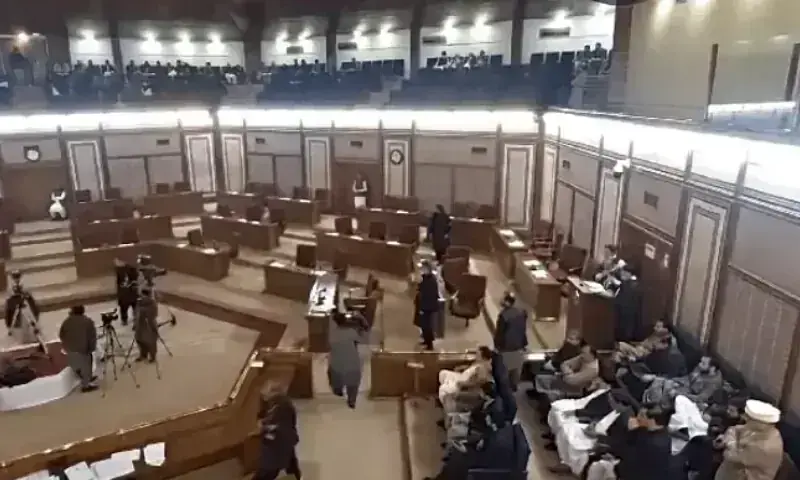
The budget in Balochistan has always brought both good and bad news, but over the years, public complaints have increased significantly and for good reason. Many people feel there is little in the budget for ordinary citizens, including the salaried class and government employees, who staged a protest sit-in during the budget session.
Moreover, members of the Balochistan Employees’ Grand Alliance not only clashed with police in Quetta, the provincial capital, but also attempted to march to the Balochistan Assembly to protest a mere seven per cent salary increase. Police subsequently arrested several of their leaders, prompting the alliance to announce a shutdown of government offices, educational institutions, and other public-sector departments across the province.
This is just the tip of the iceberg.
Besides the employees, the ordinary people spoken to for this story appeared either uninterested in the budget or angry with the provincial government, which they felt had left them in the lurch. “There is nothing for us in the budget,” was a refrain repeated by many of them, from labourers to rickshaw drivers, during conversations with Dawn.
The bulk of Balochistan’s budget has been allocated for security and to maintain existing services rather than enhancing quality and improving the socio-economic environment
Despite such sentiments, the provincial government presented a Rs1.13 trillion budget for FY27. Total expenditure has been estimated at Rs1.09tr, leaving the province with a budgeted surplus of Rs45.57bn, according to official estimates.
According to budget documents, the total outlay comprises projected receipts of Rs1.1tr and a cash carryover of Rs30.61bn from federally funded projects, underscoring Balochistan’s continued dependence on federal transfers. The province is expected to receive Rs800.13bn through its share of the National Finance Commission (NFC) Award and other federal receipts.
Balochistan is Pakistan’s largest province by area, yet it remains sparsely populated despite its vast natural resources. In terms of development, it lags behind the country’s other provinces and is widely regarded as its most underdeveloped and poverty-stricken region. The province has also been grappling with a long-running insurgency, which has shaped budgetary priorities over the years.
As a result, a significant portion of public spending continues to be directed towards maintaining law and order rather than human development. With the security situation deteriorating in recent years, law and order has emerged as one of the government’s top priorities, with an allocation of Rs107.92bn in the FY27 budget.
Economic activity in Balochistan remains limited, with few industries and a weak private sector to absorb the province’s growing youth population. As a result, unemployment remains widespread. The lack of economic opportunities and jobs has also contributed to a sense of alienation among many young people.
Consequently, a large number of educated youth look towards the public sector for employment, even though the government is already burdened by an oversized workforce. Against this backdrop, the provincial government’s announcement of 5,000 new jobs offers some relief, but it remains a drop in the ocean given the scale of unemployment in the province.
If one assumes it is a welcome development that the education sector has been given top priority in the budget, one would be mistaken. In Balochistan, both the education and health sectors remain critically important, yet facilities in both sectors are severely lacking, even in Quetta. There is no shortage of media reports, including in Dawn, highlighting how university teachers are often left unpaid for months. Against this backdrop, the education sector’s highest-ever allocation of Rs157.29bn does not necessarily translate into meaningful improvement.
A major portion of this allocation is tied up in salaries and non-development expenditures, leaving limited fiscal space to improve the quality of education. As a result, much of the budget will go towards sustaining the system rather than addressing the deeply entrenched crisis in education standards in the province.
A similar situation prevails in the health sector, which has been allocated Rs74bn. Here, too, a large portion of the budget is consumed by salaries and recurring expenditures, leaving limited room to improve facilities or the overall quality of healthcare services in the province. Taken as a whole, there is little encouraging news in the budget for the people of Balochistan, which has been described as neither realistic nor people-friendly, including by Chief Minister Sarfraz Bugti during the budget session in the assembly. Opposition to the budget has also emerged within the provincial assembly itself.
Among the critics is Member of Provincial Assembly Asad Baloch, who termed the budget ‘anti-people’ and alleged, while speaking to reporters, that it had been drafted by ‘individuals other than the elected representatives of the province’. Summing up his criticism, he noted: “Deputy commissioners are allocated Rs40bn, while elected public representatives receive only Rs20bn.”
Published in Dawn, The Business and Finance Weekly, June 22nd, 2026