53 million tonnes output, 33% margins, 10x earnings: NMDC’s volume-price paradox
✨ AI Summary
🔊 جاري الاستماع
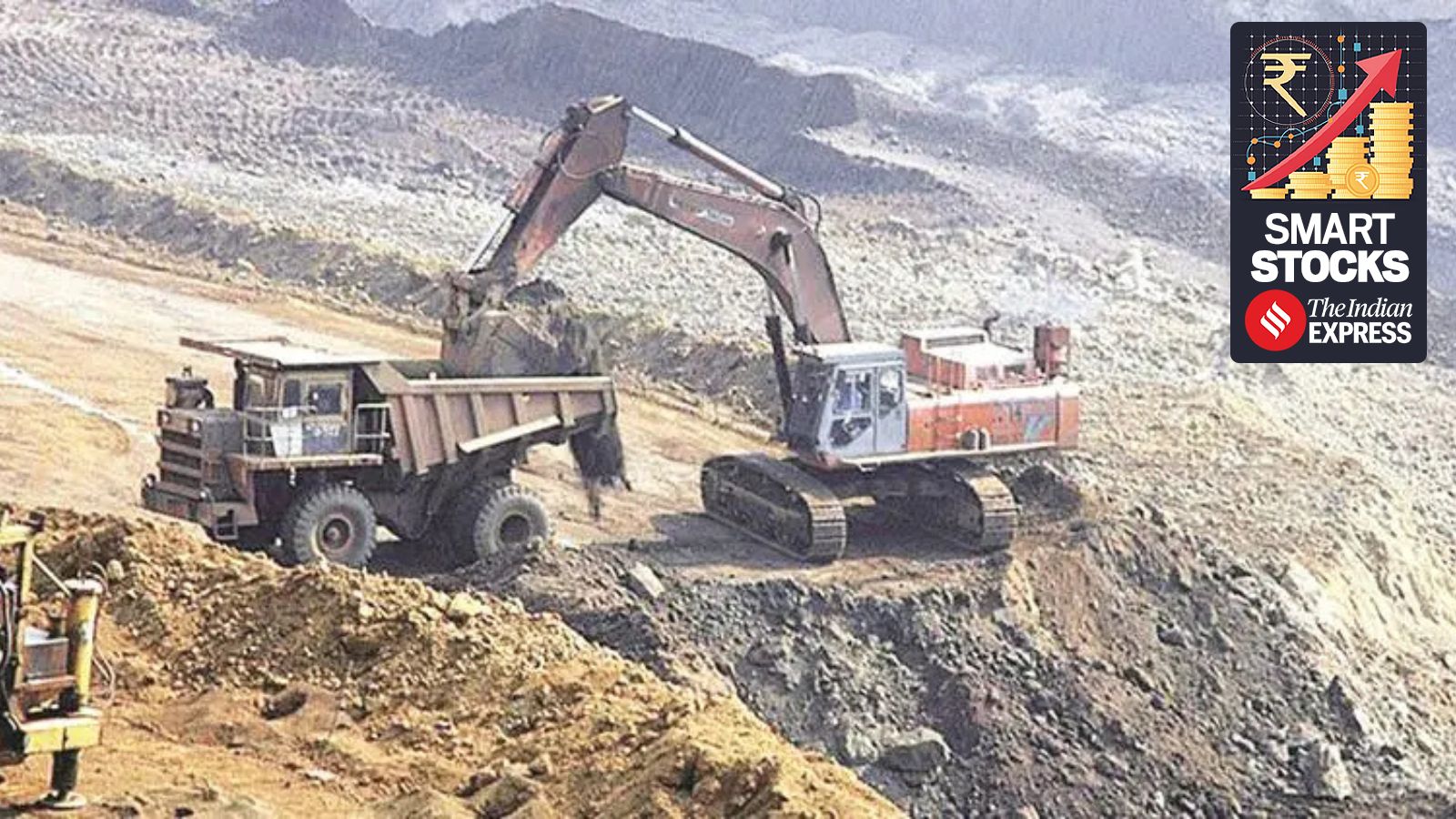
Weather ePaper Today’s Paper Journalism of Courage Home ePaper India Cities UPSC Premium Entertainment Politics Sports World Explained Opinion Business Lifestyle Tech Subscribe Sign In TrendingUPSC OfferIPL 2026US NewsPuzzles & GamesLegal NewsFresh TakeHealthResearch🎙️ Podcast Advertisement function checkAndLoadWindowSizeScript() { if (window.jQuery) { // jQuery is loaded, include your script jQuery(document).ready(function($) { // Your existing script for checking window width if (window.innerWidth) var page_w = window.innerWidth; else if (document.all) var page_w = document.body.clientWidth; if (page_w > 1024) { $(".add-left, .add-right").show(); } else { $(".add-left, .add-right").hide(); } }); } else { // jQuery is not loaded, check again after 0.2 seconds setTimeout(checkAndLoadWindowSizeScript, 200); } } // Initial call to the function checkAndLoadWindowSizeScript(); NewsSmart Stocks53 million tonnes output, 33% margins, 10x earnings: NMDC's volume-price paradox Premium 53 million tonnes output, 33% margins, 10x earnings: NMDC’s volume-price paradox NMDC just delivered its best year ever, crossing 50 million tonnes of iron ore production. But falling prices, rising costs, and Rs 10,000+ crore stuck in receivables are keeping profits, and the stock, under pressure. Written by: Rahul Rao10 min readApr 15, 2026 06:30 AM IST In FY26, it crossed 50 million tonnes of annual iron ore production for the first time, reaching 53.15 million tonnes, up 21% year-on-year. Every quarter set new records. (File Photo) Make us preferred source on Google Whatsapp twitter Facebook Reddit PRINT NMDC Limited (formerly National Mineral Development Corporation) has delivered the strongest operational performance in its 68-year history. In FY26, it crossed 50 million tonnes of annual iron ore production for the first time, reaching 53.15 million tonnes, up 21% year-on-year. Every quarter set new records. Yet the stock trades at roughly Rs 78-82 per share, with a Price-to-Earnings (P/E) ratio of about 10x, and a Price-to-Book (P/B) ratio of 2.2x. For a company firing on all operational cylinders, the market’s indifference stands out. Three things could explain the disconnect. NMDC operates three highly mechanised mining complexes: Two in Bailadila, Chhattisgarh (Kirandul and Bacheli, combined capacity roughly 37 million tonnes per annum), and one in Donimalai, Karnataka (Kumaraswamy and Donimalai pits, roughly 14 MTPA). The core business is simple: mine iron ore (lumps and fines) and sell it to domestic steelmakers. Revenue is a function of two variables: volume (tonnes sold) and realisation (price per tonne). NMDC sets its own prices, which are revised periodically. The company is transitioning towards an index-based, formula-driven pricing mechanism to better track market movements. However, what makes NMDC unusual is its cost structure. The biggest expense is not labour, equipment, or fuel. It is statutory levies. Iron ore royalty is 15% of the average sale price. NMDC also pays a District Mineral Foundation (DMF) contribution, reported as the ‘150% Additional Amount on Royalty.’ Add the National Mineral Exploration Trust (NMET) levy to it. In total, 38-39% of revenue goes to the central and state government as levies. This makes India one of the highest iron ore royalty regimes in the world, approximately 7-8% higher than Australia and Canada. This matters because these levies are ad valorem (linked to the sale price). When realisations fall, the levy amount also falls, and so does the revenue base. Operating costs (mining equipment, employees, and evacuation infrastructure) are more fixed. The result is that margins compress disproportionately when prices drop. Additional Amount (150% of Royalty) Source: Q3 FY26 Investor Presentation, Slide 7. Standalone figures, Rs Crore A July 2024 Supreme Court ruling allows states to impose additional taxes on mining, retrospectively from April 1, 2005, with staggered payments over 12 years starting April 1, 2026. Jharkhand had passed a Rs 100 per tonne cess on iron ore in 2024, which was revised upwards to Rs 400 per tonne. Karnataka had proposed a similar bill. As of April 2026, the Bill is still pending Presidential assent. But NMDC has already disclosed it as a contingent liability, and the amount keeps growing every quarter. NMDC has already disclosed Rs 14,748 crore as a contingent liability for the Karnataka bill. Beyond iron ore, NMDC is building new revenue streams. It is converting fines into pellets through a job-work arrangement with KIOCL, targeting 2.5 to 3 million tonnes in FY26, with plans to produce higher-grade DRI pellets commanding a $30-50 per tonne premium. The company also entered coal mining (Rohne and Tokisud North blocks in Jharkhand), and holds a 92.84% stake in Legacy Iron Ore in Australia, exploring gold and magnetite. These initiatives are promising but currently immaterial to earnings. NMDC’s 9M FY26 numbers tell a split story. Production surged 20% year-on-year to 36.9 MT, sales grew 10% to 34.9 MT, and revenue jumped 22% to Rs 20,381 crore. But Profit After Tax (PAT) grew just 4% to Rs 5,401 crore. EBITDA grew only 5%, with the margin compressing from 44% in 9M FY25 to 38% in 9M FY26. The margin erosion is even more visible in quarterly trends. Source: Q1, Q2, Q3 FY26 Investor Presentations. EBITDA/tonne computed from standalone EBITDA and sales volumes. Average realisation fell from Rs 5,353 per tonne in Q1 to Rs 4,681 in Q3, a 13% decline in two quarters. EBITDA per tonne dropped from Rs 2,411 to Rs 1,970 in the same period. The overall pricing trajectory has been volatile. Lump ore peaked at Rs 6,440 in May 2025 and is now at Rs 5,300. Fines bottomed at Rs 3,900 in January before recovering to Rs 4,500. NMDC even slashed prices by Rs 1,000/ton in January 2026 despite global iron ore trading near $109, then reversed course very recently with an 11% hike in April 2026. The net effect over the last few quarters is that volume growth was unable to offset the price decline. This is the paradox of NMDC’s current position. It is mining and selling more iron ore than ever before, but making less per tonne. And as the levy table above shows, the cost structure amplifies every rupee of realisation decline. As of December 2025, NMDC’s outstanding dues from NMDC Steel (NSL) stood at Rs 6,790 crore, including demerger-related amounts and trade receivables. Separately, trade receivables from RINL (Rashtriya Ispat Nigam Limited) were Rs 4,105 crore, with an expected credit loss provision of just Rs 31 crore against that exposure. The combined outstanding from these two accounts is now roughly Rs 10,900 crore. Instead of declining, the receivables grew by nearly Rs 3,000 crore in three quarters. On a net worth of Rs 29,579 crore, having over Rs 10,000 crore stuck in receivables from two loss-making PSU steel plants is a balance sheet risk. Then there are privatisation delays. NMDC Steel, the 3 MTPA integrated steel plant at Nagarnar, was demerged from NMDC in October 2022 and listed separately in February 2023. The government’s plan was to sell its 50.79% stake to a strategic buyer. Cabinet approved this in 2020. Expressions of Interest were received in January 2023. Financial bids were expected ‘shortly after elections’ in mid-2024. It is now April 2026 with no timeline for financial bids. NSL posted a loss of Rs 244 crore in Q3 FY26 and Rs 333 crore for nine months, despite revenue growing 42% to Rs 3,008 crore in Q3. The stock trades at roughly Rs 41/share, a P/B of 0.9 times. The plant reached EBITDA breakeven in March-April 2025, with HR coil production nearing 98% capacity. But PAT-level profitability remains elusive. Adding to the complexity, NMDC has paid Rs 639 crore to the Karnataka Industrial Area Development Board for 2,858 acres allotted to its subsidiary KVSL for a proposed second 3 MTPA steel plant. A final decision on project capex is pending. NMDC is targeting 100 million tonnes of iron ore production by FY30, roughly double its current run rate. The capex pipeline is massive. By mid-FY26, approximately Rs 40,000 crore of projects were expected to have been sanctioned, with another Rs 32,000 crore at the drawing board stage, according to management comments in the Q4FY25 conference call. The real capex acceleration is expected from FY28 onwards. Near-term (screening plants, debottlenecking) Medium-term (Deposit 4, Karnataka expansion) 2.5-3 MT; DRI-grade at $30-50/T premium International (coking coal, gold) Dubai office; Aus, Indonesia assets 1,167 acres; pellet plant + blending yard Source: Q4 FY25 Concall, NMDC AR FY25 CMD Letter, MD&A PL Capital, one of the brokerages covering the stock, estimates volumes of 50, 55, and 60 million tonnes for FY26, FY27, and FY28, respectively, with a Revenue/EBITDA/PAT CAGR of 16%, 16%, and 14% over the same period. At roughly Rs 83 per share, NMDC trades at approximately 11 times trailing earnings, 2.1 times book value, and offers a dividend yield of about 3.96%. FY25 EPS was Rs 7.43 on a PAT of Rs 6,520 crore. It has Rs 10,000+ crore cash on its balance sheet. On a price/book basis, it trades at a premium to its historical valuations. But the discount reflects real concerns: compressing pricing and margins lately, a Rs 14,748 crore contingent liability from the Karnataka mining tax, over Rs 10,000 crore stuck in receivables from two loss-making steel plants, a stalled privatisation, and rising high-grade iron ore imports expected to hit a 7-year high. At 10x earnings, 4.3% yield, and 31% ROCE, the stock is priced for problems. The catalyst it needs is sustained pricing improvement, so the volume and price benefits can amplify EPS growth. Note: We have relied on data from http://www.Screener.in and http://www.tijorifinance.com throughout this article. Only in cases where the data was not available, have we used an alternate, but widely used and accepted source of information. Rahul Rao has helped conduct financial literacy programmes for over 1,50,000 investors. He also worked at an AIF, focusing on small and mid-cap opportunities. Disclosure: The writer or his dependents do not hold shares in the securities/stocks/bonds discussed in the article. The website managers, its employee(s), and contributors/writers/authors of articles have or may have an outstanding buy or sell position or holding in the securities, options on securities or other related investments of issuers and/or companies discussed therein. The content of the articles and the interpretation of data are solely the personal views of the contributors/writers/authors. Investors must make their own investment decisions based on their specific objectives, resources and only after consulting such independent advisors as may be necessary.