Rabat – Days before the 2025 Africa Cup of Nations (AFCON) final, murmurs began to emerge from the Senegalese camp. Concerns about logistics and accommodation were quietly raised into the media space, creating an atmosphere of dissatisfaction even before kickoff.
However, according to official statements from Confederation of African Football (CAF), no formal indication suggested that Senegal had been subjected to conditions different from those experienced by other participating teams. The tournament organization, while not flawless, as is often the case in major competitions, was applied uniformly.
CAF later also clarified in its statements that organizational matters affected multiple delegations, not a single team. This context is essential, as it challenges the narrative that Senegal entered the final under uniquely difficult circumstances.
Match day: tension builds on the pitch
As the final began, the atmosphere reflected the magnitude of the occasion. Morocco, composed and tactically disciplined, faced a Senegalese side equally determined but visibly tense.
The turning point came late in the match, when a decisive penalty was awarded to Morocco. What followed would redefine the entire competition.
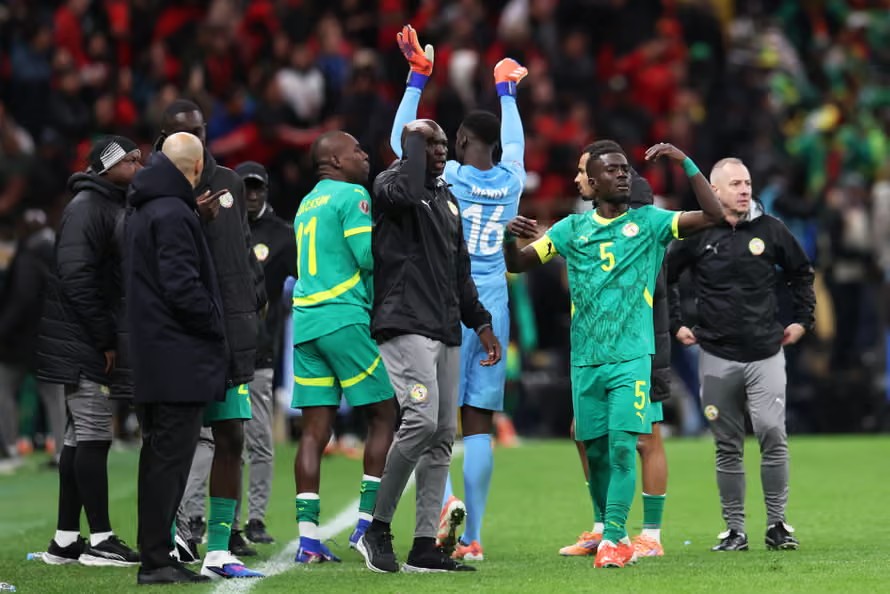
Senegalese players, led by their bench, chose to leave the pitch in protest, for what was counted around 15 minutes, according to The Guardian.
International outlets, including Associated Press, reported on the unprecedented nature of the interruption, describing a final that had slipped into chaos and not competition.
The walk-off: a line crossed
In football, protest has its place, but only within the boundaries of the game. The moment a team abandons the pitch, the situation moves from emotional reaction to regulatory violation.
This is where the AFCON regulations become decisive. Articles 82 and 84 clearly stipulate that any team refusing to continue play is considered to have forfeited the match, with a standard 3–0 defeat applied.
CAF’s later ruling did not reinterpret the situation, but simply applied the rulebook. The Senegalese walk-off, regardless of its motivation, met the legal definition of withdrawal.
What is often overlooked is the immediate impact on Morocco. The interruption broke the rhythm of the match at a crucial moment, affecting concentration, preparation, and competitive fairness. In high-level football, such disruptions are decisive.
After the match: from incident to narrative
Following the final whistle, or rather, the administrative conclusion of the match, the story began to shift.
The focus moved away from the act of withdrawal and toward a broader narrative: logistics, accommodation, and alleged injustice. Senegal’s position increasingly relied on portraying the situation as part of a larger pattern of unfair treatment.
Yet, CAF’s official stance remained consistent. In its disciplinary and media statements, the governing body emphasized that:
- No evidence supported claims of unequal logistical treatment.
- Sanctions were issued across multiple parties, reinforcing institutional neutrality.
This raises an important question: if the conditions were truly unequal, why were they not formally established before the match?
A strategy of justification?
As the case escalated, including discussions of appeals, a clearer pattern began to emerge. The narrative surrounding logistics appeared less as a primary cause and more as a post-event justification for actions taken on the pitch.
The sequence is difficult to ignore:
- A controversial decision.
- A collective walk-off.
- A regulatory defeat.
- A shift toward external explanations.
This progression suggests an attempt to reshape the perception of the incident, transforming a breach of rules into a question of circumstance.
Morocco’s silent disadvantage
Lost in the legal and media battle is the Moroccan team.
Players who had prepared for months found their moment disrupted. The psychological intensity of a final was replaced by confusion, delay, and uncertainty.
In competitive terms, this constitutes more than inconvenience. It represents instead an affective disruption, one that alters performance conditions and undermines the integrity of the contest.
While regulations address the outcome, they cannot fully restore the sporting continuity that was broken.
The most successful AFCON in history
While the closing moments of the final were defined by regulatory tension and heated debate, they cannot overshadow a fundamental truth: the 2025 edition in Morocco was the most successful and impactful in the history of the AFCON. The tournament shattered every existing record, repositioning African football as a premier global product and setting a benchmark for future editions.
The tournament’s visibility reached unprecedented heights, driven by a digital and broadcasting strategy that took the competition to every corner of the globe.
According to official CAF data, total viewership rose by an astonishing 61%, supported by 111 international broadcasters, a massive leap from the 67 seen in previous years. On social media, the competition became a global phenomenon, amassing over 6 billion views, including 5.2 billion video views. This digital dominance made 2025 AFCON the most engaged continental tournament in history, proving that the appetite for African football has never been higher.
Financially, the tournament was a powerhouse that redefined CAF’s commercial standing. The confederation reported a revenue increase of over 90%, generating approximately $200 million, nearly doubling the revenue of the 2023 edition ($96 million).
This surge was fueled by growing brand confidence, with the number of official sponsors jumping to 23 partners. This commercial triumph was mirrored on the ground in Morocco, where the event generated an estimated $1.17 billion in economic activity, bolstered by over one million fans who filled stadiums across the country, including a record 703,263 attendees during the group stage alone.
The post 2025 AFCON Final: The Truth About Senegal’s Walk-Off, Logistics Claims, and a Decisive Rulebook appeared first on Morocco World News.