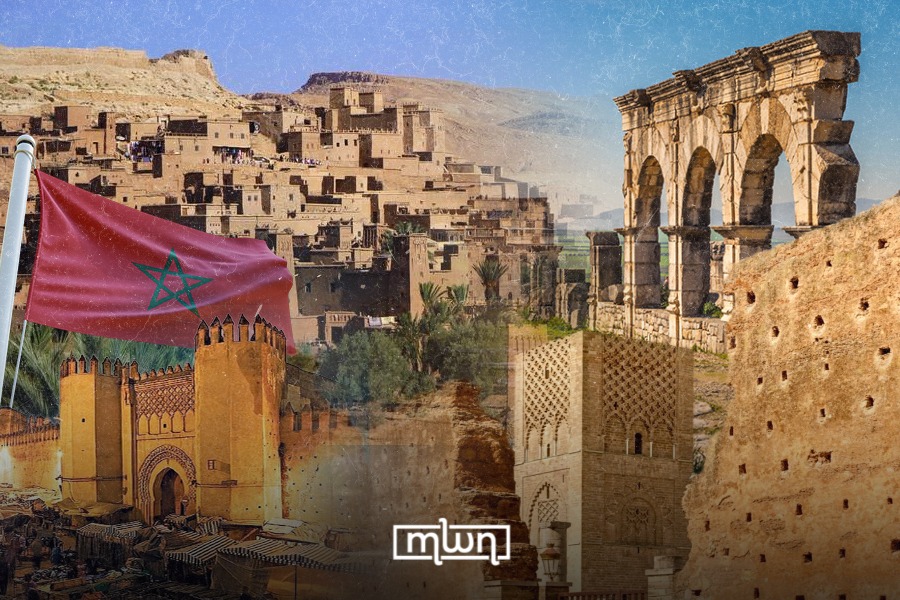
For more than a century, anthropology has been guided by a set of assumptions about origins, innovation and geography. Chief among them is the influential “Out of Africa” model, which, while correctly locating human origins on the African continent, has often framed that origin as emerging from a relatively localized East African cradle, from which modern humans later dispersed outward into the rest of the world. Within this framework, symbolic behavior appeared as a late achievement, and North Africa or the Maghreb was cast as a peripheral zone, receiving rather than generating the forces that shaped humanity. These ideas did not remain confined to academic debates; they seeped into textbooks, museum displays and the broader global imagination of human beginnings.
Now, they are giving way
A series of discoveries emerging from Morocco over the past decade has started to unsettle this inherited conceptual framework. What is taking shape in its place is not simply a revised timeline, but a different way of seeing: Africa not as a singular point of origin, but as a continent-wide field of evolutionary and cultural experimentation; the Maghreb not as a corridor, but as one of its generative centers.
This is why Moroccan archaeology matters. It does not merely add detail to an established story. It asks us to reconsider the story’s point of departure, and, in doing so, the assumptions that have long structured how that story is told.
To grasp the scale of this shift, it helps to begin with how the Maghreb was imagined.
For decades, it lingered at the margins of the human narrative, an afterthought in textbooks, a passageway rather than a destination, a space presumed to receive rather than create. This view, rooted less in evidence than in inherited habits of thought, cast North Africa as trailing behind the better-known centers of human development in East Africa, the Near East, and Europe.
Such a narrative is no longer tenable
The archaeological record emerging from Morocco tells a different story, one grounded not in speculation but in stratigraphy, radiometric dating and material remains. It reveals a region deeply implicated in the processes that shaped humanity, not at their edges but close to their core. What was once treated as peripheral now appears structurally central, an integral part of a wider network of movement, exchange, and adaptation.
What comes into view is not a singular origin point, but a mosaic: a continent-wide pattern of emergence and interaction. Within that mosaic, the Maghreb appears less as a cul-de-sac than as a crucible, one in which multiple trajectories of human development intersected, overlapped and evolved.
The implications become sharper when we turn to the question of human origins themselves.
The turning point came with discoveries that, at first glance, seemed technical: revised dates, new fossil analyses, refined chronologies. Yet their implications extend far beyond revision.
At Jebel Irhoud, fossils once thought to be relatively recent were redated to approximately 315,000 years ago. In an instant, the timeline of Homo sapiens shifted backward by more than 100,000 years. Just as importantly, the geography of our origins expanded. Early modern humans were no longer confined to an East African cradle; they were present in North Africa at a remarkably early stage.
But the significance lies not only in their age. It lies in what they reveal about the nature of human evolution itself. The faces are unmistakably modern, while the braincases retain more archaic features. This is not the sudden appearance of a finished form. It is a process, a gradual accumulation of traits unfolding across time and across regions. Evolution here appears less as a linear progression and more as a braided stream, with multiple channels feeding into what we now recognize as Homo sapiens.
Further north, near Casablanca, the site of Thomas Quarry I extends the timeline even deeper. Fossils dated to roughly 773,000 years ago suggest that populations in the Maghreb were already positioned near the divergence of major human lineages. Here, we glimpse not only the emergence of Homo sapiens, but the deeper branching that would eventually produce Neanderthals and Denisovans, hinting at a shared, entangled ancestry rooted across regions rather than confined to one.
Taken together, these findings do not overturn the “Out of Africa” model so much as they complicate it. Rather than a single birthplace, the evidence points to a pan-African process, in which multiple regions, including the Maghreb, participated in the emergence of our species. Africa becomes not a point on a map, but a shifting landscape of co-evolution: dynamic, interconnected, and internally diverse.
At this juncture, where time deepens and geography expands, the broader implication comes into view. We did not become human in one place, at one time, or in a single sudden leap; rather, we became human across landscapes, through gradual transformations of body, mind, and society unfolding over deep time. Among those landscapes, decisively, were the lands of Morocco, where crucial elements of this long process took shape. In that extended and uneven becoming, the Maghreb was not merely a witness to human emergence, it was among the places where it took shape.
If these discoveries reshape our understanding of the human body, they also invite us to reconsider the emergence of the human mind.
If fossils tell us when we became human in form, artifacts tell us when we became human in thought.
At Bizmoune Cave, archaeologists uncovered a small collection of shell beads, just 33 objects, easily overlooked. Yet their significance is difficult to overstate. Dated to at least 142,000 years ago, they represent the oldest known personal ornaments.
These beads were not incidental. They were selected, shaped, perforated and worn. Some bear traces of red ochre; many show patterns of wear consistent with suspension on cords or garments. They were transported inland from distant coasts, suggesting intentional collection and sustained value.
What they represent is not decoration, but communication
These objects functioned as markers of identity, signals of belonging, status or affiliation. They allowed individuals to communicate who they were beyond immediate kinship ties, enabling broader networks of interaction. In this sense, they operate as a kind of social technology, laying the groundwork for more complex forms of cooperation. They also hint at the emergence of shared symbols, collective meanings, and imagined communities.
This deep history of innovation does not end in prehistory; it extends into the formation of complex societies.
For much of the twentieth century, the period between roughly 4000 and 1000 BC in North Africa was treated as a gap, a sparsely populated interval awaiting the arrival of external civilizations.
That gap is narrowing
The discovery of Oued Beht reveals a different reality. Dating to 3400–2900 BC, the site presents a large, organized farming society, marked by dense concentrations of storage pits, evidence of surplus production and a diversified agricultural system.
Its inhabitants cultivated cereals and legumes, raised domesticated animals and produced sophisticated pottery. The scale and organization of the site place it among the most significant agricultural complexes outside the Nile Valley.
Oued Beht is not peripheral. It is central.
Nor does the story of innovation begin with external influence, as long assumed.
At Kach Kouch, a long-lived settlement spanning from 2200 to 600 BC reveals a sustained social formation marked by continuity and adaptation. When Phoenician influences begin to appear, they are not simply adopted; they are reworked.
What emerges is not dependency, but negotiation.
This is not diffusion. It is agency
Taken together, these findings point toward a region defined not by isolation, but by connection.
The Maghreb appears as a hinge, a zone of convergence linking Africa, Europe and the Atlantic.
These shifts, in turn, invite a reconsideration not only of history, but of how knowledge itself is produced. They reshape how we understand continuity and identity in North Africa, pointing to deep, sustained cultural trajectories rather than episodic development driven from elsewhere, while also challenging long-standing narratives that tie progress to external intervention.
From these converging discoveries, a set of broader insights comes into view: time has deepened, Africa has expanded beyond a singular cradle into a continental field of innovation, and humanity itself has shifted: earlier, wider, and more complex than we once thought.
What remains is the question of how these discoveries are to be told, and, crucially, who benefits from them.
If Moroccan archaeology has reshaped the past, its future lies in how these findings are shared, preserved and mobilized. They offer an opportunity not only for scholarship, but for rethinking heritage, narrative and public engagement, how deep time is translated into public memory, and how local communities are positioned within that story.
But the stakes are also material
Archaeology can become a driver of economic development, not just a record of it. Properly invested in, sites can anchor new forms of cultural tourism that move beyond postcard monuments toward immersive encounters with human origins. Institutions such as National Museum of Anthropology in Mexico City offer a powerful example of how archaeological and ethnographic heritage can be transformed into a national and global resource, drawing visitors, generating revenue, and embedding deep history within public life.
In a similar vein, heritage trails, site museums and community-led initiatives in Morocco can generate jobs, support local economies and foster stewardship rooted in place. The challenge is to ensure that these narratives do not simply circulate globally while value flows elsewhere. If done right, Morocco’s deep past can become a living resource, one that sustains communities in the present as much as it illuminates humanity’s origins.
In the end, what is at stake is not only the past, but the future of anthropology itself.
As archaeological research in North Africa moves beyond its colonial foundations, new questions, often shaped by local scholars and Indigenous perspectives, are beginning to reframe what is asked and what is seen.
These are not minor adjustments. They are shifts in perspective.
And it is precisely these reframed questions that are bringing into view new understandings of identity, agency, and civilization.
To tell this story fully is not just to revise the past, but to reframe how we see it, and to place Morocco not at the margins of the human story, but among the sites where being human was first worked out over time.
The post Why Moroccan Archaeology Is a Big Deal for World Anthropology appeared first on Morocco World News.